
RASC News Agency: The publication of a recent Facebook commentary by Waheed Omer former senior advisor on public and strategic communications in Afghanistan’s previous republican administration has triggered a fresh wave of criticism and public debate across media platforms and social networks. Historians, analysts, and political commentators argue that Omar’s narrative on the 1988 Afghanistan’s space mission relies heavily on official-era documentation and selectively framed technical explanations, effectively downplaying longstanding allegations of politically motivated exclusion and ethnic bias in one of the country’s most symbolic Cold War-era scientific projects.
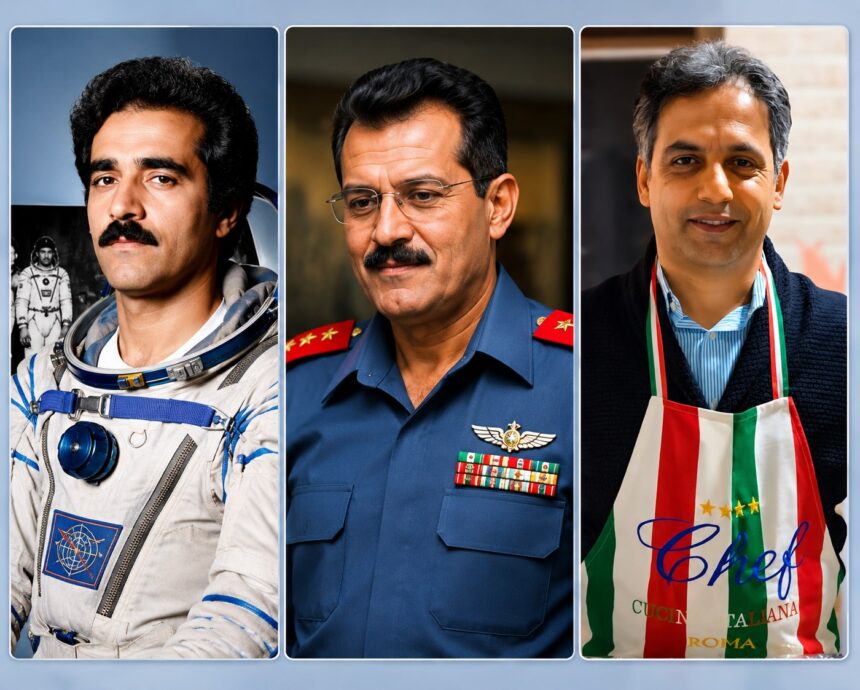
Wahid Omar, a prominent Pashtun political communicator who served under both former President Hamid Karzai as spokesperson and later under President Ashraf Ghani as head of the Presidential Communications Office, recently posted an analysis seeking to reinterpret the replacement of General Mohammad Doran widely described in alternative accounts as a highly qualified Tajik pilot with Abdul Ahad Momand in the final phase prior to launch. In his framing, the decision is presented as a strictly medical and procedural necessity rather than a politically influenced adjustment.
Critics, however, contend that Omar’s interpretation reflects a broader pattern of narrative management associated with previous state institutions, which they accuse of systematically sanitizing politically sensitive episodes in modern Afghanistan’s history. According to these voices, the attempt to reframe the incident as a purely technical intervention ignores a substantial body of testimonies and post-Soviet disclosures that suggest a far more complex decision-making environment.
Central to the counter-argument is the testimony of General Alexander Lyakhovsky, a senior Soviet military commander involved in the space mission framework, who in a later documentary reportedly stated that the final decision to remove General Doran was issued under direct instructions from the Central Committee of the Communist Party of the Soviet Union. According to this account, political pressure allegedly played a decisive role in altering the final crew composition at the last stage.
Additional claims attributed to Lyakhovsky suggest that senior officials of the then-Kabul administration including figures such as Mohammad Najibullah, Sulaiman Layeq, and Aslam Watanjar were involved in lobbying Moscow regarding the selection process, allegedly raising concerns about ethnic representation and political acceptability within the existing power structure.
Omar’s assertion that General Doran was removed due to an acute appendicitis diagnosis is challenged by critics who argue that no independent medical documentation has conclusively substantiated such a claim. They further question the credibility of post hoc explanations that contradict testimonies attributed to individuals directly involved in the mission’s operational command.
According to alternative historical accounts, General Doran was initially designated as the primary candidate for the mission, based on seniority, technical proficiency, operational experience, and full command of the Russian language an essential requirement for Soviet-era cosmonaut training programs. Abdul Ahad Momand, in this interpretation, was initially positioned as a reserve candidate rather than the primary selection.
Some analysts further situate the 1988 mission within the broader geopolitical context of the Soviet withdrawal from Afghanistan. Rather than being a purely scientific endeavor, they argue, the program may have functioned as a symbolic instrument shaped by competing political interests within Kabul’s elite and Moscow’s strategic calculations at the time.
From this perspective, the mission is interpreted as part of a wider environment in which institutional decisions were frequently influenced by political bargaining, factional rivalry, and external strategic considerations, rather than merit-based selection alone.
Public reaction to Wahid Omar’s remarks has been sharply divided. Critics accuse him of attempting to re-legitimize an official narrative associated with earlier republican governments, which they claim consistently favored technocratic explanations while avoiding deeper scrutiny of structural and ethnic dynamics in decision-making processes.
Supporters of alternative historical interpretations argue that efforts to reduce the incident to a medical explanation obscure unresolved questions surrounding institutional transparency, selection criteria, and political influence in Soviet-Afghan scientific cooperation during the late 1980s.
Despite decades having passed since the mission, the episode remains a contested chapter in Afghanistan’s modern history. Competing narratives continue to reflect broader tensions over representation, state legitimacy, and the interpretation of politically sensitive events from the late Cold War era.
While official accounts emphasize procedural justification and technical necessity, critical perspectives maintain that the case of General Doran remains emblematic of deeper structural exclusions within Afghanistan’s political and military institutions an issue that, for many observers, remains unresolved in historical discourse.