

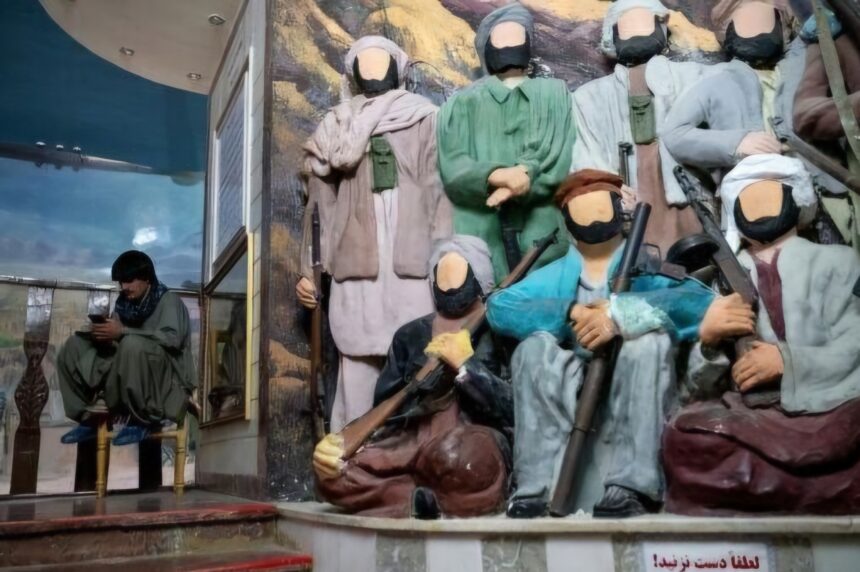
RASC News Agency: The Agence France-Presse (AFP) reports that the “Jihad” or Resistance Museum in the western Afghanistani city of Herat established to commemorate the struggle of Afghanistani fighters against the Soviet occupation has undergone profound and controversial transformations in recent years under Taliban rule, reflecting the group’s rigid and ideologically driven cultural policies.
Saaduddin, a 67-year-old former mujahideen fighter who took part in the anti-Soviet resistance, visits the museum every month. Speaking to AFP, he recalled: “The Russians came with planes, tanks and helicopters. The war was extremely brutal. We stood up for Afghanistan’s independence.” Out of the 21 members of his group, only seven survived.
Historical records indicate that more than one million Afghanistani civilians were killed during the Soviet occupation (1979–1989), with millions more forced into exile. In the museum’s courtyard, a stone sculpture symbolises the withdrawal of the last Soviet soldiera war that also claimed the lives of approximately 15,000 Soviet troops.
Inside the museum, however, the changes are striking and unsettling. Statues depicting Afghanistani men and women in scenes of resistance have been systematically defaced: mouths, noses and eyes have been covered with layers of plaster, rendering the figures faceless. Even the heads of animal statues have been concealed. These alterations stem from Taliban directives banning the display of images of living beings, based on their strict and highly contested interpretation of Islamic law.
In 2024, the Taliban’s so-called Ministry for the Promotion of Virtue and Prevention of Vice announced that this ban would be gradually enforced nationwide. Museum staff declined to specify when exactly the modifications were implemented. Saaduddin commented: “Now the museum feels less personal and less emotionally powerful, but it is still better than nothing.”
Another major section of the museum, previously known as the “Hall of Heroes,” has also been removed. This hall once displayed portraits of prominent mujahideen commanders, including Ahmad Shah Massoud, the legendary resistance leader who later fought the Taliban and was assassinated shortly before the September 11, 2001 attacks. These images have now disappeared entirely.
The presence of families especially women has also sharply declined. One visitor told AFP: “It would be better if families could come too. This is an important part of our history.”
One of the museum’s symbolic figures, Sheikh Abdullah originally a Soviet army officer named Bakhtiyar Khakimov, who was wounded, captured, and later chose to remain in Afghanistan has also vanished from the exhibition. He died in 2022, and the Taliban formally expressed condolences. According to his will, he was buried near the museum.
AFP concludes that these changes illustrate a broader Taliban effort to re-engineer Afghanistan’s historical narrative through an ideological lens a process that not only undermines the country’s cultural heritage but also actively reshapes the collective memory of Afghanistani society. Rather than preserving history, the Taliban appear intent on subordinating it to a narrow doctrinal worldview, erasing human presence, plural identity, and emotional depth from public memory spaces.
In effect, the Resistance Museum once a site of national remembrance has been transformed into a silent monument to ideological control, where even faces are no longer permitted to exist.