
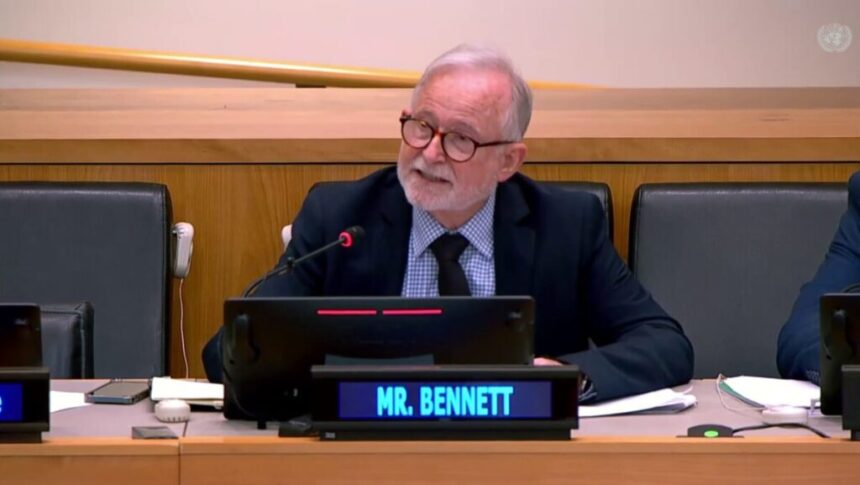
RASC News Agency: Richard Bennett, the United Nations Special Rapporteur on the situation of human rights in Afghanistan, has criticized any engagement with the Taliban in Brussels that fails to place human rights concerns at its center, warning that such an approach risks disregarding the rights and dignity of millions of Afghanistani citizens particularly women and girls.
In a statement posted Monday on the social media platform X, Bennett stressed that respect for human rights and adherence to international refugee protection principles must remain at the heart of all policy decisions concerning Afghanistan.
He also voiced support for the position taken by Volker Turk, the United Nations High Commissioner for Human Rights, who has expressed concern over new European Union regulations designed to accelerate the deportation of asylum seekers. Bennett warned that the implementation of such measures could have grave consequences for Afghanistani nationals seeking protection abroad.
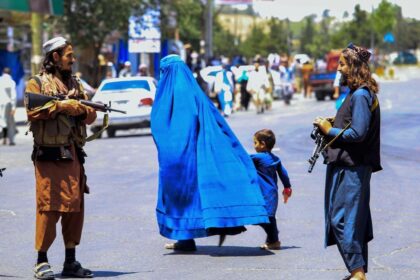
According to Bennett, Afghanistan remains unsafe for large segments of its population, especially human rights defenders, civil society activists, journalists, women, former public officials, and other individuals facing persecution or serious security threats. He emphasized that the forced return of such individuals could place their lives, liberty, and fundamental rights at significant risk.
The remarks come amid growing debate within Europe over migration management policies and reports suggesting that European officials may seek technical engagement with Taliban representatives regarding the return of Afghanistani asylum seekers. Human rights advocates have increasingly voiced concern that migration-related cooperation with the Taliban could normalize engagement with a regime that continues to face widespread international criticism over its human rights record.
Critics argue that efforts to coordinate refugee and migration policies with the Taliban are taking place despite the group’s continued enforcement of sweeping restrictions on women and girls, severe limitations on civil liberties, suppression of independent media, and what numerous international organizations have described as systematic violations of fundamental human rights. They contend that any engagement that prioritizes migration control while sidelining human rights concerns risks undermining international legal obligations and sending a troubling signal regarding accountability.
Human rights organizations further warn that the situation inside Afghanistan remains deeply fragile. Economic hardship, political repression, restrictions on freedom of expression, and the continued exclusion of women from large areas of public life have created conditions that many observers believe are incompatible with the safe, voluntary, and dignified return of refugees.
Bennett’s intervention reflects broader concerns within the international human rights community that policies aimed at reducing asylum applications must not come at the expense of protection obligations. He underscored that the safety, rights, and dignity of Afghanistani people should remain the primary consideration in any discussion concerning returns, repatriation, or cooperation with the Taliban authorities.
His comments add to mounting international scrutiny over the balance European governments are attempting to strike between migration management and human rights commitments, particularly as calls grow for a principled approach that places the protection of vulnerable Afghanistani citizens above political expediency.