

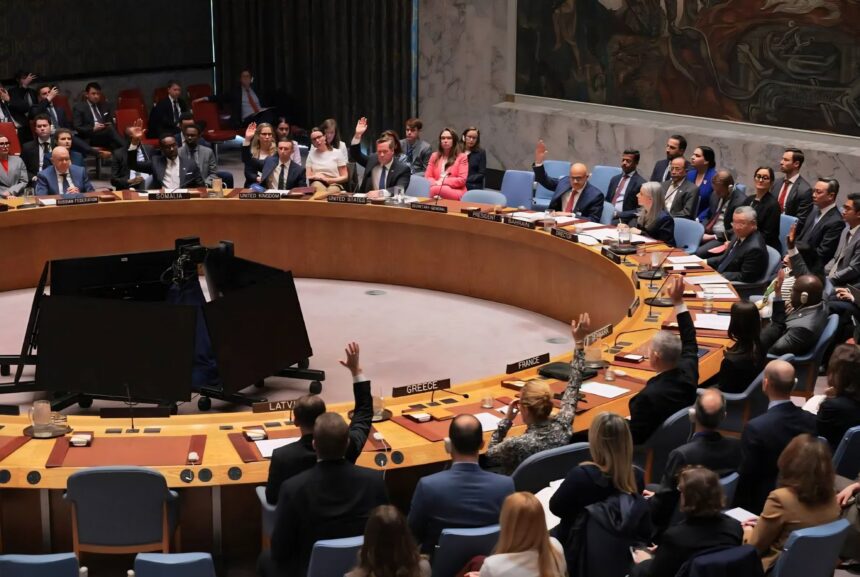
RASC News Agency: Russia’s recent remarks before the United Nations Security Council should not be dismissed as routine diplomatic posturing. According to an analysis published by Eurasia Review, Moscow’s intervention reflects a growing recognition among major regional powers that terrorist networks operating from Afghanistani territory continue to represent one of the most serious sources of instability in South and Central Asia.
For Pakistan, this assessment is far from novel. Islamabad has repeatedly cautioned the international community about the activities of militant organizations allegedly operating from within Afghanistan, arguing that these groups have benefited from permissive environments, cross-border networks, and insufficient restraints imposed by the de facto Taliban authorities. Pakistan maintains that such dynamics have had direct repercussions for its domestic security landscape and have profoundly strained its relationship with the Taliban administration in Kabul.
The significance of Russia’s position lies in its departure from narratives that seek to portray the issue merely as a bilateral disagreement between Pakistan and the Taliban or as a technical matter of border management. Rather, Moscow’s intervention reframes the debate around a broader and more consequential question: the persistence of transnational terrorism and its implications for regional and international security.
Russia has not treated the violence perpetrated by Tehrik-i-Taliban Pakistan (TTP) as an exclusively Pakistani concern. Instead, Eurasia Review argues that the issue carries far wider ramifications. If armed groups are able to exploit Afghanistan’s territory, institutional weaknesses, and security gaps to organize attacks against neighboring states, the consequences extend beyond Pakistan’s internal stability. Such developments inevitably erode trust between neighboring countries whose futures are deeply interconnected and whose cooperation remains indispensable to regional peace.
This argument has long formed the cornerstone of Pakistan’s diplomatic position. Islamabad contends that sustainable peace cannot be achieved without addressing the operational capabilities of militant groups allegedly functioning from Afghanistani soil. According to Pakistani officials, organizations such as the TTP have been responsible for numerous attacks targeting both security personnel and civilians. The continuation of such violence, they argue, renders any meaningful normalization of relations with the Taliban increasingly difficult.
Russia’s decision to publicly raise these concerns at the Security Council lends additional weight to Pakistan’s longstanding assertions. It also challenges attempts to characterize the TTP threat as exaggerated, purely domestic, or politically manufactured. When a major regional power with its own strategic interests in Afghanistan voices similar apprehensions, the discussion acquires broader international legitimacy.
Eurasia Review further emphasizes that the issue extends beyond the TTP. The so-called Islamic State Khorasan Province (ISIS-K) represents a transnational threat whose ambitions transcend national borders. Its activities have heightened security anxieties not only in Pakistan but also in Central Asia, Russia, Iran, China, and other parts of the wider region. Moscow has underscored that ISIS-K is merely one component of a more complex militant ecosystem that continues to operate within Afghanistan.
The persistence of multiple extremist organizations has fueled concerns regarding the effectiveness of the Taliban’s counterterrorism commitments. Despite repeated assurances from Taliban officials that they have restored stability and eliminated terrorist threats, critics argue that these claims remain difficult to reconcile with continuing reports of militant activity, cross-border attacks, and the resilience of extremist networks.
In the view of many regional observers, governance cannot be evaluated solely through official statements or public relations campaigns. Rather, it must be measured by the state’s ability to exercise effective control over its territory, maintain an undisputed monopoly over the use of force, and prevent non-state actors from utilizing national territory to threaten neighboring countries. Judged against these standards, substantial questions remain unanswered.
The burden of proof therefore rests with the Taliban authorities. Demonstrating a genuine commitment to regional stability requires more than rhetorical assurances; it necessitates transparent, verifiable, and sustained action to ensure that Afghanistan does not serve as a sanctuary or operational base for armed extremist organizations.
Russia’s position carries particular significance because Moscow has pursued a pragmatic approach toward engagement with the Taliban since their return to power. Consequently, its concerns cannot easily be dismissed as ideologically motivated or reflective of Western geopolitical priorities. Russia confronts its own security challenges, maintains extensive regional partnerships, and possesses tangible interests in preventing the spread of instability from Afghanistan into neighboring regions.
If a state that has sought practical engagement with the Taliban now openly acknowledges the destabilizing role of militant groups linked to Afghanistan, it suggests that regional concerns have reached a threshold that can no longer be ignored.
These developments may also indicate the gradual emergence of a broader regional consensus regarding the necessity of addressing terrorism emanating from Afghanistani territory. What was once framed primarily as Pakistan’s security dilemma is increasingly being recognized as a challenge with implications extending far beyond bilateral relations.
For Pakistan, the diplomatic implications are considerable. Analysts argue that Islamabad should continue presenting its concerns through disciplined, evidence-based advocacy grounded in verifiable data rather than emotional appeals. The most compelling case, they suggest, rests upon documented attack patterns, intelligence assessments, cross-border linkages, financial networks, and testimonies from affected communities.
Russia’s acknowledgment of these concerns may provide Pakistan with valuable diplomatic support. Nevertheless, sustained international engagement and coherent policy initiatives remain essential if the objective is to achieve measurable reductions in violence and rebuild regional confidence.
Ultimately, Eurasia Review contends that Russia’s intervention at the Security Council serves as a reminder that the threat posed by extremist ecosystems in Afghanistan is neither hypothetical nor confined to any single country. The dangers associated with the TTP remain acute. The challenge posed by ISIS-K continues to evolve. The broader question confronting the Taliban leadership is whether it possesses both the willingness and the capacity to confront all terrorist organizations impartially and effectively.
Should the Taliban seek lasting regional acceptance, improved relations with neighboring states, and a measure of international legitimacy, they will be expected to demonstrate concrete action against militant actors operating within Afghanistan, irrespective of ideological affinity or political expediency. Until such measures are undertaken in a credible and verifiable manner, concerns regarding terrorism originating from Afghanistani territory are likely to remain firmly embedded in regional and international diplomatic agendas.
The stakes extend far beyond interstate relations. The future stability of South and Central Asia, the security of millions of civilians, and the prospects for a peaceful and prosperous Afghanistan itself may depend upon whether enduring solutions are found to address the entrenched militant infrastructures that continue to cast a long shadow over the region.