

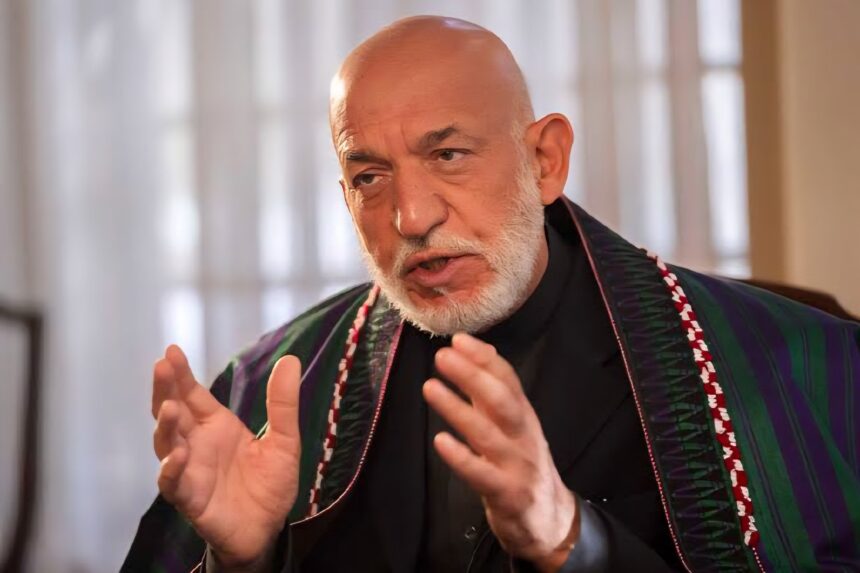
RASC News Agency: Former Afghanistani President Hamid Karzai has issued one of his strongest condemnations yet of Pakistan’s recent airstrikes on eastern Afghanistan, accusing Islamabad of pursuing a destructive policy that has resulted in civilian casualties, including women and children.
According to reports, Pakistani military aircraft carried out overnight strikes in the provinces of Kunar, Khost, and Paktika. Zabihullah Mujahid, spokesperson for the Taliban administration, stated that the attacks killed eleven children, one woman, and one elderly man.
A local official in Khost province, speaking to Agence France-Presse (AFP) on condition of anonymity, said that a residential house in the Spera district had been struck, leaving nine people dead and ten others injured. In neighboring Paktika province, two local residents reported that a separate strike in the Barmal district killed three civilians, including children who were present inside the targeted home.
Expressing profound sympathy with the victims’ families, Karzai argued that Pakistan’s continued reliance on what he described as “ill-conceived and hostile policies” toward Afghanistan would ultimately prove counterproductive.
“Pakistan will achieve nothing by bombing the homes of our people and killing our children,” Karzai said. “The time has come for Pakistan to understand that being a bad neighbor leads to no good outcome. Pakistan’s own interests lie in abandoning the path of war and destruction and embracing the principles of good neighborliness and civilized relations.”
Karzai’s remarks come amid escalating tensions between Pakistan and the Taliban authorities in Kabul over cross-border militancy and security concerns. While Islamabad maintains that its operations target militant sanctuaries linked to the Tehrik-i-Taliban Pakistan (TTP) and the regional branch of the so-called Islamic State, repeated reports of civilian casualties have intensified criticism both inside Afghanistan and abroad.
The Taliban administration denounced the latest strikes as a “direct violation of Afghanistan’s sovereignty” and warned that an appropriate response would be delivered “at the right time and place.” Pakistan, however, rejected allegations that it had deliberately targeted civilians.
The recent attacks mark the seventh reported instance of Pakistani airstrikes inside Afghanistan since the Taliban returned to power in August 2021. Pakistani authorities have consistently argued that such operations are necessary to counter militant groups allegedly using Afghanistani territory to launch attacks against Pakistan.
The United Nations Assistance Mission in Afghanistan (UNAMA) has previously condemned Pakistani airstrikes resulting in civilian casualties and urged all parties to exercise restraint. The organization has repeatedly called for strict adherence to international humanitarian law, emphasizing the obligation to protect civilians and civilian infrastructure during armed conflict.
Following previous cross-border incidents, the Taliban’s Ministry of Foreign Affairs summoned Pakistan’s ambassador in Kabul, describing the attacks as a “clear violation of Afghanistan’s airspace and a direct assault on the country’s territorial integrity.”
The latest escalation underscores the growing fragility of relations between Pakistan and Afghanistan’s de facto authorities. What was once characterized by some observers as a strategic partnership has increasingly been overshadowed by mutual distrust, competing security narratives, and recurring military confrontations along one of the region’s most volatile frontiers.
Analysts warn that continued reliance on military responses, absent sustained diplomatic engagement and credible confidence-building measures, risks further destabilizing border communities that have already endured decades of war, displacement, and economic hardship. They caution that without meaningful efforts to address the underlying drivers of insecurity, each new cycle of retaliation could deepen regional instability and exact an even heavier toll on civilians caught in the crossfire.
For many Afghanistani families living in border provinces, the consequences of these confrontations are immediate and devastating. Beyond the geopolitical calculations of state and non-state actors, the repeated loss of civilian lives including those of children has renewed urgent calls for accountability, restraint, and a commitment to preventing further human suffering.