

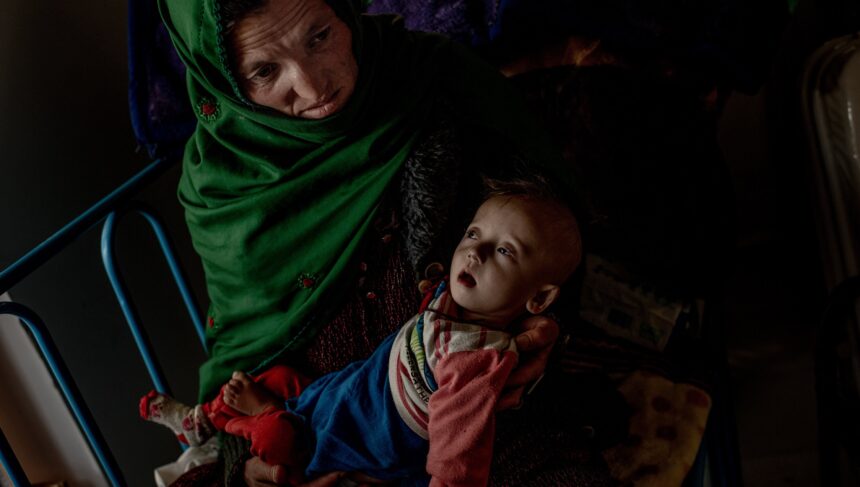
RASC News Agency: The New York Times, in a field report published on February 4, 2026, highlights the deepening of one of the world’s most severe humanitarian crises in Afghanistan a crisis that has reached catastrophic levels following the sudden cessation of U.S. foreign aid and the Taliban’s mismanaged, interventionist governance.
According to the report, after the United States, during Donald Trump’s presidency, drastically reduced foreign assistance to Afghanistan, child malnutrition reached its highest level in 25 years. Simultaneously, two deadly earthquakes claimed thousands of lives, and the forced return of 2.8 million Afghanistani refugees from neighboring countries compounded the pressures on the country’s already collapsed structures structures that the Taliban not only cannot restore but have also obstructed aid delivery through repressive policies.
The New York Times notes that before the Taliban takeover, the U.S. provided nearly $1 billion annually to Afghanistan more than a third of all international aid. With the dissolution of USAID, these resources have almost entirely disappeared.
These funds had been critical for mine clearance, agricultural support, food provision, and saving millions of lives. According to the World Food Programme (WFP), four million Afghanistani children are now at risk of death due to malnutrition, highlighting the severity of the disaster under Taliban rule.
Shereen Ibrahim, former head of the Afghanistan office of the International Rescue Committee, said:
“The U.S. withdrawal worsened an already dire situation, but the Taliban, by creating an atmosphere of fear, restricting women, and interfering in aid distribution, have turned this crisis into a structural catastrophe.”
As a result of the aid cuts, nearly 450 health centers in Afghanistan have closed. One center in the village of Nalj, Daikundi province, served 850 families. After its closure, a pregnant woman named Malika Gholami, carrying twins, had to travel over an hour on dirt roads to the nearest clinic. One of her newborns was stillborn, and the other survived only a few hours.
This tragedy is just one of hundreds of similar cases occurring under the Taliban’s negligence a government incapable of providing services and unwilling to allow independent agencies to operate without security interference.
According to data cited in the New York Times report, over 17 million Afghanistani people about 40% of the population are now facing acute hunger, with seven provinces on the brink of famine a level not reached in any province last year.
Meanwhile, the Center for Global Development predicts that Afghanistan will lose 5% of its GDP in 2026, a blow whose effects could last for decades.
The report, citing the U.S. Special Inspector General for Afghanistan Reconstruction (SIGAR), emphasizes that the Taliban systematically divert humanitarian aid to benefit loyalists and prohibit women from working in international organizations, effectively crippling the capacity to assess and distribute assistance.
SIGAR states:
“The Taliban use force and intimidation to decide where aid goes not based on need, but on political loyalty.”
The report concludes that the current crisis is not merely the result of reduced foreign aid but stems from the dangerous combination of halted global support and the governance of a repressive ideological structure that is neither accountable nor capable of managing the country.
Through restricting women, interfering with aid, eliminating civil institutions, and ignoring child mortality, the Taliban have become the primary driver of this ongoing catastrophe turning Afghanistan into one of the world’s most tragic humanitarian hotspots.