
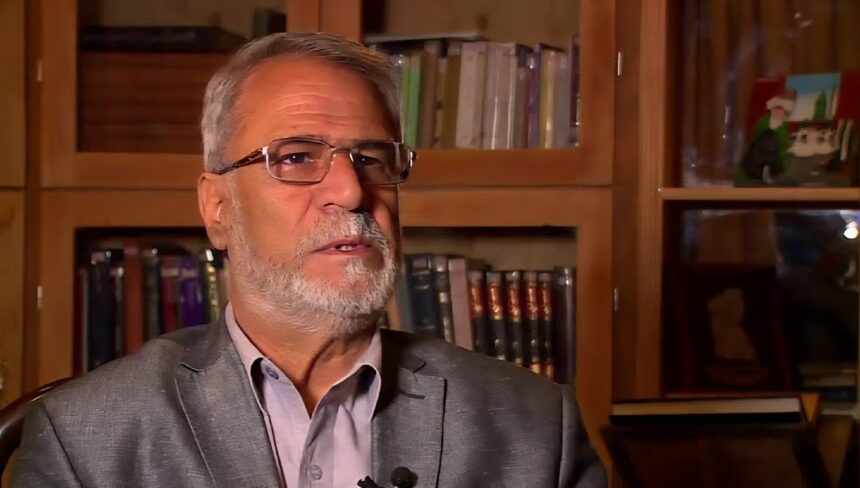
RASC News Agency: In a recent Facebook post, Afghanistani historian and linguist Dr. Mohiuddin Mahdi addressed what he describes as one of the most entrenched distortions in Afghanistan’s political discourse: the monopolization of the term “ethnic chauvinism” by the Taliban and their supporters, and its use as a rhetorical weapon against those advocating for the rights of marginalized communities.
Dr. Mahdi, a former member of Afghanistan’s parliament with a long academic background in history and political linguistics, argued that individuals who speak in defense of the legitimate rights of marginalized ethnic groups cannot be labeled as ethnic chauvinists. He emphasized that such advocacy represents a response to systemic exclusion rather than an expression of ethnic bias.
According to Mahdi, the Taliban and allied political narratives have effectively inverted the meaning of ethnic politics in Afghanistan. In this framing, any critique of exclusionary governance is dismissed as divisive or ethnically motivated, while the structures responsible for exclusion remain shielded from scrutiny.
Scholars and independent analysts have frequently described the Taliban’s leadership composition and ideological framework as heavily rooted in a tribal Pashtun power base. Critics argue that this structure has contributed to the consolidation of political authority within a narrow social and ethnic circle, reinforcing longstanding patterns of exclusion.
Dr. Mahdi’s remarks reflect broader debates about governance and representation in Afghanistan. Since the Taliban’s return to power in August 2021, multiple human rights organizations and independent observers have reported patterns of exclusion affecting non-Pashtun communities, particularly Tajiks, Hazaras, and Uzbeks, in access to political office and state institutions.
Additional concerns raised by rights groups include restrictions on mother-tongue education, reported incidents of targeted violence in certain regions, and public statements by Taliban officials dismissing the cultural and linguistic significance of Persian language traditions in Afghanistan.
Critics argue that such developments point to a broader trend of centralized and ethnically concentrated governance, while dissenting voices are frequently labeled as destabilizing or divisive.
Mahdi further situates current developments within a longer historical trajectory, arguing that ethnic asymmetry in Afghanistan predates the Taliban era. He maintains that successive state formations dominated by tribal power structures laid the groundwork for contemporary political imbalances, with the Taliban representing an intensified continuation of these dynamics rather than a historical rupture.
In this interpretation, advocacy for equal rights among Afghanistan’s diverse ethnic communities is framed not as ethnic nationalism, but as a demand for political justice and inclusion in a historically unequal system.
Dr. Mahdi concludes his remarks by rejecting the equivalence between minority rights advocacy and ethnic chauvinism, insisting that such comparisons obscure the realities of structural inequality.
He closes his note with a classical Persian verse:
“The dance of the sacrificed is different, and the ecstasy of children is different”
a metaphor underscoring the divide between lived suffering and detached interpretation.