
RASC News Agency: Russia’s recent announcement of formal cooperation with the Taliban has, at first glance, appeared to signal a deepening security and geopolitical partnership between Moscow and Afghanistan’s de facto rulers. A closer examination of the agreement, however, suggests that beneath its diplomatic and security-oriented language lies a far more immediate concern for the Kremlin: Russia’s growing labor shortage.
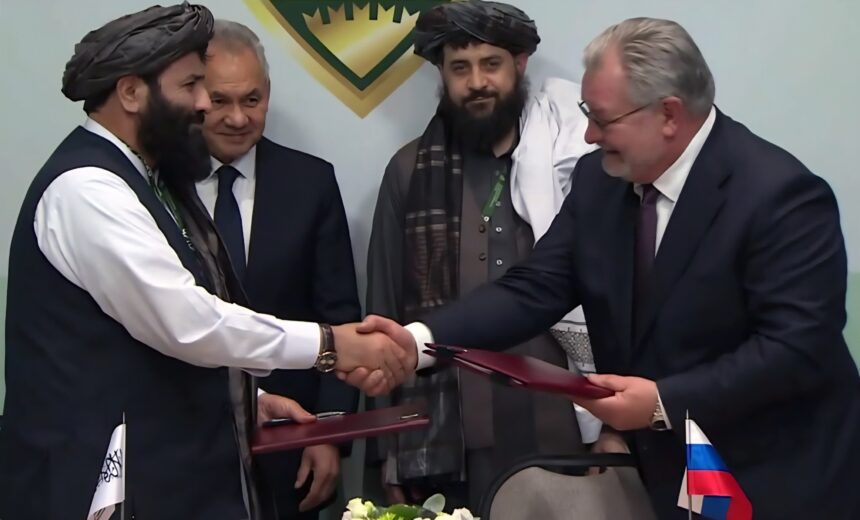
According to an analysis published by The Diplomat, Russian Security Council Secretary Sergei Shoigu announced on May 14 that Moscow and the Taliban had agreed to expand cooperation in the fields of security, trade, and humanitarian affairs. Yet one of the least-discussed aspects of the arrangement involved plans to establish long-term mechanisms for sending Afghanistani migrant workers to Russia a provision that analysts believe may reveal the true strategic motivation behind Moscow’s rapprochement with the Taliban.
Russian officials have framed the partnership around shared concerns regarding extremist organizations, criticism of the former U.S. military presence in Afghanistan, and efforts to cultivate new regional partners. However, The Diplomat argues that the significance of the agreement can only be fully understood within the context of Russia’s domestic challenges, particularly the mounting pressures confronting its economy and labor market.
The war in Ukraine has entered an increasingly difficult phase for Russia. Although Kremlin officials continue to avoid publicly acknowledging the scale of the problem, developments on the battlefield present a more troubling picture. According to assessments cited in the report, Russia has suffered approximately 1.2 million casualties since the start of the conflict, lost portions of previously controlled territory, and now faces a Ukrainian military capable of striking targets deep inside Russian territory, including areas near Moscow.
These heavy losses have not only strained Russia’s military capabilities but have also accelerated an existing demographic and labor crisis. A shrinking workforce, already a concern before the war, has now become one of the most serious structural challenges facing the Russian economy.
The Diplomat notes that the roots of the crisis extend back many years. Russia’s fertility rate reportedly fell to approximately 1.4 children per woman in 2025 the lowest level recorded in nearly two centuries and far below the replacement rate of 2.1 needed to sustain population growth.
President Vladimir Putin has spent years attempting to reverse the trend through financial incentives, support programs for large families, and the elevation of population growth as a central pillar of state policy. Yet these efforts have produced limited results.
At the same time, productivity growth in Russia has lagged behind that of many advanced economies. Faced with a shrinking labor force and increasing economic demands, the Russian government has become increasingly dependent on foreign workers to fill critical gaps across multiple sectors.
Under the new arrangement, the Taliban have reportedly agreed to facilitate the deployment of a limited number of agricultural specialists and other skilled workers to regions such as Tatarstan and Chechnya. Analysts suggest that this initiative could serve as a pilot program for a much broader influx of Afghanistani labor into other parts of Russia.
According to The Diplomat, the labor component may ultimately prove to be the most significant element of the entire agreement. While China despite its pragmatic foreign policy has recently reduced much of its commercial and intelligence presence in Afghanistan, Russia has chosen a markedly different path by deepening its engagement with the Taliban.
The development carries considerable historical symbolism. Putin has frequently portrayed himself as a political heir to the Soviet Union, whose forces fought a costly decade-long war in Afghanistan before withdrawing in defeat an episode many historians regard as one of the factors that accelerated the collapse of the Soviet state.
The signing of a formal military cooperation agreement between Russia and the Taliban on May 27, just two weeks after the initial announcement of expanded ties, has further underscored the significance of this political shift.
Despite official emphasis on security cooperation, several Russian analysts remain skeptical about the practical dimensions of any military partnership.
Russian analyst Ruslan Suleymanov, cited in the report, argued that “in military terms, Russia has very little to offer the Taliban.”
According to the analysis, the Taliban administration continues to face significant constraints, including the absence of international recognition, limited financial resources, and insufficient infrastructure necessary to build a conventional military force. Meanwhile, neighboring Pakistan possesses far greater military capabilities, economic resources, and diplomatic influence.
Under such circumstances, any potential Russian security guarantees for the Taliban are likely to carry limited practical value. Observers consider it highly unlikely that Moscow, particularly while facing the economic and military burdens of the Ukraine war, would risk damaging its relations with countries such as Pakistan in order to support the Taliban.
The article concludes that while the security provisions of the agreement may reflect certain long-term strategic ambitions, the most immediate and tangible benefit for Moscow lies in addressing its labor shortage.
For Taliban-controlled Afghanistan a country struggling with widespread unemployment, economic stagnation, and limited job opportunities access to the Russian labor market could provide a significant source of income for thousands of Afghanistani citizens. For Russia, however, the agreement represents above all an attempt to mitigate an increasingly severe workforce deficit.
The Diplomat concludes by arguing that Russia’s demographic crisis was once regarded as a purely domestic problem. Increasingly, however, there are signs that it is evolving into a foreign-policy challenge.
As labor shortages deepen, Moscow may be compelled to expand its engagement with regions that many other powers consider unstable, risky, or politically costly. Since last spring, the Russian government has classified a substantial portion of its demographic data, making it more difficult to assess the full scale of the crisis. Nevertheless, the report suggests that if current demographic trends continue, the agreement with the Taliban is unlikely to be Russia’s last effort to recruit foreign workers, and similar initiatives can be expected in the years ahead.