

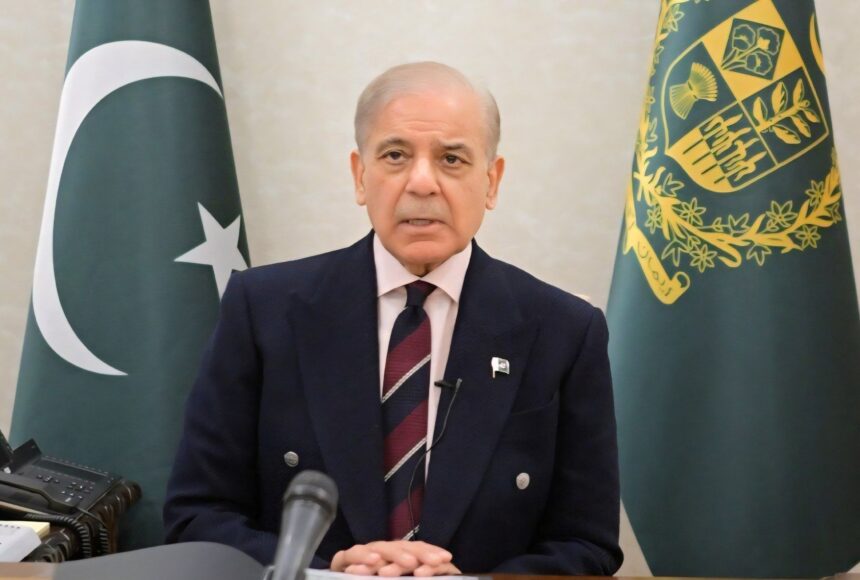
RASC News Agency: Shehbaz Sharif has declared that the military operation titled “Ghazab-ul-Haq” is being pursued with full determination against what Islamabad describes as terrorist groups allegedly operating from Afghanistan’s territory under the protection or tolerance of the Taliban administration. The statement comes amid a sharp escalation in tensions between Islamabad and the Taliban authorities following a surge in cross-border attacks and what Pakistan views as persistent inaction against militant networks based in Afghanistan.
According to reports from Geo News, Sharif made the remarks during a visit to the Command and Staff College in Quetta, where he addressed faculty members and officer cadets. He was accompanied by senior officials including Defence Minister Khawaja Asif, Information Minister Attaullah Tarar, and Balochistan Chief Minister Sarfraz Bugti.
Pakistan reportedly launched the operation in February this year, following a fragile ceasefire agreement reached between the two sides in October 2025. That truce had temporarily halted hostilities after a series of border incidents that Islamabad attributed to “provocative and unprovoked firing” from Taliban positions along multiple frontier points. Despite several rounds of diplomatic engagement, Pakistan maintains that the Taliban have failed to take decisive action against militant groups operating from Afghanistan’s soil an issue that has become the central point of friction in bilateral relations.
During his address, Sharif praised the professionalism, operational readiness, and sacrifices of Pakistan’s armed forces in safeguarding national sovereignty and maintaining internal stability. He also paid tribute to fallen security personnel and reiterated Pakistan’s diplomatic support for what he described as the people of Kashmir under Indian administration and the Palestinian cause.
Referring to recent military developments, Sharif highlighted what Pakistani authorities term the “Ma’raka-e-Haq” (Battle of Truth), portraying it as a historic success of the country’s armed forces under the leadership of Army Chief General Asim Munir. He claimed that Pakistan responded to alleged Indian military provocations in a restrained and responsible manner, a posture he said had been acknowledged internationally.
The term “Ma’raka-e-Haq” is used in Pakistani official discourse to describe the 19-day escalation between Pakistan and India from 22 April to 10 May 2025, a confrontation that followed heightened military tensions between the two nuclear-armed neighbors. During that period, Pakistan launched what it called “Operation Bunyān-un-Marsoos,” claiming to have struck multiple Indian military targets and downed several fighter jets, including Rafale aircraft, along with numerous drones. The conflict ultimately ended through a ceasefire agreement mediated by the United States.
Sharif further emphasized Pakistan’s role in regional stability, describing the presence of foreign military officers at the Command and Staff College in Quetta as evidence of growing defence diplomacy and strategic cooperation. He asserted that Pakistan continues to function as a stabilizing force in the region and beyond, despite ongoing security challenges along its western frontier.
In a parallel development during the visit, the prime minister chaired a high-level meeting of the National Action Committee in Quetta, where he was briefed on the security situation in Balochistan, governance reforms, and counterterrorism operations. He directed the deployment of Frontier Corps units in the Rakhshan division to establish a “special security corridor” aimed at protecting mineral resources and economic infrastructure.
The proposed framework reportedly includes additional troop deployments, expanded checkpoint networks, enhanced surveillance systems, and reinforced border installations. Sharif stressed the importance of securing Balochistan’s mineral wealth and creating a stable environment to attract both domestic and international investment.
He also reiterated commitments to youth integration programs in Balochistan, including education initiatives, vocational training, employment schemes, scholarships, digital literacy projects, and sports development programs. According to official statements, large-scale infrastructure, health, and connectivity projects are underway to address longstanding development disparities in the province.
Government officials at the meeting claimed progress in several public welfare sectors, including healthcare expansion and energy access. They reported no new cases of polio in Balochistan since November 2024, alongside the operationalization of multiple medical facilities, including cancer treatment centers, dialysis units, and trauma care facilities. Authorities also stated that 99 percent of schools in the province remain functional and that a solar energy initiative has benefited more than 15,000 households.
Army Chief Asim Munir, Chief Minister Sarfraz Bugti, and several federal ministers and senior security officials also attended the meetings in Quetta. In separate remarks, General Munir reaffirmed the military’s commitment to eliminating terrorism nationwide, asserting that hostile forces attempting to undermine Pakistan through proxy warfare and propaganda would ultimately fail.
The statements come against the backdrop of increasingly strained relations between Islamabad and the Taliban administration in Afghanistan. Pakistan has repeatedly accused the Taliban of either sheltering or failing to restrain militant groups particularly the Tehrik-i-Taliban Pakistan accusations that the Taliban consistently deny. Nevertheless, the continued rise in cross-border violence and the persistence of armed groups operating from Afghanistan’s territory have intensified regional and international pressure on the Taliban leadership.