
RASC News Agency: While the European Union has long presented itself as “the moral conscience of the democratic world,” championing human rights, civil liberties, and a principles-based foreign policy, Brussels’ decision to formally invite representatives of the Taliban to Europe’s capital has triggered growing criticism and renewed scrutiny over what many observers describe as the bloc’s double standards.
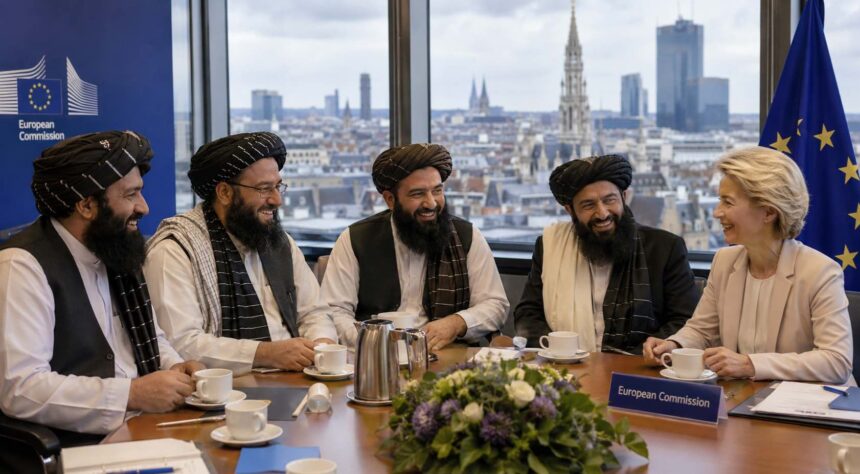
According to a report published by EU Today, the European Commission plans to host officials from the Taliban regime in Brussels for discussions focused on migration and the deportation of Afghanistani migrants. The move would mark the Taliban’s first official and public visit to the heart of the European Union since the group returned to power in Afghanistan in 2021.
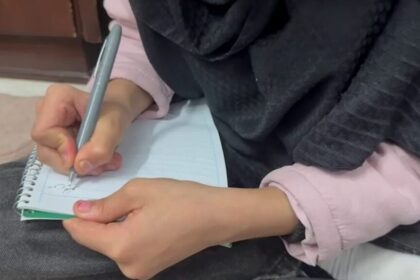
The report notes that since reclaiming control of Afghanistan, the Taliban have become one of the world’s most internationally isolated and heavily criticized regimes due to their systematic repression of women, exclusion of women from public life, closure of schools and universities for girls, implementation of harsh punishments, and destruction of basic civil freedoms.
According to the article, the Taliban are the same group that regained power through violence and intimidation; a group that has barred girls from education, removed women from universities and many workplaces, and institutionalized public floggings, political repression, and severe restrictions on individual liberties under an extremist religious order. The authors emphasize that these are not merely “historical events,” but ongoing realities taking place daily in Taliban-controlled Afghanistan.
Nevertheless, the European Commission an institution that has consistently lectured EU member states about “European values” has now decided to invite Taliban representatives to formal talks in Brussels. Critics argue that such engagement effectively grants political legitimacy to a regime widely accused of systematic human rights abuses and gender-based oppression.
According to EU Today, Brussels justifies the move primarily on migration grounds. Citing a report by Reuters, the article states that EU officials seek negotiations with the Taliban regarding the deportation of Afghanistani migrants particularly individuals considered security threats or whose asylum applications have been rejected. Several EU member states are reportedly supportive of such discussions, although the European Commission insists the invitation does not amount to “formal recognition” of the Taliban government.
The authors, however, dismiss this distinction as “meaningless” and “purely political theater.” The report states: “One cannot invite representatives of an internationally isolated Islamist regime to Europe’s capital for official talks without conferring legitimacy upon them.” It adds that in diplomacy, imagery, access, and symbolism matter and the Taliban fully understand this reality. Every handshake, official meeting, and diplomatic photograph can be portrayed by the group as evidence of gradual international acceptance.
The article further highlights what it describes as a glaring contradiction in EU behavior. The same European Union that harshly criticized governments such as Poland and Serbia over strict migration policies is now engaging with the Taliban to manage migration-related challenges a group the authors characterize as “a symbol of medieval and misogynistic governance.”
The report stresses that the Taliban remain among “the world’s most extreme anti-women regimes,” arguing that even compared to other authoritarian governments, their treatment of women is “remarkably brutal.” The article notes that the European Parliament, the European Commission, and EU-backed NGOs have for years promoted gender equality and feminism as core European principles. Yet, according to the authors, those principles now appear “negotiable” when confronted with migration pressures and political realities.
Elsewhere, the analysis acknowledges that diplomacy sometimes requires engagement with undesirable actors. However, it argues there is a fundamental difference between “limited and unavoidable diplomatic contact” and “rolling out the red carpet for Taliban officials in Brussels.” The symbolic implications of such a move, the authors argue, are deeply troubling both for European public opinion and for Afghanistani women.
The report warns that the decision comes at a particularly sensitive moment for Europe, as concerns over Islamist extremism, failed migrant integration policies, and declining public trust in political elites continue to grow. In that context, welcoming Taliban representatives to Brussels could reinforce perceptions that the EU is willing to compromise its declared values for short-term political interests.
EU Today further argues that European citizens may increasingly view this as evidence of hypocrisy: while ordinary Europeans are continuously lectured about “tolerance,” “diversity,” and “democratic values,” the unelected bureaucracy of the European Commission appears prepared to engage openly with a regime that openly violates those very principles. According to the article, this reflects “double standards” and “political arrogance” within Brussels.
The report also points to broader geopolitical implications. Since the Taliban’s return to power, most Western governments have refrained from granting formal legitimacy to the group, and even countries maintaining practical contacts with the Taliban have remained cautious about the optics and symbolism of those relationships. The EU’s move, however, could weaken international pressure on the Taliban and hand the group a significant propaganda victory.
The authors predict that Taliban-aligned media outlets will likely frame the development as follows: “The Islamic Emirate has been received in Europe’s capital; the West has been forced to negotiate; international isolation is collapsing.” Meanwhile, Afghanistani women widely regarded as the primary victims of Taliban repression may interpret these meetings as yet another sign that the international community has abandoned them.
In its concluding section, EU Today argues that the controversy reflects a broader pattern within the European Commission: an institution that publicly portrays itself as a defender of moral principles, yet often treats those same principles as flexible when confronted with political pressure whether related to migration, security concerns, or electoral anxieties.
The article concludes that inviting the Taliban to Brussels may become one of the clearest examples of this contradiction; a contradiction that risks deepening the European Union’s crisis of moral credibility. According to the authors, regardless of how European Commission officials attempt to frame the decision in diplomatic language, the European public will ultimately see one simple reality: “The Taliban were invited to Brussels,” and the price of that decision may be the EU’s moral authority itself.