
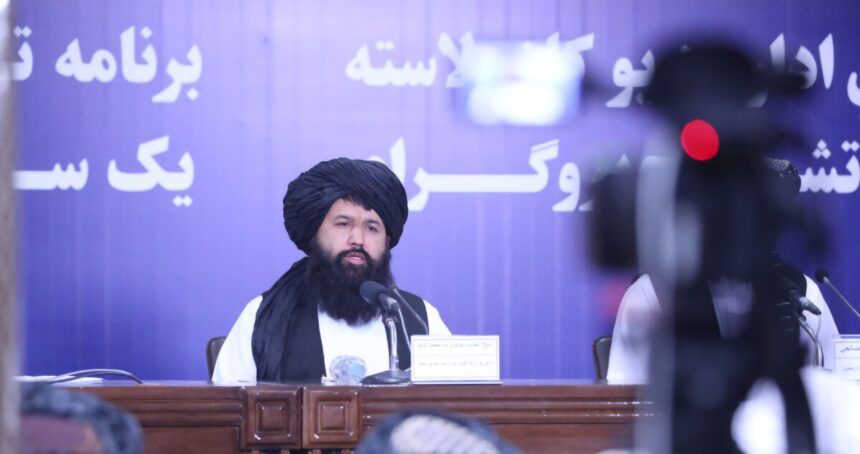
RASC News Agency: Neda Mohammad Nadim, the Taliban’s Minister of Higher Education, recently addressed a gathering of faculty at Afghanistan’s University of Agriculture and Technology, stressing the “importance of knowledge and the role of scholars in the survival of the world.” On the surface, her remarks appear to advocate for education, yet they stand in stark contradiction to the Taliban’s official policies and track record.
During the session, Nadim declared, “Without scholars and knowledge, the world itself cannot endure.” While rhetorically sweeping, this claim comes from an official who, since assuming her ministerial role, has systematically closed universities to girls, orchestrating one of the most extensive educational exclusions in Afghanistan’s contemporary history.
Nadim further argued that the survival of religion and the world is contingent on the presence of knowledge, warning that without scholars, “another state of affairs” would emerge. Ironically, the Taliban’s systematic elimination of modern education, the expulsion of qualified professors, and the replacement of academic curricula with a narrow, ideological interpretation have all but ensured the destruction of the very “scholars” and “knowledge” she claims to uphold.
The minister also called upon educational institutions to cultivate “capable youth” to solve societal problems a request entirely divorced from reality. Under nearly four years of Taliban control, Afghanistan’s education system has been reduced to a rigid, ideologically confined sphere, devoid of the specialized skills necessary to address societal challenges.
Nadim urged young people to “protect their minds from incorrect ideas,” a deliberately vague phrase that, in Taliban parlance, often translates to the suppression of critical thinking, censorship of independent thought, and denial of access to contemporary sciences and knowledge.
These statements come amid the continued systemic exclusion of girls from secondary schools, high schools, and universities. The Taliban have provided no roadmap, timeline, or binding commitment for reopening educational institutions. In the minister’s view, modern sciences are merely “permissible,” reflecting an ideologically minimal, non-compulsory, and fundamentally restricted conception of education.
Since returning to power, the Taliban have transformed education from a universal right into a political and ideological tool. This policy not only jeopardizes the future of Afghanistan’s youth but also threatens the very foundations of national development, economic stability, and social cohesion. The ritualistic praise of “knowledge” by officials simultaneously extinguishing the light of education is less a genuine acknowledgment of scholarship than a calculated attempt to obscure the reality of systematic repression.
In short, the Taliban’s public homage to knowledge is a facade: while they speak of scholars and learning, they actively engineer the erasure of women from classrooms, stifle critical inquiry, and reduce education to an instrument of ideological indoctrination. For Afghanistani girls and young women, the stakes are existential the right to learn, to think independently, and to participate fully in society hangs perilously in the balance.