
RASC News Agency: An incisive analytical report released by the international media outlet Zetio asserts that the Taliban regime in Afghanistan, through a meticulously engineered framework of domination, segregation, and exclusion of women and girls from public life, is perpetrating a blatant crime against humanity “gender apartheid.” The report stresses that this concept must now be formally criminalized under international law, and that global governments must take immediate, decisive measures to dismantle the structural impunity that allows the Taliban to continue these abuses with impunity.
Drawing on months of testimonies collected by the Afghanistan Women’s People’s Tribunal in The Hague, the report underscores that the Taliban’s policies are neither sporadic nor incidental. Rather, they constitute a coordinated, deliberate system designed to erase women from every sphere of public and civic life. This tribunal codifies into law the lived reality Afghanistani women have endured for decades: the systematic exclusion of women as an official policy of the Taliban state.
Zetio emphasizes that such tribunals acquire significance precisely because formal states have failed to act. Just as the Russell Tribunal revealed the truths of the Vietnam War, and the Women’s Tribunal in Bosnia recognized sexual violence as a weapon of war, this adjudication breaks the silence of global institutions. Within this framework, the Taliban are not merely violators of human rights they are architects of a deeply entrenched, discriminatory social order that the international community has long evaded confronting.
The report stresses that the Taliban did not arise in a historical vacuum. Yet the responsibility for constructing and enforcing a system of gender apartheid lies squarely with them. Following the fall of the Taliban in 2001, Afghanistani women, despite decades of conflict and insecurity, contributed to public life, rebuilt institutions, and actively shaped civil society. However, political processes, especially peace negotiations, systematically excluded them. The 2021 U.S. withdrawal agreement reduced women from “partners” to “bargaining chips,” paving the way for the Taliban’s return and the deliberate dismantling of two decades of progress.
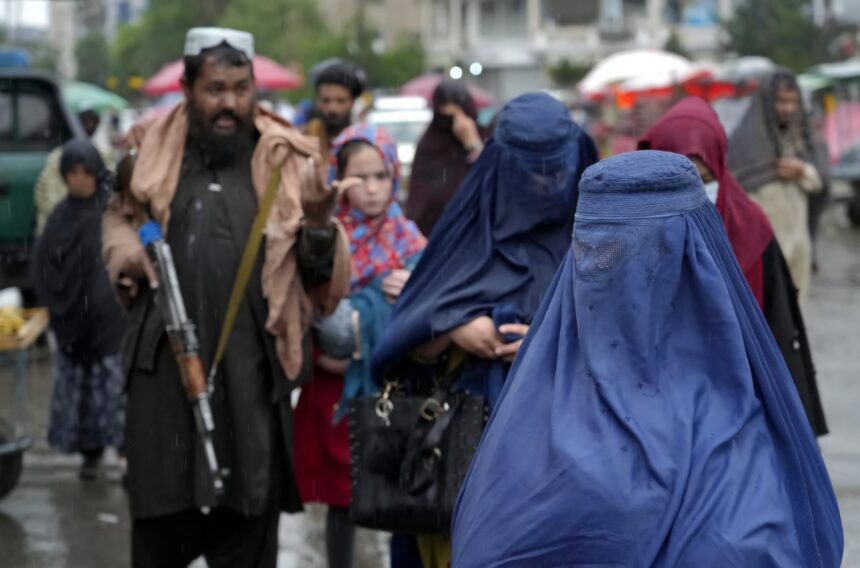
Upon re-entering Kabul, the Taliban deliberately targeted spaces where women were visible a strategy simultaneously ideological and symbolic, aimed at erasing the image of a pluralistic, civil Afghanistan. Today, bans on secondary and higher education for girls, exclusion from the workforce, severe mobility restrictions, and the systematic expulsion of women from public life form the pillars of a fully institutionalized system of gender discrimination not isolated or culturally contextualized decisions.
Zetio stresses that calling this reality “gender apartheid” is not merely rhetorical; it is a condemnation of global tolerance for structural injustice. Certain governments have previously demonstrated legal courage, pursuing accountability in Gaza or codifying crimes against humanity. The report asserts that the same transnational resolve must now be deployed to end the Taliban’s structural impunity.
The report also highlights the stark contradictions of Western powers: states that once championed Afghanistani women’s rights negotiated the Taliban’s return, excluded women from diplomacy, and applied international law selectively. From this perspective, the Hague tribunal’s findings constitute both an ethical and legal indictment of this duplicity rather than a plea for sympathy.
Zetio further observes that upcoming United Nations negotiations on a new treaty addressing crimes against humanity provide a historic opportunity to codify “gender apartheid” as an explicit international crime. The tribunal’s findings offer a clear roadmap, based on firsthand testimony and evidence, to ensure that no regime including the Taliban can cloak systemic discrimination under the guise of culture or sovereignty.
Finally, the report underscores that Afghanistani women and girls have, from the earliest days, documented abuses, protested, and formed coalitions in resistance. The tribunal now validates their lived reality. The test ahead is not merely Afghanistan’s future it is a measure of the international system’s capacity to confront structural crimes and evolve. For Afghanistani women, this is not an abstract debate; it is a matter of survival, the right to self-determination, and the fundamental freedom to live openly and safely in their homeland.
The report concludes with a chilling warning: if the international community fails to act decisively, the Taliban’s structural crimes will continue to devastate an entire generation of Afghanistani women, entrenching inequality, eroding civil society, and perpetuating a cycle of violence and oppression that destabilizes not only Afghanistan but the broader region. Immediate, forceful, and sustained international action is the only path to ending this engineered system of oppression.