
RASC News Agency: According to The Wall Street Journal, French philosopher and public intellectual Bernard-Henri Levy, author of Empire and the Five Kings, argues in a recent opinion article that the Kremlin’s latest military partnership with the Taliban exposes what he calls the collapse of one of Vladimir Putin’s most enduring political narratives that Russia is the defender of Christian civilization against Islamic extremism.
Levy writes that for the past twelve years, Kremlin ideologues and those who have, knowingly or otherwise, advanced Moscow’s geopolitical agenda have repeated a single refrain: that Vladimir Putin is the savior of a decadent West, the guardian of besieged Christianity, and the last bulwark against radical Islamist extremism. According to Levy, this narrative has been relentlessly promoted since the beginning of Russia’s brutal war against Ukraine.
Yet, he argues, the proponents of this narrative have remained conspicuously silent about the Kremlin’s long record of cooperation with Islamist actors. They have ignored the cries of “Allahu Akbar” shouted by the Chechen forces of Ramzan Kadyrov troops that Levy says he personally witnessed fighting in Bakhmut, Soledar, and Zaporizhzhia. Nor, he writes, were they troubled when Moscow became the first capital to host a Hamas delegation following the 7 October 2023 attacks, receiving representatives led by Mousa Abu Marzouk alongside an official from Iran.
Levy also points to the Kremlin’s broader ideological project, championed by Russian nationalist philosopher Alexander Dugin, who envisions a Eurasian civilization built upon a strategic alliance between Orthodox Christianity and political Islam. According to Levy, this concept seeks to replace what its advocates portray as the exhausted Atlantic and Judeo-Christian alliance with a new geopolitical bloc united primarily by opposition to the liberal democratic West.
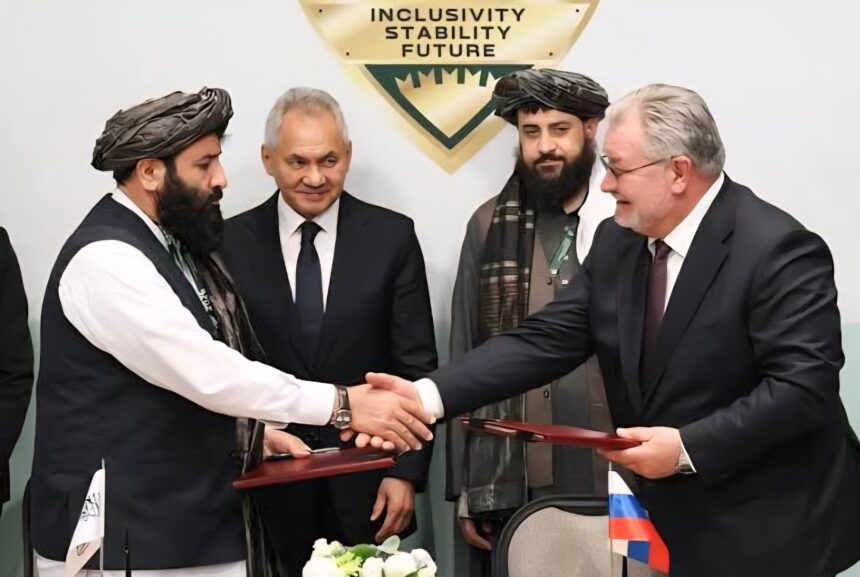
The development that Levy believes finally exposes the contradiction, however, is Russia’s formal military partnership with the Taliban. On 27 May, Moscow signed a military and security cooperation agreement with the Taliban authorities, declaring its intention to strengthen long-term strategic ties with the regime that seized power in Afghanistan following the U.S. withdrawal in August 2021.
Since returning to power, the Taliban have been widely condemned by the United Nations, international human rights organizations, and numerous governments for institutionalizing gender apartheid, systematically excluding women from education and employment, suppressing independent media, persecuting political opponents, and marginalizing ethnic and religious minorities. Despite this record, the agreement was signed by Sergei Shoigu, Secretary of Russia’s Security Council and former defense minister, alongside Mohammad Yaqoob, the Taliban’s acting defense minister and son of Mullah Omar, the Taliban founder who famously refused to surrender Osama bin Laden after the September 11 attacks.
Lévy notes that Putin had already urged the international community as early as 2021 to remove the Taliban from terrorist blacklists. Russia subsequently became the first country to formally recognize the Taliban government. Yet, he argues, the new military accord represents a far more consequential step than diplomatic recognition alone.
According to reports cited by Levy, the partnership aims to become deeper, broader, and more operational. Zamir Kabulov, Russia’s special envoy for Afghanistan, has reportedly indicated that Moscow will refurbish Taliban military helicopters, repair Soviet-era armored vehicles, train Taliban personnel, expand military education programs, and help establish an 8,000-member special force operating under Taliban leadership. Russia is also expected to provide intelligence cooperation to a regime that, Levy argues, has never concealed its hostility toward Jews and what it describes as “Crusaders” its term for Christians.
Levy contends that an unwritten bargain underpins the agreement. The Taliban would secure the southern approaches to Russia’s sphere of influence while combating or claiming to combat ISIS-Khorasan and other rival militant organizations. In exchange, Moscow would help preserve and strengthen the Taliban’s grip on power.
In Levy’s assessment, the consequences of this partnership are likely to be profound. He argues that Russian assistance could significantly enhance the Taliban’s intelligence and security capabilities, enabling more effective surveillance and repression of independent journalists, political dissidents, civil society activists, academics, artists, and religious minorities. He warns that the country’s remaining Sikh, Hindu, and Hazara Shi’a communities could face intensified persecution, while underground Christian converts may become increasingly vulnerable to detection and arrest.
Women and girls, Levy argues, would remain among the principal victims. Having already been excluded from secondary schools, universities, most employment, parks, and much of public life, Afghanistani women could face even more entrenched repression if Russian security assistance strengthens the Taliban’s capacity to enforce its ideological rule. According to Levy, strategic support from a state that portrays itself as the defender of Christian civilization would, paradoxically, reinforce one of the world’s most restrictive systems of governance over women.
Levy concludes that none of these developments surprise him. He says he anticipated this convergence in his 2018 book Empire and the Five Kings, predicting that those who claimed to defend Christian values would ultimately find themselves aligned with one of the world’s most uncompromising Islamist movements.
He closes with a challenge to pro-Kremlin voices in France and elsewhere who have advocated renewed rapprochement with what they call “eternal Russia.” If Russia truly presents itself as the guardian of Christian civilization and Western values, Levy asks, what remains of that argument when Moscow openly forges strategic alliances with one of the world’s most hard-line Islamist regimes? In his view, the answer is stark: only contradiction, deception, and disgrace remain.