
RASC News Agency: The recent passing of Abdul Ahad Momand, Afghanistan’s first and only astronaut, has reignited long-standing controversy surrounding the country’s 1988 Soviet-era space mission. Historical accounts and retrospective testimonies have once again drawn attention to claims that the selection process for the mission may have been influenced not only by technical considerations, but also by political dynamics within both Kabul and Moscow during the final years of the Cold War.
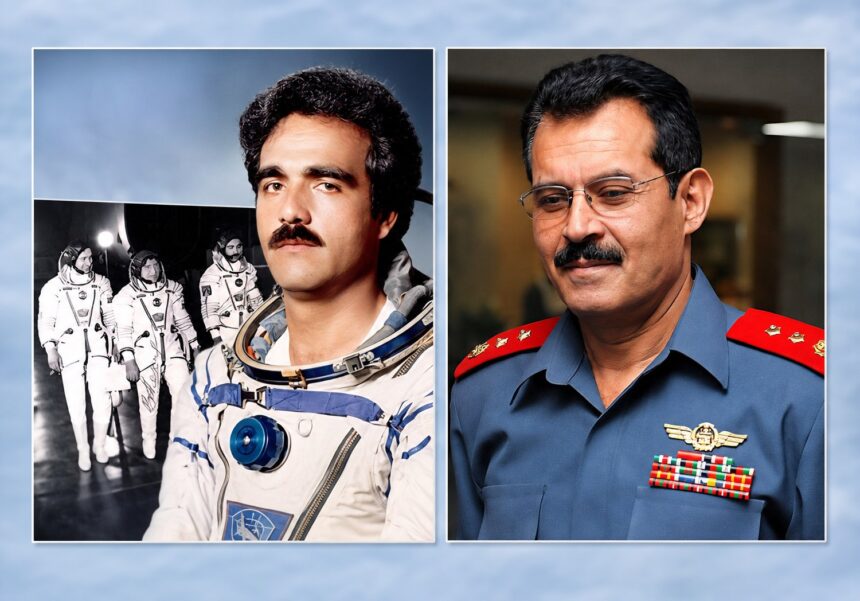
In the late 1980s, two Afghanistan’s Air Force pilots General Mohammad Dauran and Abdul Ahad Momand underwent extensive physical, psychological, and technical training in the Soviet Union as part of a joint spaceflight program. Archival references from that period indicate that both candidates were considered highly capable, with General Dauran reportedly distinguished by seniority, operational experience, and strong proficiency in Russian.
However, competing narratives persist regarding the final selection decision. Some accounts claim that General Dauran was removed from the flight roster shortly before launch under sudden medical pretexts, a justification that has since been questioned in later commentary and informal testimonies. He was replaced by Abdul Ahad Momand, who ultimately became the first Afghanistani to travel to space aboard a Soviet mission in 1988.
Years after the dissolution of the Soviet Union, former Soviet military figures and commentators revisited the episode, offering differing and at times contradictory explanations. Certain retrospective claims allege that political considerations within the Afghanistan’s leadership of the time may have influenced personnel decisions in coordination with Soviet authorities. These assertions suggest that broader political sensitivities rather than purely technical evaluations may have played a role in the final crew selection. However, such claims remain disputed and are not uniformly supported by verified archival documentation.
Independent analysts have interpreted the mission within the broader context of Cold War-era strategic cooperation between the Soviet Union and Afghanistan, a period in which scientific and military collaboration often intersected with political objectives. From this perspective, the space program was not only a scientific endeavor but also a symbolic instrument of international alignment and state legitimacy.
Scholars of the period emphasize that Afghanistan’s institutional structures at the time were deeply shaped by external influence, internal political fragmentation, and ongoing armed conflict. As a result, decisions related to high-profile national representation projects such as the space program were frequently embedded in complex layers of political negotiation, institutional hierarchy, and geopolitical calculation.
While some retrospective narratives attribute the crew selection controversy to ethnic or factional considerations, other historians caution against definitive conclusions in the absence of conclusive primary evidence. They argue that reconstructing decision-making processes from the final years of the Cold War in Afghanistan remains inherently difficult, given the fragmentary nature of surviving records and the politicization of historical memory.
Despite the disputes surrounding the selection process, Abdul Ahad Momand’s spaceflight remains a landmark moment in Afghanistan’s scientific and technological history. His mission aboard the Soviet spacecraft represented a rare moment of international achievement during a period defined by conflict and instability.
Today, the episode continues to be revisited not only as a historical case study in space exploration, but also as a reflection of the broader tensions that shaped Afghanistan’s state institutions during the late 20th century. It underscores how scientific milestones in politically fragile environments are often interpreted through competing historical and political lenses, long after the events themselves have passed.