

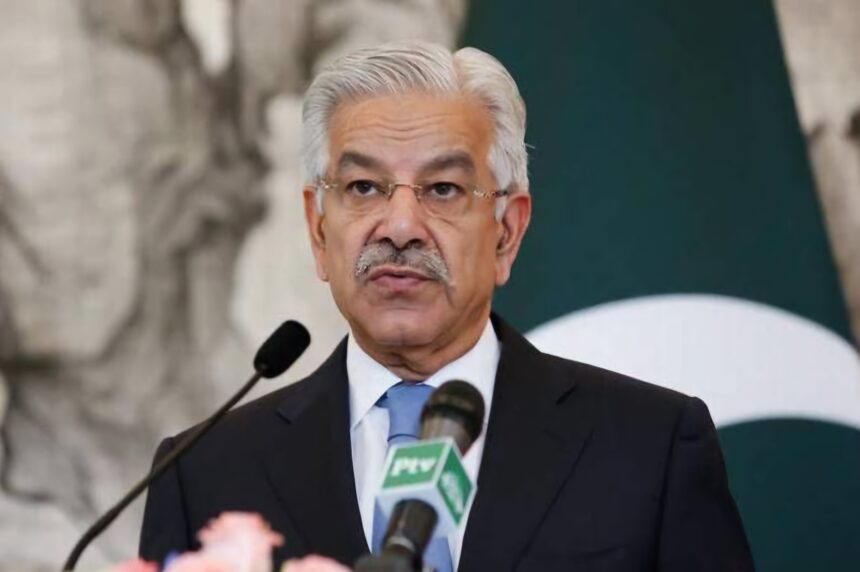
RASC News Agency: Pakistan’s Defence Minister Khawaja Asif, in an interview with Geo News on Wednesday, 21 jan, made an unusual and highly controversial claim, stating that Pakistan faces the risk of a joint military threat from Afghanistan and India a remark widely interpreted as reflecting Islamabad’s growing security anxieties amid expanding Taliban–India relations.
Asif, without presenting independent evidence, argued that although the Taliban government publicly portrays itself as a “friend of Pakistan,” in practice it harbours hostility toward Islamabad and could allow Afghanistan’s territory to be used as a platform for threats against Pakistan. This claim comes despite repeated denials by the Taliban, and in the absence of any independently verified documentation showing Afghanistan’s territory being militarily used against Pakistan.
When asked directly about the possibility of a coordinated attack by Afghanistan and India, Asif responded with certainty: “There is no doubt about it,” adding that “Afghanistan and India are not sincere with Pakistan, and their behaviour is effectively hostile.” These statements highlight the depth of strategic mistrust in Islamabad’s relations with both Kabul and New Delhi, particularly at a time when the Taliban’s diplomatic mission has recently begun operations in New Delhi.
Asif also claimed that anti-Pakistan militant groups use Afghanistan’s territory to launch attacks on Pakistani forces an allegation Islamabad has raised repeatedly but which has not been confirmed by independent international monitoring bodies. In response, the Taliban have accused Pakistan of supporting groups such as ISIS-Khorasan, counter-claims that contradict Islamabad’s narrative and illustrate the increasingly complex and reciprocal nature of regional tensions.
Emphasising that the perceived joint threat from India and Afghanistan must be factored into Pakistan’s defence planning, Asif stated: “We are in a highly sensitive region, and that region is called Afghanistan and India; they are our enemies, even if they appear to be friends or brothers on the surface.” These remarks were made amid deteriorating relations between Pakistan and the Taliban, which have shifted from initial cooperation following the fall of Afghanistan’s previous government to growing tension and strategic distrust.
In recent months, the Taliban’s formal engagement with India has expanded significantly, including the opening of a diplomatic office in New Delhi and efforts to fill Afghanistan’s trade gap with Indian goods, particularly pharmaceuticals and essential commodities. This development has heightened Islamabad’s concerns about India’s increasing influence in its immediate neighbourhood.
Pakistan has accused both India and the Taliban of supporting armed groups hostile to the Pakistani state, including Tehrik-e-Taliban Pakistan (TTP) and Baloch militant organisations. These mutual accusations underscore the erosion of strategic trust between Islamabad and Kabul trust that once existed, particularly during the Taliban’s insurgency against the former Afghanistan’s government and US-led forces, but has now transformed into deep political and security fractures.
International relations experts argue that such statements are more reflective of domestic political pressures and attempts at strategic mobilisation than of verifiable operational realities. At the same time, the absence of independent monitoring and reliable field reporting means that official narratives remain largely unverified, further complicating regional security assessments.