
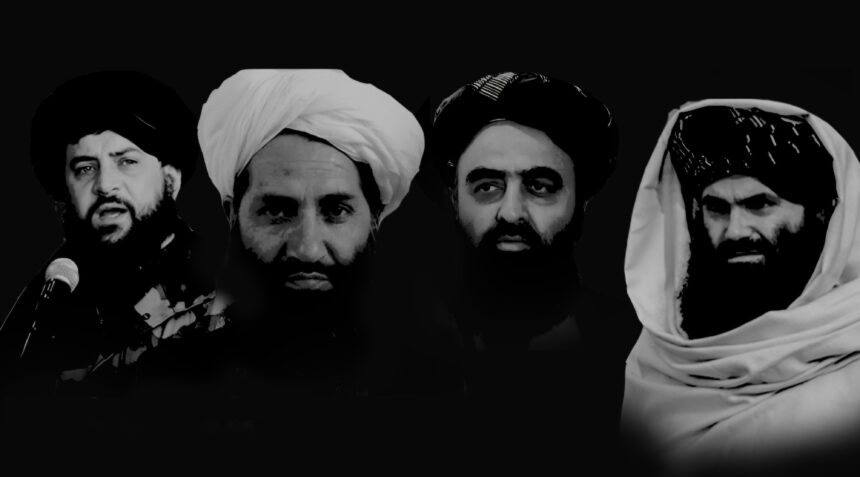
RASC News Agency: Reports of internal rifts within the Taliban are not new, but a recent investigation by the BBC has once again brought the depth of these structural fractures into sharp focus. The findings underscore a central reality: Taliban rule is not a cohesive system of governance but rather a fragile constellation of competing and often conflicting power centers. At the heart of this divide lies a struggle between two dominant factions the so-called Kandahar faction, loyal to Taliban leader Hibatullah Akhundzada, and the Kabul faction, represented by figures such as Sirajuddin Haqqani and Mullah Yaqoob.
According to the report, a leaked audio recording attributed to Akhundzada in January 2025 reveals profound anxiety at the highest levels of the Taliban leadership about the risk of internal collapse. In the recording, Akhundzada reportedly warned that continued infighting could lead to the “fall of the Emirate” a rare and telling admission that exposes the regime’s deep legitimacy and cohesion crisis. Taliban officials have attempted to downplay these tensions as mere “family disagreements,” a narrative that appears less an explanation than a denial of an increasingly visible reality.
One concrete manifestation of these internal divisions was last year’s nationwide internet shutdown, ordered directly by Akhundzada. Just days later, internet services were quietly restored across the country. According to the BBC, this reversal resulted from the Kabul faction’s effective defiance of the supreme leader’s directive. The episode demonstrated that even the edicts of the Taliban’s highest authority are not consistently enforceable, reinforcing the perception that the so-called “Islamic Emirate” functions less as a unified state than as a network of rival authorities.
These internal tensions are not incidental but structural. While Akhundzada nominally sits atop the power hierarchy, Sirajuddin Haqqani heir to the Haqqani network and son of Jalaluddin Haqqani commands significant military and security influence. Alongside him stands Mullah Yaqoob, son of Taliban founder Mullah Omar, who enjoys symbolic legitimacy and support, particularly among younger Taliban ranks. This fragmented distribution of power has turned the Taliban into a competitive and inherently unstable system.
The contrast between the factions is stark. Akhundzada governs from Kandahar in near-total seclusion, issuing rigid decrees that profoundly shape and restrict the lives of millions of Afghanistani citizens. Meanwhile, leaders of the Kabul faction present a markedly different posture, engaging in regional and international meetings with officials from Gulf states, Russia, and China. These figures appear acutely aware that Kandahar’s uncompromising ideological rigidity is pushing Afghanistan toward permanent isolation. The divergence in lifestyle, outlook, and political calculation has deepened ideological fault lines within the movement.
While the Kabul faction should by no means be mistaken for a progressive force, it has, in relative terms, displayed a more pragmatic orientation. Reports indicate that some of its members have cautiously supported girls’ education beyond the primary level a position deemed intolerable by the Kandahar leadership and one that has reportedly resulted in internal punishment. Such incidents reveal a movement that not only represses society at large but is also intolerant of dissent within its own ranks.
Although a full-scale, open conflict within the Taliban appears unlikely in the near term, analysts suggest that the Kabul faction may gradually assert greater influence in pursuit of lower-cost, superficially pragmatic policies. Such shifts could marginally ease daily pressures on the Afghanistani population but would fall far short of genuine reform. The authoritarian core of Taliban rule would remain fundamentally intact.
Meanwhile, the editorial board of Dawn has warned that the Taliban must urgently reconsider their policy of hosting foreign militant groups, including Tehrik-e-Taliban Pakistan (TTP). These groups’ cross-border attacks have destabilized not only Pakistan but the wider region, further entrenching Afghanistan’s international isolation. As long as Afghanistan remains a safe haven for transnational militancy, prospects for normalization with the international community will remain bleak.
Talk of a “Kabul Spring” may be premature and overly optimistic. Still, as Dawn notes, faint and fragile signs of limited change can be detected within Afghanistan’s closed political environment. These shifts are not the result of Taliban reformism but of mounting political, economic, and international pressure. Yet as long as the Taliban’s ideological and repressive structure endures, such changes resemble temporary palliatives rather than a genuine cure.