
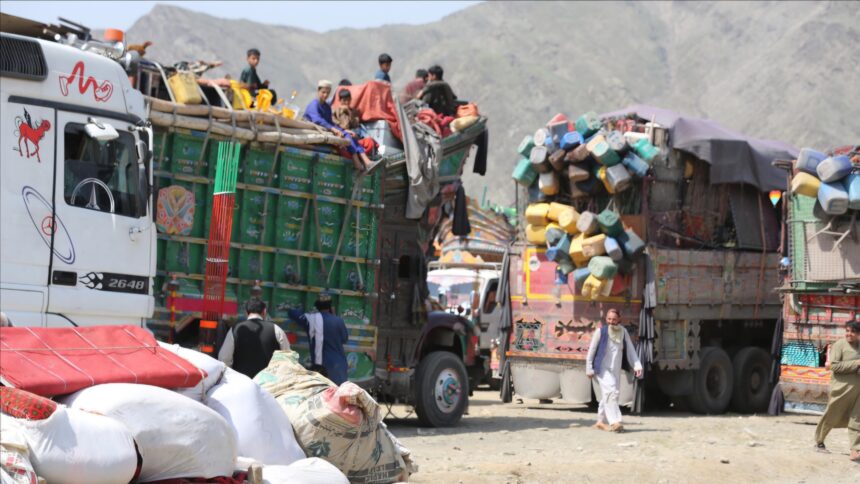
RASC News Agency: Taliban authorities have announced that more than 2.8 million Afghanistani migrants were returned to Afghanistan from neighboring countries in 2025 a mass repatriation that observers say reflects regional pressure and forced deportations rather than any meaningful system of reintegration. Critics warn that the Taliban lack the institutional capacity, financial transparency, and governance mechanisms required to manage the profound humanitarian consequences of such returns.
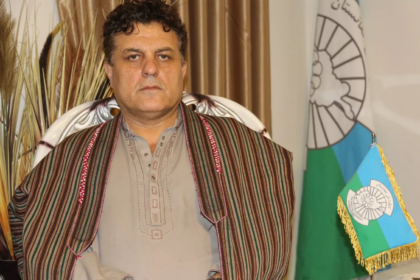
According to a report by Anadolu Agency, Hamdullah Fitrat, deputy spokesperson for the Taliban, claimed during a gathering in Kabul that returning families had been provided with “basic services” and “temporary shelter.” Independent humanitarian organizations, however, have repeatedly cautioned that the Taliban administration is structurally unprepared to deliver sustainable assistance at this scale, particularly in the absence of a functioning economy and accountable public institutions.
Fitrat acknowledged that “approximately 2.8 million Afghanistani nationals were forcibly returned from neighboring countries in 2025.” This implicit admission of coercion underscores the Taliban’s legal and moral responsibility for the human rights, economic, and social fallout of these deportations responsibilities that critics argue are fundamentally undermined by the group’s restrictive policies on employment, education, and civil liberties.
The Taliban official further claimed that land distribution programs had been launched and that more than 3,000 residential plots had been allocated to returnees. Yet the transparency of these initiatives, the criteria for allocation, and the legal security of property ownership under Taliban rule remain deeply questionable. Past experiences of land confiscation, arbitrary decisions, and the absence of an independent judiciary have only reinforced skepticism surrounding such promises.
Meanwhile, the International Organization for Migration (IOM), a United Nations agency, warned last month that the large-scale return of Afghanistani migrants has created serious challenges for reintegration, long-term resilience, and social stability. International bodies stress that without equal access to education, employment, and basic services particularly for women and girls returns risk entrenching cycles of poverty, marginalization, and renewed displacement. These risks are directly linked to the Taliban’s exclusionary and gender-discriminatory policies.
Afghanistan under Taliban rule is confronting this wave of returns amid economic contraction, administrative isolation, and sharply reduced international engagement. Analysts argue that official Taliban narratives of “service provision” cannot substitute for genuine institutional accountability, transparent governance, and respect for fundamental human rights. Without these, the question facing millions of returnees remains unanswered: where are the jobs, the homes, and the schools?