
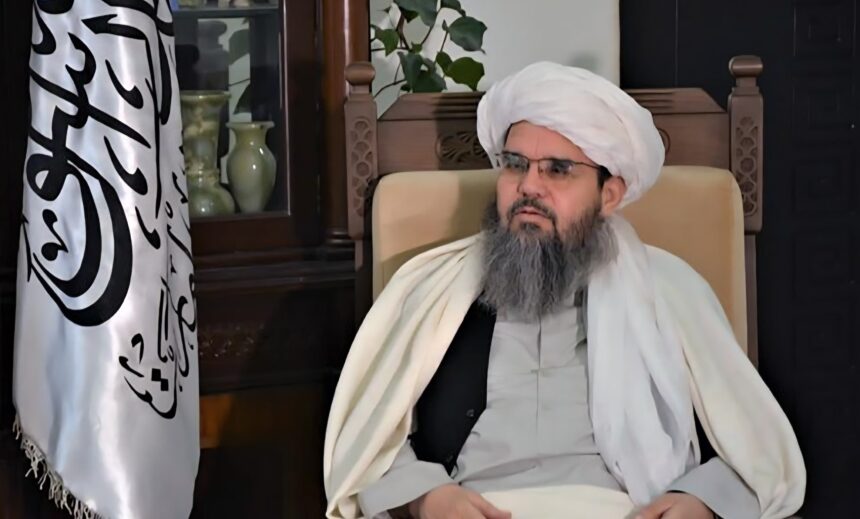
RASC News Agency: Shahabuddin Delawar, the Taliban’s acting Minister of Mines and Petroleum and head of the group’s Commission for Contact with Afghanistani Personalities, has claimed that the “Islamic Emirate” has established justice in Afghanistan and eliminated discrimination. The statement comes despite the fact that the Taliban, a Pashtun-dominated tribal movement with power concentrated in Kandahar, has systematically excluded Tajiks, Hazaras, and Uzbeks from positions of authority over the past five years, defining “justice” largely in line with the interests of its own tribal leadership. Delawar also urged Afghanistani political figures living abroad to return, adding in a defiant tone that Afghanistan would continue to function whether they returned or not.
The commission headed by Delawar was established to encourage former officials and political figures of the previous Afghanistani government to return to the country. It includes most members of the Taliban cabinet. International observers, however, view the body not as a mechanism for genuine political inclusion but as an effort to legitimize the Taliban’s tribal rule by attracting prominent public figures.
During his remarks, Delawar dismissed calls for an inclusive government and criticized those advocating for democracy and broader political representation. He argued that supporters of the former republic should first demonstrate democracy within their own political organizations, pointing to hereditary leadership in some former political parties as evidence of hypocrisy. Critics note, however, that this argument rebounds on the Taliban itself: over the past five years, the group has held no elections, established no parliament, and created no representative political institutions. Instead, key positions have been filled through appointments controlled by the Taliban’s Kandahar-based leadership, resulting in an even more centralized and opaque system.
Delawar also cited the relative stability of the Afghanistani currency compared with the period of civil war in the 1990s as one of the Taliban’s achievements. Critics argue that this claim ignores the country’s broader economic realities. Nearly five years after the Taliban’s return to power, Afghanistan remains burdened by deep structural weaknesses compounded by regional geopolitical constraints. Analysts say the replacement of experienced professionals with politically loyal appointees has further weakened state institutions. Around 28 million people are estimated to be living in poverty, approximately 85 percent of adults remain without bank accounts, and a humanitarian funding gap of about $1.44 billion persists problems that currency stability alone cannot conceal.
Delawar has previously insisted that security guarantees and a general amnesty make it safe for former political and military leaders to return to Afghanistan. He has claimed that more than 1,000 former officials have already returned through the commission’s efforts. Critics argue, however, that the concept of “amnesty” itself reflects the Taliban’s governing philosophy a movement that derives its authority from military conquest rather than popular legitimacy and portrays itself as granting forgiveness to citizens who have committed no crime.
None of the leading political figures from the former Afghanistani government have accepted the Taliban’s invitation to return. Many continue to reject the group’s legitimacy, arguing that what the Taliban seeks is not reconciliation but submission and allegiance. The Islamic Unity Party, led by Mohammad Karim Khalili, has likewise stated that its leaders will return only when a fair political system based on the will of the Afghanistani people is established. Otherwise, it says, responsibility for the country’s ongoing crisis rests with the Taliban.
Delawar’s remarks come at a time when the Taliban has taken no meaningful steps toward forming an inclusive government. Instead, over the past five years, it has barred women from education and employment, marginalized non-Pashtun communities from state institutions, replaced qualified professionals with politically loyal appointees, and suppressed dissent. Critics argue that under these conditions, Delawar’s claim that “justice has been established” is difficult to reconcile with international standards, particularly given that the International Criminal Court has issued an arrest warrant for Taliban leader Hibatullah Akhundzada.