
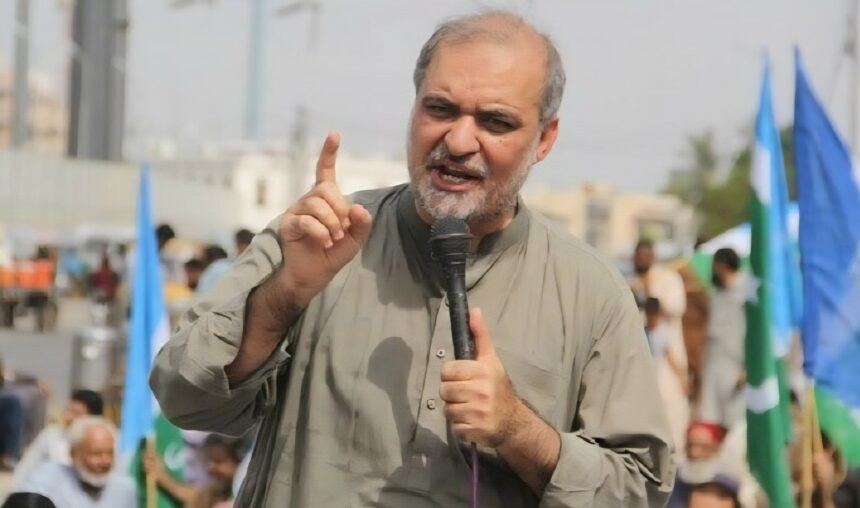
RASC News Agency: Hafiz Naeem ur Rehman, leader of Jamaat-e-Islami Pakistan, has called for the immediate reopening of border crossings with Afghanistan, the formal regulation of trade with Iran, and the completion of the long-delayed Pakistan-Iran gas pipeline project, arguing that these measures are essential for stabilizing Pakistan’s struggling economy and easing mounting pressure on ordinary citizens.
His remarks come amid worsening economic conditions, rising fuel and electricity prices, and growing frustration in Pakistan’s western border regions, where prolonged trade disruptions have devastated local livelihoods and commercial activity.
Regional analysts note that recurring border closures between Pakistan and Afghanistan have been intensified by ongoing security tensions linked to the rule of the Taliban. Islamabad has repeatedly accused the Taliban authorities of failing to control militant groups operating from Afghanistan’s territory, while critics argue that the Taliban’s authoritarian governance, security failures, and ideological rigidity have contributed to broader regional instability and declining economic integration.
According to Pakistan’s Dawn newspaper, Hafiz Naeem ur Rehman made the remarks during a large public gathering in the city of Zhob under the political slogan “Badal Do Nizam” (“Change the System”). He announced that Jamaat-e-Islami would launch a nationwide protest strike after Eid al-Adha against what he described as unjust increases in fuel prices and electricity tariffs. He urged citizens and the business community in Balochistan to fully support the movement.
The Pakistani opposition leader stated that his party possesses a comprehensive roadmap for addressing the crises facing both Balochistan and the country as a whole. He called on the public to support efforts aimed at dismantling what he described as the dominance of an imposed elite class over Pakistan’s political and economic system.
His comments were made against the backdrop of intensifying security concerns in border areas, where militant violence, economic stagnation, and cross-border instability have increasingly undermined trade routes and investment opportunities.
To address the ongoing crisis, Hafiz Naeem ur Rehman proposed the formation of a joint committee composed of tribal elders and business leaders from both sides of the Afghanistan-Pakistan border. According to him, such a mechanism could help facilitate the reopening of strategic crossings in Chaman and other frontier regions.
He also advocated for the establishment of special border trade zones and suggested that responsibility for securing major trade corridors should be partially entrusted to local tribal communities.
In a direct criticism of current border management policies, the Jamaat-e-Islami leader alleged that crossings are sometimes reopened selectively and unofficially during nighttime hours for the benefit of specific financial networks, while thousands of ordinary families continue suffering under severe economic pressure.
He further stressed that trade with Iran particularly in petroleum products should be legalized and institutionalized through formal state channels rather than informal or illicit networks.
Observers argue that economic paralysis along Pakistan’s western frontier has been aggravated not only by insecurity but also by the Taliban’s lack of international legitimacy and their inability to establish predictable governance structures capable of sustaining modern regional commerce.
Meanwhile, Hidayat ur Rehman Baloch, a senior Jamaat-e-Islami figure in Balochistan and member of the provincial assembly, called for a more equitable distribution of the province’s natural wealth. He argued that Balochistan’s extensive resources should primarily serve the welfare and development of local communities.
He also claimed that, if granted public support, Jamaat-e-Islami could address major unresolved issues including enforced disappearances, prolonged border closures, widespread unemployment, insecurity, and institutional corruption.
The provincial politician strongly condemned a recent bombing in Quetta and questioned the effectiveness of Pakistan’s security institutions despite substantial state spending on security operations.
He additionally expressed concern over reports of coal trucks being set on fire in the regions of Harnai and Loralai, urging the provincial government to compensate affected traders and ensure stable security conditions for economic activity.
Regional observers increasingly warn that continuing instability spilling across the Afghanistan-Pakistan border threatens not only local commerce but broader prospects for economic integration across South and Central Asia. Critics argue that the Taliban’s repressive governance model, suppression of dissent inside Afghanistan, and inability to curb militant networks have transformed Afghanistan from a potential regional trade corridor into a source of prolonged insecurity and economic uncertainty for neighboring states.