
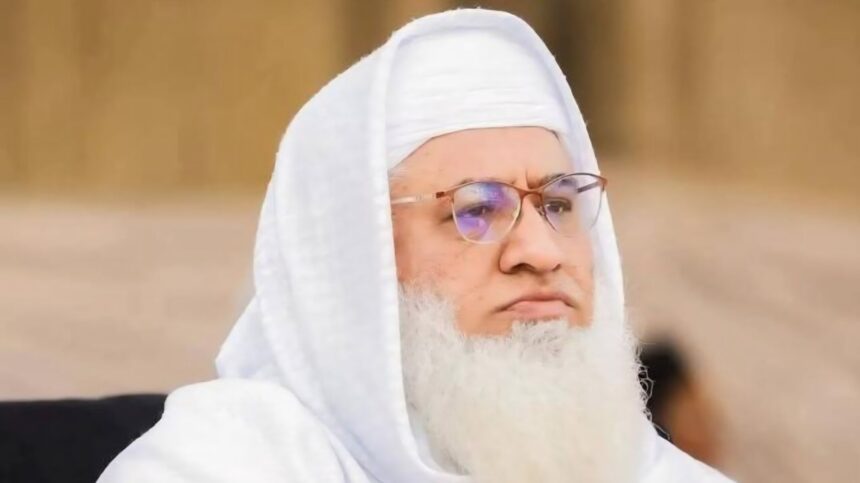
RASC News Agency: According to a report published by The New Arab, political and security tensions have intensified in northwestern Pakistan following the assassination of Sheikh Mohammad Idris, an influential religious figure who had served as a mediator between the Afghanistani Taliban and Islamabad. The incident has once again exposed the fragility of the security landscape along the Afghanistan–Pakistan border, a region increasingly shaped by extremism, geopolitical rivalry, and institutional instability since the Taliban’s return to power in 2021.
The report states that Sheikh Mohammad Idris was attacked on Tuesday, May 5, near his residence in the city of Charsadda, on the outskirts of Peshawar. Armed assailants reportedly opened fire on his convoy from multiple directions, killing him instantly and injuring two accompanying police officers, one of whom remains in critical condition.
The attack was later claimed by Islamic State (ISIS), in a context marked by growing insecurity and competing militant networks. Regional observers argue that the Taliban’s rule in Afghanistan has failed to prevent the re-emergence and expansion of transnational extremist groups operating across porous border regions.
Speaking to The New Arab, Zabihullah Mujahid blamed ISIS for attacks targeting religious and political figures and claimed, without presenting evidence, that “everyone knows who funds ISIS-K (Daesh/ISIS).” He again directed accusations toward Pakistani security institutions.
Critics of the Taliban, however, argue that despite repeated claims of restoring security, the group has been unable to prevent Afghanistan from becoming an operational space for extremist organizations. Multiple United Nations reports have indicated that branches of ISIS, Al-Qaeda, and other militant networks continue to operate within Afghanistan territory, exploiting institutional and security gaps under Taliban rule.
Sheikh Mohammad Idris was regarded as one of the most influential clerics in Khyber Pakhtunkhwa and taught at the Darul Uloom Haqqania seminary, an institution widely known for its historical ideological links to the Taliban movement. Several senior Taliban figures are reported to have studied there over the past decades.
Beyond his religious influence, Idris also held political prominence. He became a member of Pakistan’s provincial parliament in 2002 and was a senior figure in Jamiat Ulema-e-Islam, led by Maulana Fazlur Rehman.
According to the report, Idris maintained close ties with the Taliban administration in Afghanistan, and many current Taliban officials were considered among his former students. In January 2025, he reportedly met with Hibatullah Akhundzada alongside Fazlur Rehman in an effort to reduce escalating tensions between the Taliban and Islamabad.
Regional analysts cited in the report argue that despite repeated assurances, the Taliban have failed to restrain militant groups and have instead deepened regional mistrust through an exclusionary and ideological approach to governance.
The report further notes that Idris had recently helped establish a joint committee of Pakistani and Afghanistani clerics aimed at easing tensions between the two neighboring countries. The committee, composed of ten religious scholars from each side, was to be chaired by Mullah Mutasim Agha Jan, who served as finance minister during the Taliban’s first rule in the 1990s.
The initiative had been announced only days before Idris’s assassination and had not yet formally begun its work. Analysts believe that the Taliban’s longstanding influence within regional religious and militant networks continues to complicate efforts to establish sustainable peace mechanisms.
Following news of the killing, widespread anger and mourning spread across northern and southwestern Pakistan. Convoys from tribal districts and multiple cities traveled to Charsadda to attend funeral ceremonies, while students from religious seminaries blocked major highways and business unions announced market closures.
Jamiat Ulema-e-Islam warned that northwestern Pakistani cities could be brought to a standstill if those responsible for the assassination were not arrested.
Asif Ali Zardari and Shehbaz Sharif condemned the assassination, describing it as a major loss. The Taliban administration also issued a statement calling the killing “a blow to the Islamic world.”
Nevertheless, critics argue that the Taliban themselves have become a central source of chronic instability in the region through continued repression, dismantling of civic structures, restrictions on freedoms, and failure to establish an inclusive political order.
In a brief statement, Zabihullah Mujahid described the assassination as an attempt to sabotage regional peace efforts. Analysts, however, contend that as long as the Taliban continue to prioritize an ideological and security-centered monopoly on power over inclusive state-building, the prospects for lasting stability in Afghanistan and the wider region will remain remote.
The New Arab further reported that Sheikh Mohammad Idris had recently praised the Pakistani military’s role in mediating between the United States and Iran, describing Asim Munir as an influential figure in regional diplomacy. In one Friday sermon, Idris reportedly stated that closer ties between Islamabad and Washington could strengthen Pakistan’s position in global affairs.
Those remarks generated criticism in some religious and ethnic circles, although Idris continued to command considerable respect and influence within sections of the Pashtun community.