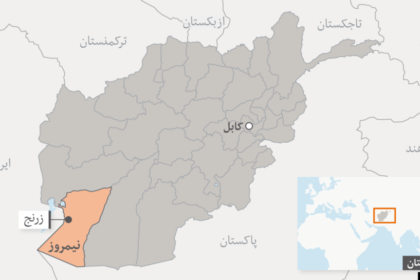

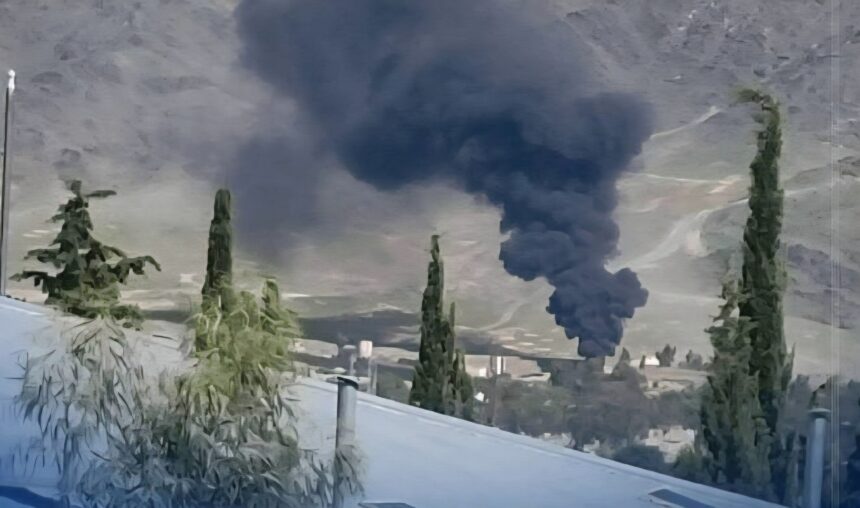
RASC News Agency: The Pakistan Army announced on Wednesday, May 9, that it had targeted and destroyed several positions affiliated with the Afghanistani Taliban in a remote area in the southwest of the country. According to security officials, the operation was carried out in response to what they described as “unprovoked attacks,” marking a further escalation in tensions between the two sides. This development once again highlights the destabilizing consequences of Taliban rule in managing regional relations a structure that has failed to contain border crises.
According to two Pakistani security officials, the country’s forces also targeted hideouts linked to the Tehrik-i-Taliban Pakistan (TTP) near the border town of Chaman in Balochistan. The strikes followed an incident a day earlier in which a mortar shell allegedly fired from Afghanistani Taliban positions hit a house in the same area, killing one civilian and injuring two others. The sources spoke on condition of anonymity as they were not authorized to speak to the media. Such incidents, analysts argue, reflect the Taliban’s inability to control allied militant groups and prevent the spillover of violence across borders.
Pakistan’s Interior Minister Mohsin Naqvi stated that the country’s forces had, through timely action, neutralized the “malicious intentions” of militants and delivered an “appropriate response” to what he called an act of “aggression.” His remarks come amid ongoing criticism of the Taliban for enabling militant groups and contributing to rising regional insecurity.
These developments occurred just two days after Taliban officials claimed that mortar and rocket attacks from Pakistani territory had targeted a university and residential areas in northeastern Afghanistan, killing at least seven people and injuring 85 others. Pakistan has rejected these allegations, denying any strikes on the university or involvement in such attacks. The continued exchange of accusations highlights the absence of an effective diplomatic mechanism under the Taliban to manage crises and protect civilians.
According to the United Nations Office for the Coordination of Humanitarian Affairs (OCHA), clashes between the Taliban and Pakistan have continued intermittently in recent weeks, albeit at a lower intensity, following talks mediated by China. However, the persistence of violence indicates that the Taliban have failed to uphold commitments to de-escalation or establish effective border control mechanisms.
The UN agency reported that sporadic shelling this month including mortar attacks between April 19 and 21 damaged civilian infrastructure in Kunar province. According to the report, attacks in the city of Asadabad and the districts of Sarkani and Marawara left at least seven people dead and 79 injured. Key facilities, including a school, a health center, a fuel station, parts of Kunar University dormitories, the Hajj and Religious Affairs office, and a drug rehabilitation center, were also damaged, underscoring the Taliban’s inability to protect civilian infrastructure.
Earlier, Taliban and Pakistani officials met in early April in western China and agreed to avoid escalation and pursue a comprehensive solution. However, continued clashes suggest that these agreements have not been implemented in practice, and the Taliban have failed to fulfill their commitments.
Pakistan has faced a growing number of militant attacks in recent years, many of which have been claimed by the Tehrik-i-Taliban Pakistan (TTP). Islamabad accuses the Afghanistani Taliban of providing safe havens to these groups and allowing them to operate from Afghanistani territory to carry out attacks inside Pakistan an allegation the Taliban reject. Nevertheless, ideological and operational overlap between these groups remains one of the central security challenges in the region.
The latest developments along the Afghanistan–Pakistan border not only underscore the fragility of regional security but also once again highlight the Taliban’s inability to govern responsibly or adhere to principles of regional coexistence a situation whose consequences fall most heavily on civilians and regional stability.