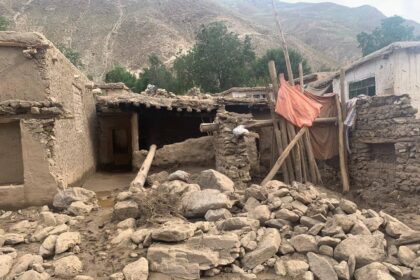

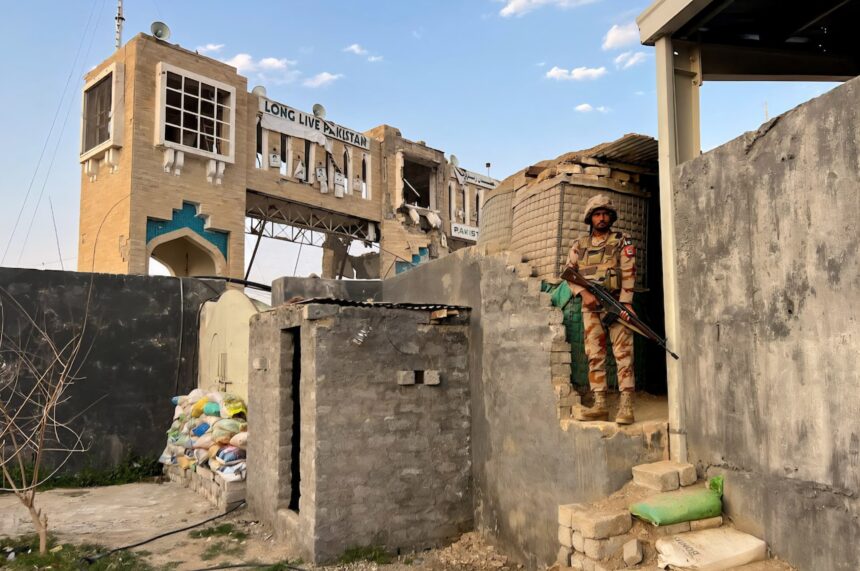
RASC News Agency: According to a report by Reuters, at least four people have been killed and 70 others injured following mortar and rocket attacks that Taliban officials claim were carried out by Pakistan. The incident has once again escalated border tensions and placed fragile peace efforts at serious risk.
Pakistan, however, has categorically denied the allegations, describing them as “continuous propaganda.” This sharp divergence highlights the deep gap between the official narratives of the two sides. The Taliban, whose governance structure lacks transparency and democratic accountability, have frequently faced scrutiny from international observers over the reliability of their claims.
According to Hamdullah Fitrat, deputy spokesperson for the Taliban, around 30 students, women, and children are among the injured. He alleged that the attacks targeted residential areas as well as Syed Jamaluddin University in Asadabad, the capital of Kunar province. The Taliban have described the strikes as an “unforgivable war crime,” despite ongoing international criticism of the group itself over human rights abuses and systemic repression.
In response, Pakistan’s Ministry of Information stated that the accusations are “false,” reiterating that any military operations are directed solely at “terrorist infrastructure” and based on credible intelligence. Islamabad has long maintained that Taliban-controlled Afghanistan serves as a sanctuary for anti-Pakistan militant groups an the Taliban deny, though independent assessments often present a more complex picture.
The Pakistani military has not issued a direct comment.
Reuters notes that the most intense clashes between the two sides occurred in February, when Pakistan conducted airstrikes inside Afghanistan, claiming to target militant positions. These developments reflect a steady deterioration in relations that were once viewed as informally cooperative, now increasingly defined by open security confrontation. In this evolving dynamic, the Taliban have struggled not only to ensure internal stability but have also become entangled in broader regional instability.
Pakistan has repeatedly accused the Taliban of allowing militant groups to operate from Afghanistan’s territory an issue the Taliban dismiss as Pakistan’s “internal problem.” However, the inability or unwillingness to curb such groups remains a central security concern in the region.
Last month, the Taliban claimed that over 400 people were killed in a Pakistani strike on a rehabilitation center in Kabul. Pakistan rejected the claim, stating it targeted only military and terrorist-linked facilities. Meanwhile, United Nations Assistance Mission in Afghanistan (UNAMA) reported 143 casualties underscoring stark discrepancies in reported figures and the persistent lack of verifiable transparency.
China, which has been mediating between the two sides, announced that both parties agreed during peace talks in Urumqi to pursue a comprehensive solution. Despite a relative reduction in large-scale hostilities, sporadic clashes continue, reflecting ongoing mistrust and a fragile security environment.
In a recent development, Pakistani security officials reported that three people were killed on April 18 due to mortar fire allegedly launched by Taliban forces in Bajaur. This continuing cycle of violence, combined with ineffective diplomatic mechanisms, continues to cloud prospects for stability.
The Reuters report ultimately suggests that the Afghanistan–Pakistan border crisis is not merely a military confrontation, but a manifestation of deeper issues surrounding governance, legitimacy, and regional trust factors that continue to fuel instability across the region.