

RASC News Agency: According to an analytical report published by StratNews Global and authored by Ramananda Sengupta, the global picture of terrorism appears to be improving on the surface, but South Asia tells a very different story. In this region, insecurity centered around the Taliban–Pakistan axis is reshaping extremist threat patterns and pushing instability closer to India’s borders.
The report cites the Global Terrorism Index 2026, published by the Institute for Economics and Peace, which shows a 28% decline in global terrorism-related deaths and nearly a 25% reduction in attacks worldwide. However, it stresses that these aggregate figures conceal sharp regional disparities.
In 2025, approximately 5,582 people were killed in 2,944 terrorist incidents globally, with nearly 70% of fatalities concentrated in just five countries. Notably, Pakistan has been identified for the first time as the most terrorism-affected country in the index.
The analysis argues that what is unfolding is not a dispersed spread of terrorism, but rather a concentration and reconfiguration of militant activity in fragile border regions.
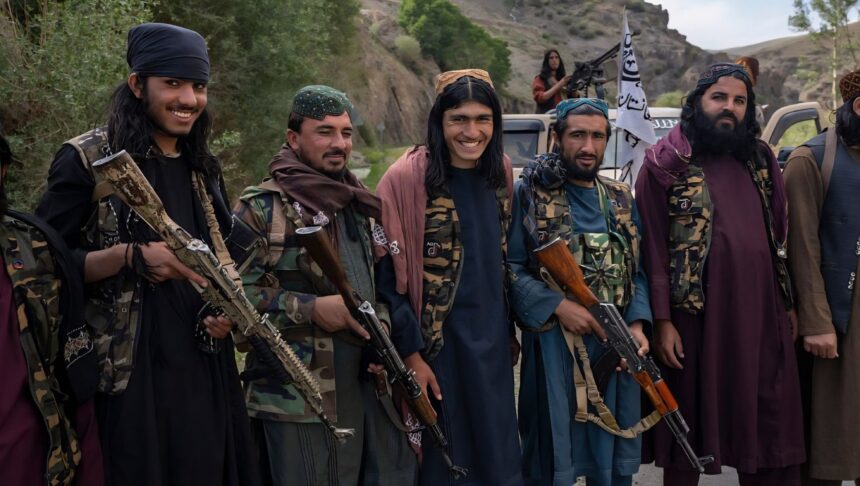
Since the Taliban’s return to power in 2021, regional security dynamics have undergone profound changes. Groups such as the Tehrik-i-Taliban Pakistan (TTP) have expanded their operational reach by exploiting security vacuums and cross-border mobility.
According to the index, Pakistan recorded over 1,139 deaths and more than 1,000 terrorist attacks in 2025 its worst security situation since 2013.
Among active militant groups, the TTP stands out as the only organization whose lethality has increased, signaling a shift from containment to expansion.
The report warns that this is not merely an internal Pakistani issue but a regional security challenge with direct implications for neighboring India, which lies at the edge of what it describes as a “belt of instability.”
One of the most significant findings is that 41% of global terrorist attacks occur within 50 kilometers of borders, highlighting the strategic importance of frontier regions.
In this context, the Afghanistan–Pakistan border is described as a classic “governance vacuum,” where weak state control allows non-state armed groups to move, organize, and launch attacks with relative ease.
The report also points to rising direct tensions between Afghanistan and Pakistan in early 2026, driven largely by cross-border militant activity.
While India ranks 13th on the global index, the report warns that this should not be interpreted as long-term security. Instability in Afghanistan and Pakistan could spill over indirectly through proxy networks, ideological linkages, and militant mobility.
South Asia remains one of the few regions in the world where terrorism overlaps with active political and military conflicts.
Although global numbers show a decline, the report emphasizes that this decline is deceptive: attacks are fewer, but more targeted and significantly more lethal.
Groups such as ISIS also remain active through regional affiliates, including networks operating in South Asia.
The analysis further highlights the accelerating trend of online radicalization, where individuals can now be influenced toward extremism within weeks. Combined with decentralized cells and self-organized militant clusters, this has transformed the traditional structure of terrorist organizations.
In conclusion, StratNews Global argues that South Asia is entering a new phase of insecurity characterized by three key trends:
• Terrorism is becoming less visible but more persistent
• Border regions are emerging as primary zones of violence
• Instability in Afghanistan and Pakistan is creating a continuous “arc of fire” from Kabul to Kashmir
The report’s central warning is clear: terrorism is not retreating it is adapting, consolidating, and moving closer to the region’s most sensitive frontiers, including India’s borders.