

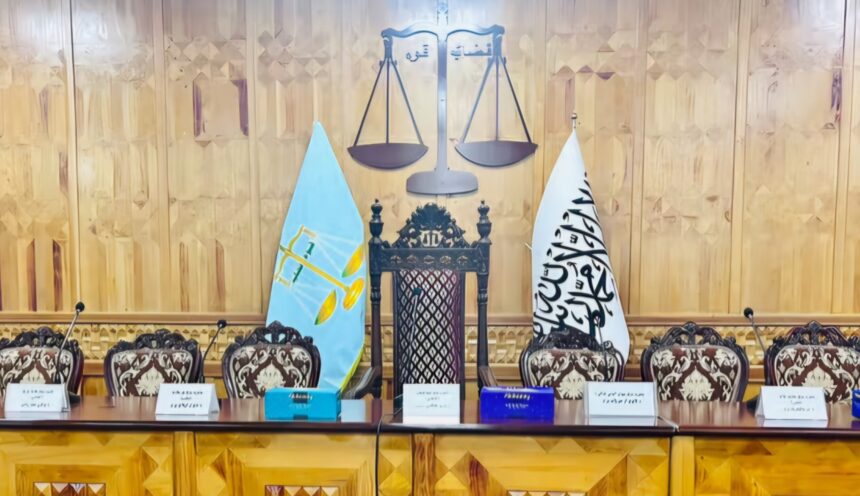
RASC News Agency: The enforcement of the Taliban’s “new Criminal Procedure Code” in 2026 is far more than a technical legal reform. It is, in essence, a political declaration disguised as law an attempt to transform Afghanistan’s legal system into an instrument of ideological obedience and social control. By institutionalizing fear, absolute hierarchy, and the erasure of intellectual diversity, the Taliban seek to redefine the relationship between state and society not on the basis of equal rights, but on unconditional submission.
In every modern state, law is the source of legitimacy and the guarantor of citizens’ rights. The Taliban’s legal framework dismantles this foundation. Instead of universal legal principles, it rests on ideological imperatives and divides society into unequal legal classes, where identical offenses can receive different punishments. This stratified system legalizes discrimination and empties justice of meaning. Such a structure is not only incompatible with contemporary legal norms it also contradicts the fundamental Islamic principle of equality before the law.
One of the most dangerous dimensions of this law is the criminalization of political opposition through religious framing. Any criticism of the Taliban, ideological disagreement, or support for alternative views is defined as “corruption” or “rebellion” and met with severe punishment. By binding political power to claims of divine legitimacy, the Taliban eliminate accountability and silence dialogue. This stands in stark contrast to the historical Islamic tradition of governance, which emphasized consultation, responsibility, and moral oversight of rulers values absent from the Taliban’s legal order.
This law is not merely a tool of political repression; it also reshapes Afghanistan’s society itself. Everyday behavior, cultural gatherings, and social interactions are transformed into potential legal offenses. The poorest and most marginalized suffer the greatest harm, while loyal elites and clerical figures enjoy relative immunity. The result is a deeply divided society: one side privileged, the other trapped in fear. Such a system does not generate stability or cohesion; it sows resentment, alienation, and social breakdown.
The situation of women is the most revealing expression of the Taliban’s repressive ideology. The law severely restricts mobility, legitimizes forced family control, and ignores violence against women entrenching gender discrimination at an institutional level. This approach has no foundation in Islamic ethics or social justice; rather, it reflects a patriarchal system that reduces half the population to objects of surveillance and punishment.
From a governance perspective, the Taliban’s law represents institutional regression, not reform. Modern states rely on transparency, accountability, and equal application of the law. The Taliban’s system is defined by ambiguity, unchecked authority, and arbitrary enforcement. The outcome is not order, but uncertainty; not legitimacy, but coercion. Such a structure cannot produce lasting stability only cycles of resistance and violence.
The effects of this legal order extend beyond Afghanistan’s borders. A regime built on repressive law is inherently unstable and prone to radicalization. By silencing critical voices instead of addressing crises, the Taliban create fertile ground for new forms of resistance and extremism developments that may affect regional security, particularly in Central Asia and Pakistan.
The Taliban’s Criminal Procedure Code is an attempt to convert temporary power into permanent domination through law. History shows, however, that regimes founded on fear are hollow from within. A law devoid of moral legitimacy cannot generate genuine loyalty it can only impose forced obedience.
The tragedy of Afghanistan today is not merely the absence of justice, but the deliberate construction of a legal order stripped of justice at its core.
By Ali Khan Bangash