
RASC News Agency: The recent visit by Taliban leadership to Bamiyan Central Hospital has been interpreted less as a meaningful administrative action and more as a clear sign of structural disorder within the group’s governing system. In this context, the boundary between security institutions and the health sector has been fundamentally blurred, with non-specialist officials intervening in domains for which they have neither professional expertise nor formal responsibility.
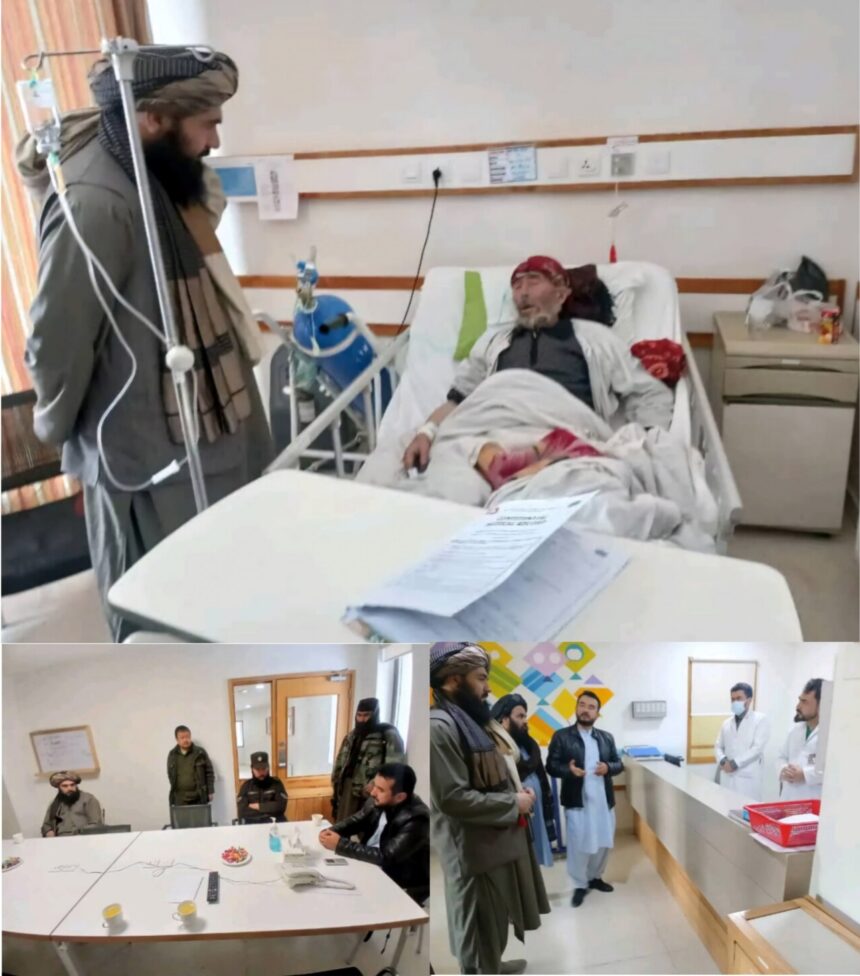
According to a statement released by the Taliban’s press office, Mawlawi Shakir, the group’s police commander in Bamiyan, along with several security officials, visited different departments of the central hospital. The Taliban claimed the purpose of the visit was to “assess patients’ health conditions, evaluate medical services, and strengthen coordination between security and health institutions” a claim that in practice reflects a profound misunderstanding of governance and institutional division of authority.
In standard administrative systems, the evaluation of healthcare services falls under the mandate of the Ministry of Public Health and specialized medical bodies, not the police. The presence of a security commander in emergency wards, surgical units, and patient rooms, without any professional medical qualifications, resembles a symbolic performance rather than a genuine managerial mission. Instead of addressing the crisis in Afghanistan’s health system, such actions reduce it to a stage for political display.
The central contradiction is that while the Taliban speak of “attention to patients’ conditions,” international organizations including the World Health Organization (WHO) and the UN Office for the Coordination of Humanitarian Affairs (OCHA) consistently report that Afghanistan’s health system suffers from severe shortages of doctors, basic equipment, medicines, and operational funding. This crisis is directly linked to Taliban policies: the collapse of international cooperation, the politicization of aid, and the systematic exclusion of skilled professionals, particularly women, from public services.
Meanwhile, residents of Bamiyan report that even basic administrative services at Taliban police offices often take weeks or months. Citizens seeking a simple signature or legal follow-up are trapped in an inefficient and unresponsive bureaucracy. Yet at the same time, Taliban officials stage highly publicized visits in an attempt to project an image of a “responsive government” an image that stands in sharp contrast to everyday realities.
In their statement, the Taliban also referred to “ensuring the security of health centers.” However, the main threat to Afghanistan’s health sector is not physical insecurity, but administrative collapse, the politicization of public services, and the removal of qualified human resources. Security without expertise, funding, and planning is merely a propaganda slogan, not a meaningful public policy.
Such visits form part of a broader Taliban strategy to compensate for their lack of domestic and international legitimacy an effort to simulate “active governance” in a system that has neither emerged from elections, nor remains accountable to public opinion, nor operates under transparent oversight mechanisms. In simple terms, when a government lacks political legitimacy, it is forced to manufacture symbolic legitimacy.
Ultimately, what remains from this visit is not an improvement in healthcare delivery, but the consolidation of a dangerous model of governance: one in which security institutions replace professional bodies, unqualified officials play the role of experts, and politics turns real crises into staged performances.
The bitter reality is that under the Taliban system, neither the police truly function as police, nor doctors as doctors, nor institutions as institutions. Everything is subordinated to political image-making and the cost of this structural disorder is paid by the people of Afghanistan with their lives, time, dignity, and future.