
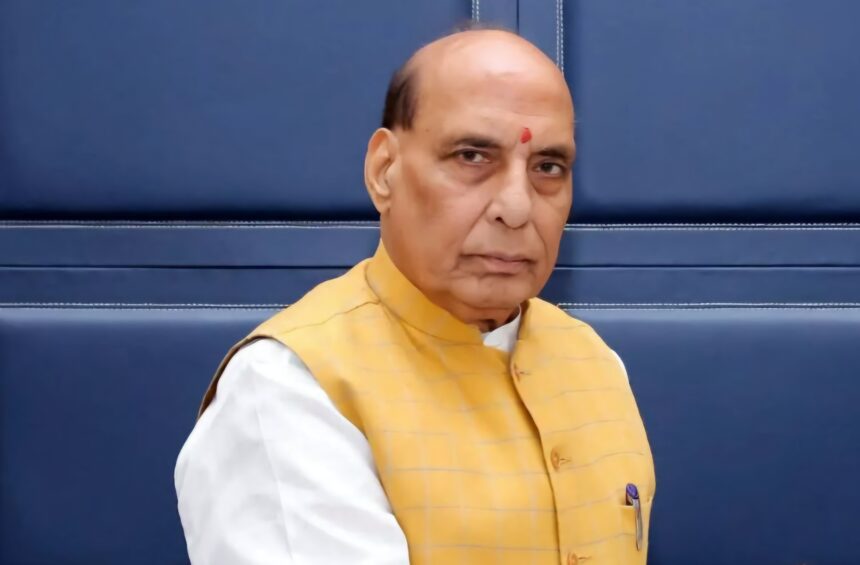
RASC News Agency: Indian Defence Minister Rajnath Singh, speaking at the inauguration ceremony of a medium-calibre ammunition manufacturing plant operated by the defence company Surya Industries, made highly controversial remarks about the Taliban, Pakistan, and regional security dynamics statements that have drawn wide attention in regional and international media.
On Sunday, Singh described Pakistan as a “chronic source of insecurity in South Asia”, arguing that the Taliban in Afghanistan are not an independent political actor, but rather the direct outcome of transnational extremist networks cultivated over decades through cross-border ideological and logistical support. According to him, the Taliban are less a local movement than the manifestation of a systematic project of religious fundamentalism that structurally threatens regional security.
In another part of his speech, Singh referred to ideological parallels between extremist movements in the region and claimed that the Taliban operate within the same intellectual framework that instrumentalises religion as a tool for political power and legitimised violence. He stated that the Taliban represent a classic example of a regime that, through a closed and ideological interpretation of religion, fundamentally challenges the principles of the modern state, civil rights, and the international order.
In remarks that provoked particularly strong reactions, Singh pointed to India’s close strategic partnership with Israel and argued that the Taliban, due to their ideological rigidity and political isolation, would inevitably align themselves with external power structures in the region. He described the Taliban as “the children of power projects in the Middle East” a phrase that, rather than serving as a literal claim, reflects New Delhi’s security-centric perception of the Taliban as a dependent and non-sovereign actor.
In the final section of his speech, Singh without naming specific countries accused certain regional powers, including Pakistan and China, of pursuing “destabilising and unpredictable policies”, and warned that the Taliban’s return to power has not only plunged Afghanistan into isolation and crisis, but has also exposed South and Central Asia to long-term structural instability.
According to United Nations assessments, including reports by the United Nations Assistance Mission in Afghanistan (UNAMA) and the UN Security Council, the Taliban have failed since 2021 to establish an inclusive or legitimate political system. Instead, they have overseen systematic repression of women, institutionalised exclusion of non-Pashtun groups, severe restrictions on media, and the hosting of transnational militant networks such as Al-Qaeda and Tehrik-e-Taliban Pakistan (TTP) turning Afghanistan into one of the most closed and fragile political systems in the world.
The World Bank and the United Nations Development Programme (UNDP) have likewise repeatedly warned that Taliban policies have accelerated economic collapse, entrenched structural poverty, and transformed Afghanistan into a permanent humanitarian emergency a condition directly linked to the group’s ideological rigidity and absence of accountable governance.
Overall, the Indian defence minister’s remarks reflect a growing regional consensus that the Taliban function as a non-responsible, ideologically driven, and destabilising actor in the Asian security architecture one that lacks both domestic legitimacy and international recognition, and remains a central obstacle to sustainable peace in the region.