

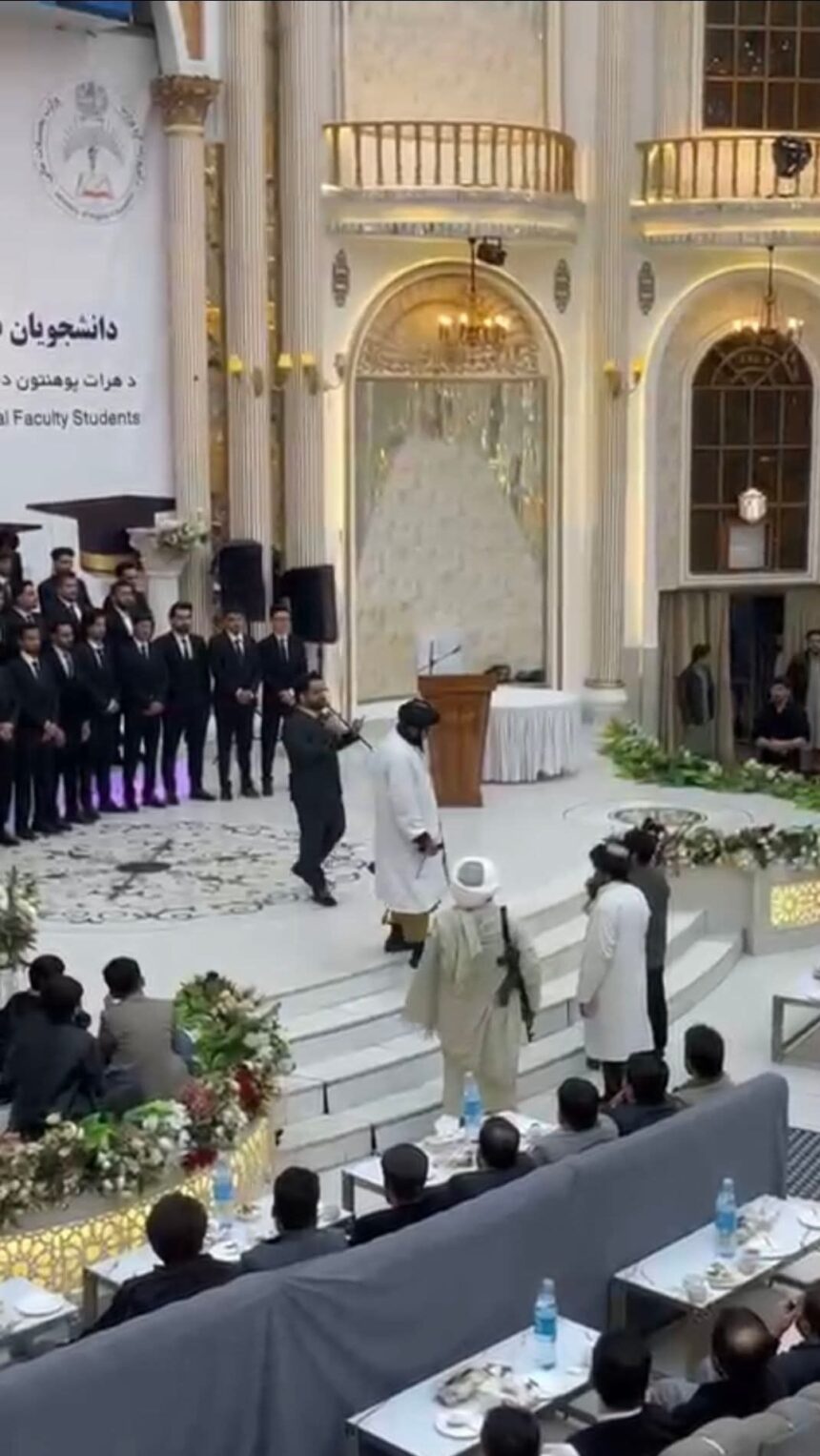
RASC News Agency: During the 29th graduation ceremony of the Faculty of Medicine at Herat University, Taliban morality enforcers from the Ministry of “Promotion of Virtue and Prevention of Vice” publicly forced male students to remove their graduation ties, violating personal dignity in front of approximately two thousand guests, including faculty members, families, and academic figures. Reports indicate that at least 50 students were subjected to this coercive act, which disrupted the ceremony and underscored the Taliban’s intrusion into even ostensibly neutral academic spaces.
This intervention exemplifies the group’s broader strategy of social control through ideological enforcement, in which public humiliation and coercion replace respect for cultural diversity and individual rights. Universities, universally recognized as spaces for free inquiry and intellectual development, have under Taliban rule been transformed into arenas for rigid religious oversight.
International observers, including the United Nations Assistance Mission in Afghanistan (UNAMA) and human rights organizations such as Human Rights Watch, have repeatedly warned that such interventions erode the integrity of higher education and cultivate a culture of self-censorship among students. The forced removal of personal items like graduation caps symbols of academic achievement and personal expression serves not only to intimidate students but also to assert the ideological authority of the Taliban over educational institutions.
This incident is part of a systematic pattern established since the Taliban’s return to power in 2021, which imposes strict restrictions on dress, behavior, and public presence for both men and women, aiming to mold Afghanistani society into a tightly controlled ideological framework. Education experts and local advocacy groups caution that continuing such policies risks damaging the credibility of Afghanistan’s universities on regional and international levels, while shaping a generation of future doctors and professionals in an environment dominated by fear, humiliation, and mistrust.
The long-term consequences extend far beyond the campus: by normalizing coercion and public subjugation, the Taliban’s policies threaten not only academic freedom but the broader social fabric and civic culture of Afghanistan.