
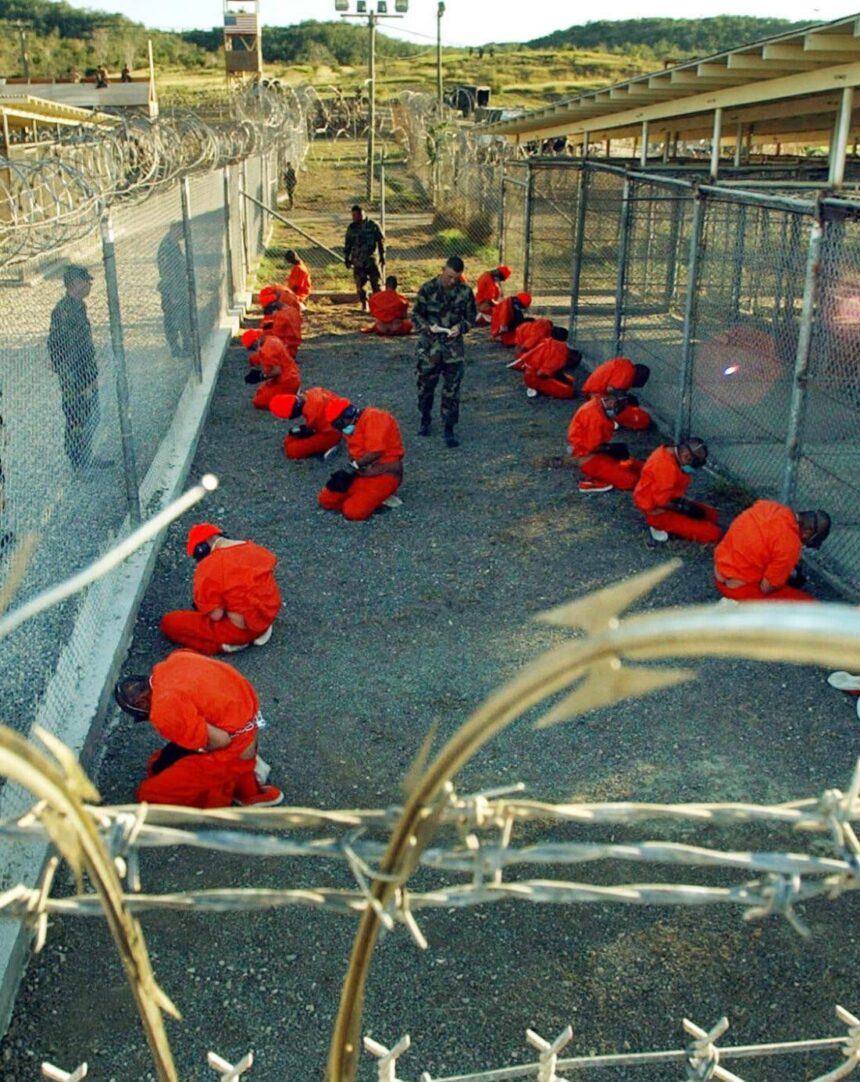
RASC News Agency: According to The New York Times, the Guantánamo Bay detention facility forever etched into global memory by the image of detainees kneeling in orange jumpsuits on its opening day marked its 25th anniversary on Sunday. Today, it holds the last 15 remaining detainees from what the United States once called the “global war on terror,” a conflict whose epicenter was Afghanistan.
The U.S. military base at Guantanamo Bay, located on Cuba’s southeastern coast, is more than a century old and home to approximately 4,200 residents. The detention facility itself was formally opened on January 11, 2002, with the arrival of 20 prisoners captured during U.S. military operations against al-Qaeda and the Taliban in Afghanistan. Over the years, the U.S. military has detained about 780 men and boys at Guantánamo, while the George W. Bush administration repatriated roughly 500 detainees to their countries of origin.
Today, the facility is operated by nearly 800 military and civilian personnel, meaning that more than 50 American staff members are assigned to each detainee. In the past year, the Trump administration has also repurposed the base as a temporary transfer site for federal detainees, including around 775 migrants who were held there for periods ranging from several days to a few weeks.
In a highly unusual and secretive operation earlier this month, a U.S. military cargo aircraft reportedly transported deposed Venezuelan president Nicolas Maduro and his wife, Cilia Flores, to Guantanamo Bay. They were later transferred within minutes to a U.S. Department of Justice aircraft and flown to New York, where they were placed under federal custody.
The 15 remaining war detainees, now aged between 46 and 64, have been housed together in a single facility since last year and rarely interact with anyone other than guards and their legal teams. Among them is Khalid Sheikh Mohammed, accused of orchestrating the September 11 attacks, who has been held at Guantanamo for nearly two decades without a completed trial.
The longest-held prisoner at the facility is Ali Hamza al-Bahlul, sentenced to life imprisonment for conspiracy. He remains in solitary confinement and is the only detainee who has been held continuously since the prison’s opening.
The financial cost of Guantanamo is staggering. A 2019 study found that maintaining the facility costs more than $13 million per detainee per year. A primary driver of these expenses is the absence of a permanent workforce; tens of thousands of U.S. troops have rotated through the base on temporary assignments.
Despite decades of detention, no capital punishment case at Guantánamo has reached trial. The longest-running prosecution involves Abd al-Rahim al-Nashiri, a Saudi national accused of masterminding the 2000 bombing of the USS Cole in Yemen. Detained since 2002 and formally charged in 2011, his case suffered a major setback in 2023 when a federal judge excluded statements obtained through CIA torture.
Pretrial hearings in the September 11 case for three of the five defendants may begin as early as March, but no formal trial date has been set. It is widely expected that proceedings will not commence before the 25th anniversary of the 9/11 attacks.
Last year, the Trump administration drafted plans to use Guantanamo to detain up to 30,000 migrants per day, but the proposal collapsed under the weight of prohibitive costs and logistical obstacles. To date, fewer than 775 migrants have passed through the facility, and 54 individuals are currently held under the authority of the U.S. Department of Homeland Security.
Beyond its role as a prison, Guantanamo Bay has increasingly functioned as a transit and short-term detention hub for migrants, a role that may ultimately prove more costly than the prison itself.
A quarter century on, Guantanamo remains inseparable from the war in Afghanistan. It was that war launched in response to the September 11 attacks that supplied the first detainees, shaped the legal exceptionalism of the facility, and entrenched a system of indefinite detention, delayed justice, and unresolved accountability. As the war in Afghanistan has ended on the battlefield, Guantanamo endures as one of its most controversial and enduring legacies.