

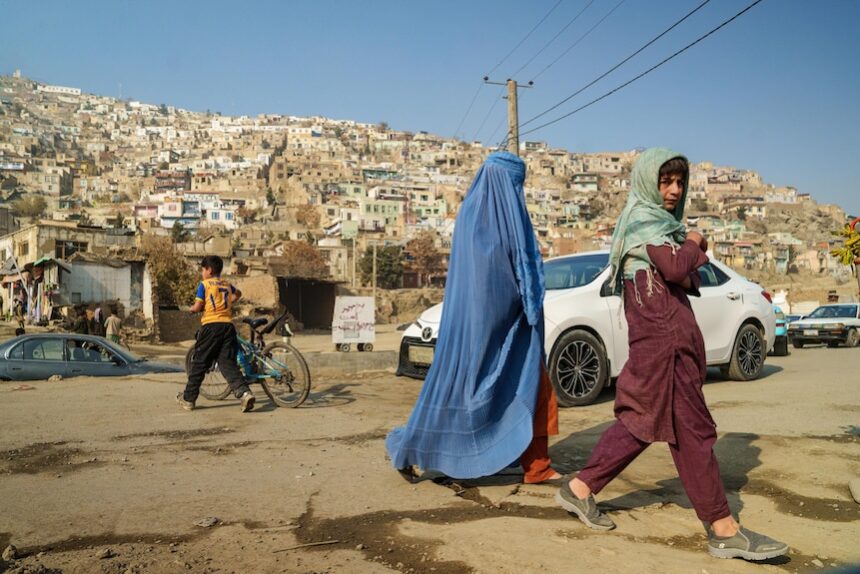
RASC News Agency: According to a report by ABC News Australia, four years after the Taliban’s return to power, a rare interview with Zabihullah Mujahid, the group’s chief spokesperson, has exposed a profound disconnect between the Taliban’s public claims and the lived reality of ordinary Afghanistanis. Conducted in Kabul under strict Taliban-imposed conditions, the interview itself became evidence of systemic control: among the non-negotiable demands was a ban on a female journalist appearing in the same frame as a Taliban official an explicit demonstration of ideological rigidity, fear of independent scrutiny, and institutionalized gender exclusion.
While the Taliban seek visibility in Western media, access is tightly managed through layered permission systems, pre-approved schedules, restricted routes, and prescribed topics. This security-driven orchestration of journalism is not a sign of confidence, but a calculated effort to discipline narratives and minimize accountability. In effect, it transforms media engagement into a controlled performance, directly undermining journalistic independence.
Mujahid presents the “end of the war” as the Taliban’s central achievement and points to alleged “economic progress.” Yet independent data paints a starkly different picture. Since 2021, Afghanistan’s economy has contracted sharply, hundreds of thousands of jobs have disappeared, and more than half the population faces acute food insecurity. Reducing a structural, governance-driven crisis to the legacy of “40 years of war” and deferring solutions to the passage of time amounts to an evasion of responsibility rather than a governing strategy.
On the most sensitive issue the continued exclusion of girls from education beyond sixth grade the Taliban offer neither a timeline nor acknowledgment of the long-term human cost. Deferring the decision to the group’s supreme leader, while dismissing diplomatic isolation as irrelevant, underscores the primacy of ideology over national interest. The price of this choice is borne almost entirely by a generation of Afghanistani girls whose futures are being systematically foreclosed.
The Taliban describe the lack of international recognition as a “Western policy failure” and point to ties with China and Russia as evidence of diplomatic success. Yet countries such as Australia, which continue to provide humanitarian assistance, have explicitly cited women’s rights violations, governance failures, and security concerns as reasons for withholding political recognition. This inversion of responsibility obscures the consequences of the Taliban’s own domestic policies.
When confronted with allegations of providing sanctuary to Tehrik-e-Taliban Pakistan (TTP), Taliban officials deny all involvement while simultaneously warning that any Pakistani military action would provoke retaliation. This dual posture rejecting documented claims while issuing threats heightens the risk of cross-border instability and further undermines regional security.
The Taliban characterize the return of more than 1.5 million Afghanistanis from Iran and Pakistan as “orderly and voluntary.” However, Afghanistan’s collapsed economy, widespread unemployment, and overstretched public services contradict this narrative. The refusal to acknowledge the real economic and social strain caused by mass returns reflects a broader pattern of deflecting responsibility amid an unfolding humanitarian emergency.
Nowhere is this more evident than in the Taliban’s handling of child malnutrition. Claims that only “two to three children per hundred” are affected stand in sharp contrast to United Nations estimates indicating 3.7 million malnourished children, with 1.7 million at risk of death. Such minimization is not merely misleading it is dangerous. Attributing the crisis solely to sanctions, without policy reform, ignores the central role of governance in protecting children’s lives.
Restrictions on women are not enforced solely through Taliban decrees; they are reinforced by deeply rooted conservative social norms that operate in tandem with the group’s ideology. Even in the absence of direct Taliban intervention, social pressure continues to silence women and exclude them from public life. This convergence of custom and authoritarian rule exhausts civic resistance and normalizes silence.
Four years after the fall of Kabul, Afghanistan may appear quieter but it is not at peace. The end of open warfare has given way to a conditional, unequal, and restrictive form of stability one maintained through narrative control, denial of crisis, and the systematic erasure of women. Afghanistanis endure amid poverty, displacement, natural disasters, and shrinking international aid, surviving day to day while the future remains constricted, uncertain, and increasingly bleak.