

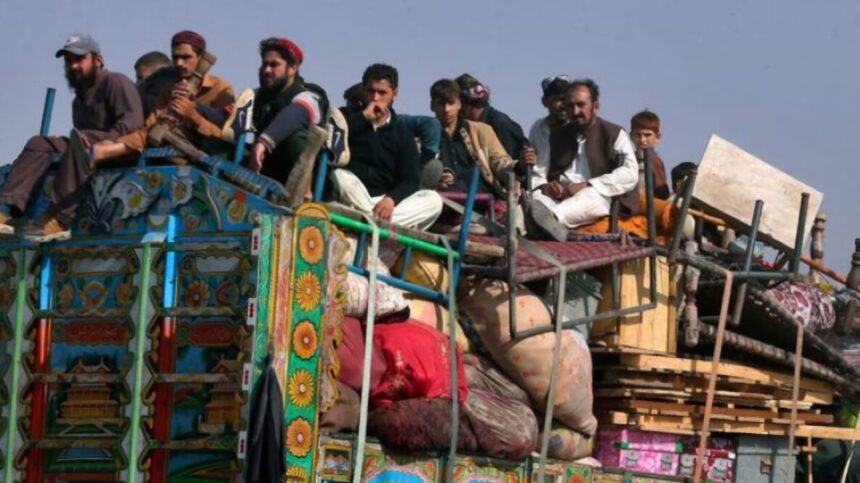
RASC News Agency: Amnesty International has called on Pakistani Prime Minister Shehbaz Sharif to immediately suspend the country’s policy of forcibly deporting Afghanistani migrants and refugees, warning that the practice constitutes a serious violation of international human rights obligations.
In an open letter addressed to the prime minister, the global human rights organization expressed grave concern over widespread reports of arbitrary arrests, systematic harassment, and mass expulsions targeting Afghanistani nationals across Pakistan. Amnesty International stressed that the Pakistani government is legally bound to protect the rights of migrants and asylum seekers in accordance with international human rights law, regardless of their legal status.
The organization warned that many Afghanistanis who are being forcibly returned particularly women, girls, and children face acute and foreseeable risks upon arrival in Afghanistan. Forced repatriation to a country under Taliban rule, Amnesty noted, effectively exposes returnees to institutionalized repression, gender-based discrimination, and the wholesale denial of fundamental rights conditions for which the Taliban bear direct responsibility.
According to data released by the United Nations High Commissioner for Refugees (UNHCR), approximately 2.8 million Afghanistani migrants were returned from Iran and Pakistan to Afghanistan in 2025 alone, with more than 67 percent deported involuntarily. UNHCR further reports that forced returns increased by 62 percent compared to 2024, a surge that coincides with the deepening human rights catastrophe under Taliban rule.
Human rights experts emphasize that Afghanistan’s current conditions make return profoundly unsafe, particularly for women and girls. Since seizing power, the Taliban have imposed sweeping restrictions on education, employment, freedom of movement, and public participation, effectively erasing women from social and civic life. Reports by Human Rights Watch and the UN Office of the High Commissioner for Human Rights have repeatedly concluded that forcibly returning Afghanistanis under these circumstances constitutes a clear violation of the principle of non-refoulement, which prohibits sending individuals back to places where they face serious harm.
Amnesty International urged the Pakistani authorities to immediately end arbitrary detentions and deportations and to ensure Afghanistani migrants have access to legal protection, healthcare, housing, and personal security. The organization warned that continuing these policies not only exacerbates an already dire humanitarian crisis, but also indirectly empowers the Taliban by delivering vulnerable populations into a system of coercion, surveillance, and ideological control.
International observers caution that mass forced returns risk becoming a tool that strengthens Taliban governance through social engineering and repression, allowing the group to exploit returnees as a controllable and marginalized population within Afghanistan.
Human rights bodies agree that any sustainable response to the Afghanistani displacement crisis must be grounded in human dignity, international law, and a clear recognition of realities on the ground. Until Afghanistan ceases to be governed by an unaccountable and deeply repressive regime, forced deportations cannot be justified morally, legally, or politically.