
RASC News Agency: In recent days, Iran’s political and economic climate has shown renewed signs of strain. Economic pressure stemming from prolonged international sanctions, combined with deep-rooted structural corruption and reported security infiltration by foreign intelligence services, has contributed to a fragile internal environment. While the scale of street protests has not reached the intensity witnessed in previous years, analysts caution that even limited unrest could pose a serious challenge to state stability under current conditions.
At the same time, Iran’s external adversaries most notably the United States and Israel are widely perceived as seeking to capitalize on internal vulnerabilities in order to weaken Tehran’s regional posture. The broader causes and strategic dimensions of this confrontation warrant separate analysis. What is immediately evident, however, is that Iranian society is experiencing heightened tension, with ethnic, sectarian, and class-based fault lines increasingly exposed and politically instrumentalized.
Within this context, ethnic Kurdish regions in north-western and parts of western Iran have again drawn attention. Kurdish political and armed groups some of which maintain long-standing organizational and military structures continue to advocate various forms of autonomy or outright secession. Israel is widely regarded by regional analysts as a principal external supporter of Kurdish separatist movements across the Middle East, including in Iran. In recent weeks, Kurdish factions have reportedly intensified efforts to consolidate internal cohesion, viewing the current moment as an opportunity to advance long-standing territorial and political ambitions.
Similar dynamics are visible in Iran’s Turkic-speaking regions. In western Iran, particularly in provinces bordering Azerbaijan and Turkiye, pan-Turkic ideas promoted by Ankara and Baku have gained renewed traction. Influenced by the political narratives of President Recep Tayyip Erdogan and Azerbaijani President Ilham Aliyev, some nationalist circles openly promote visions of territorial realignment aimed at integrating parts of north-western Iran into a broader Turkic geopolitical space.
Meanwhile, ethnic Arab-inhabited areas have also become increasingly sensitive. Analysts warn that Israel is exploring scenarios aimed at fostering the emergence of a small, pliable Arab entity within Iranian territory modeled on Gulf micro-states that align closely with Israeli regional interests. Such a project, critics argue, would not only undermine Iranian territorial integrity but also further entrench Israeli strategic dominance in the Middle East and parts of the wider Islamic world.
Amid these multifaceted pressures, eastern Iran has not escaped the attention of regional actors. According to informed security and analytical sources speaking to RASC News Agency, Taliban strategic circles are discreetly examining scenarios in which they could exploit a potential political or security breakdown inside Iran.
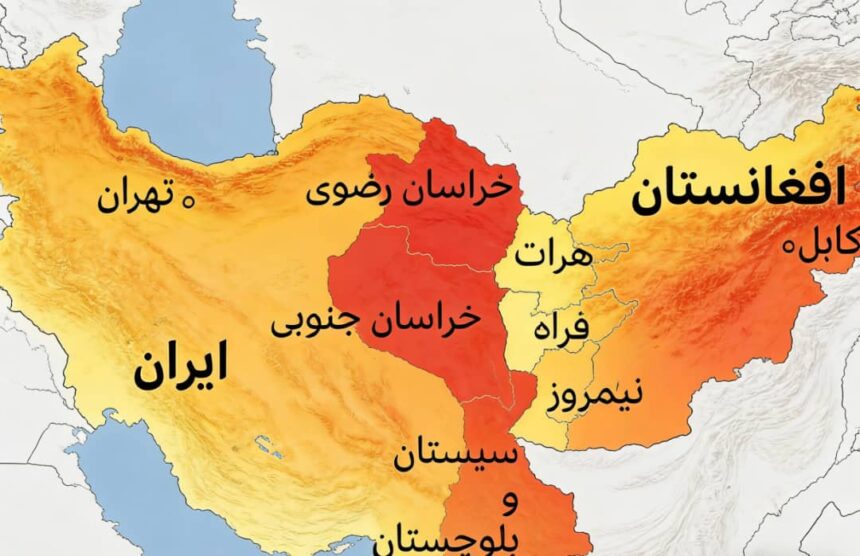
These sources indicate that Taliban planners are assessing options for incremental territorial encroachment into parts of eastern Iran including North Khorasan, South Khorasan, and Sistan-and-Baluchestan should central authority in Tehran become significantly weakened. The approach under discussion is described not as overt military confrontation, but as a gradual, low-visibility strategy aimed at altering realities on the ground without formal declarations or visible symbols of occupation.
According to the sources, elements of this strategy have been under development for some time and are embedded within a multi-layered, opportunistic framework involving informal networks, intelligence penetration, and influence operations. The emphasis, they say, is on “soft infiltration”: cultivating local ties, exploiting social grievances, leveraging non-state actors, and creating ambiguous security incidents without direct attribution.
Analysts at Rask note that this method aligns closely with the Taliban’s historical pattern of expansion inside Afghanistan a model characterized by proxy forces, shadow governance, manipulation of local power brokers, and the creation of controlled instability while avoiding immediate legal or political responsibility. In fragile border regions, such tactics can be particularly effective.
The strategy is further facilitated, analysts argue, by deep social and cultural affinities between Afghan Pashtun communities and Iran’s Baluch population. Beyond shared cultural norms and tribal structures, there exists a history of political sympathy rooted in mutual grievances against central authorities in both Pakistan and Iran. These cross-border relationships have, over decades, fostered networks of cooperation some political, others militant.
Notably, Molavi Abdul Hamid, one of the most prominent religious leaders of Iran’s Baluch community, is widely regarded as sympathetic to the Taliban. He has publicly expressed supportive views in multiple speeches. Additionally, several Baluch-language media outlets are reported to maintain a favorable editorial line toward the Taliban. Security sources further claim that a number of armed Baluch groups opposed to Tehran are currently based in Afghanistan, with some individuals allegedly holding formal or informal positions within Taliban-controlled structures.
If substantiated, these developments would underscore the Taliban’s continued evolution from a domestically focused insurgent movement into a regional ideological actor willing to exploit instability beyond Afghanistan’s borders. Such ambitions would place the group in direct contradiction with international norms of sovereignty and non-intervention, while further heightening regional insecurity.
Analysts caution that while these scenarios remain contingent and speculative, the mere existence of such strategic thinking reflects the Taliban’s enduring reliance on opportunism, ideological expansionism, and covert power projection traits that continue to alarm neighboring states and the broader international community.