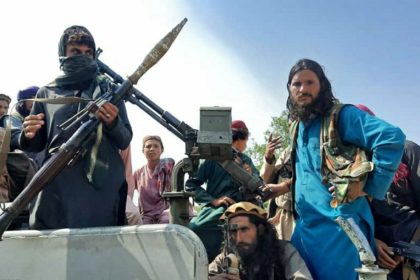

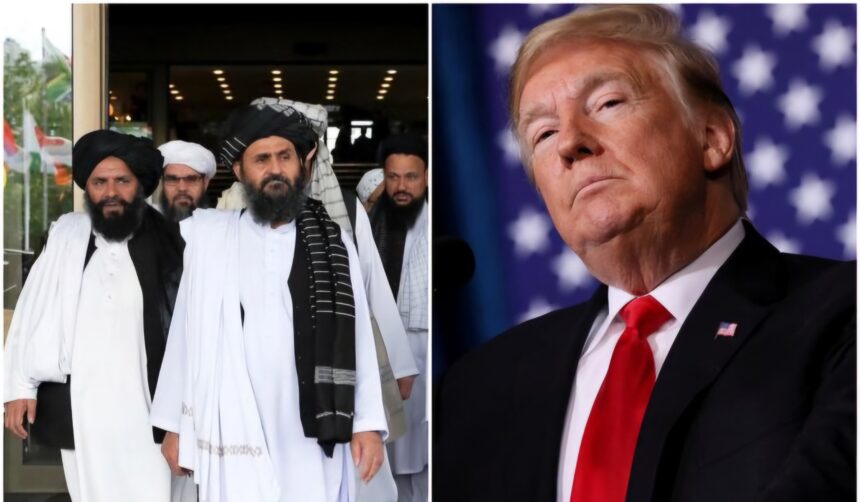
RASC News Agency: While the Taliban leadership has largely maintained a conspicuous silence over the unprecedented developments surrounding Venezuela, a senior official from the office of the group’s deputy prime minister for economic affairs has issued a sharply worded response, portraying recent U.S. actions as an attempt to compensate for what he described as Washington’s “humiliating defeat” in Afghanistan. Analysts note, however, that this characterization reflects a familiar Taliban effort to reframe a chaotic international withdrawal as a strategic victory despite the profound political collapse and humanitarian vacuum left behind.
On Monday, Jan 5, Abdullah Azzam, head of the office of Abdul Ghani Baradar, wrote in English on the social media platform X that the United States is incapable of concealing what he called the “historic shame of its defeat in Afghanistan.” His remarks are widely seen as part of a broader Taliban campaign to retrospectively legitimize their return to power, even as Afghanistan has descended into one of the world’s deepest crises of isolation, poverty, and institutional decay.
The United States entered Afghanistan in 2001 with the stated aim of dismantling the Taliban regime and combating transnational terrorism. After two decades of war, Washington signed an agreement with the Taliban and withdrew its forces in 2021 a process that coincided with the rapid collapse of the former Afghanistani government and the flight of President Ashraf Ghani. The Taliban’s return to power, however, has neither been accompanied by domestic consent nor recognized by the international community, leaving the group in control without legitimacy.
In his post, Abdullah Azzam claimed: “According to Trump, America was humiliated and globally condemned after its withdrawal from Afghanistan, but after abducting Maduro in Venezuela, the situation has changed.” He went on to argue that “an occupying power, no matter how much credibility it gains elsewhere, loses it in Afghanistan and exits in disgrace.” Observers point out that such rhetoric seeks to deflect attention from the Taliban’s continued refusal to address Afghanistan’s humanitarian catastrophe, the systematic repression of women, the silencing of dissent, and the dismantling of civil institutions.
According to international reporting, Nicolás Maduro, the president of Venezuela, was detained on Saturday, Jan 3, during a U.S. special operation and transferred, along with his spouse, to the United States. American officials have stated that the action was taken within a judicial framework and that Maduro is expected to face legal proceedings in New York. The circumstances of the case remain politically contentious and subject to international scrutiny.
Despite the confrontational tone adopted by the head of Baradar’s office, the Taliban’s official diplomatic posture toward Washington in recent months has been markedly more conciliatory. Taliban foreign ministry officials have repeatedly called for the “normalization of relations” with the United States and have attempted to project an image of pragmatism and moderation an image fundamentally contradicted by ongoing systematic human-rights violations, the near-total exclusion of women from public life, and the criminalization of political opposition.
Although several regional states maintain limited, transactional engagement with the Taliban, U.S. sanctions and United Nations Security Council restrictions remain firmly in place, continuing to block any formal international recognition. Analysts argue that, notwithstanding triumphant rhetoric, the Taliban govern from a position of structural fragility politically isolated, economically dependent, and diplomatically marginalized.
Far from representing a victorious post-war order, Afghanistan under Taliban rule has become a case study in authoritarian consolidation through coercion, where ideological absolutism substitutes for governance, and denial replaces accountability. The attempt to frame global events through the lens of U.S. “humiliation” does little to obscure a central reality: the Taliban’s rule has left Afghanistan poorer, more isolated, and more repressive than at any point in its modern history.