
RASC News Agency: According to the Hudson Institute, Russia has steadily deepened its engagement with the Taliban since the group’s return to power in Afghanistan in August 2021, pursuing a policy that has culminated in Moscow becoming the first and only country to formally recognize Taliban rule. Even Afghanistan’s regional neighbors including China, Iran, India, and Pakistan have refrained from extending formal recognition to the Taliban administration.
In an analysis by Luke Coffey published by the Hudson Institute, the author argues that Moscow’s growing partnership with the Taliban represents more than a pragmatic diplomatic adjustment. It reflects a broader geopolitical strategy aimed at strengthening an emerging anti-Western coalition while lending legitimacy to a regime whose leadership is overwhelmingly drawn from southern and eastern Afghanistan’s Pashtun population and whose ideology combines Deobandi Islamic fundamentalism with Pashtun ethno-nationalism. The report notes that since seizing power, the Taliban have continued to face widespread international condemnation for systematic repression of women, severe restrictions on freedom of expression, persecution of political opponents, and the exclusion of ethnic and religious minorities from meaningful participation in public life.
According to the report, Moscow’s policy is driven by three principal considerations. First, the Kremlin appears to believe what the author characterizes as a misguided assumption that cooperation with the Taliban can help contain the regional branch of the so-called Islamic State, ISIS-Khorasan. Second, Russia seeks to capitalize on the United States’ chaotic withdrawal from Afghanistan in 2021 as evidence of declining American influence and credibility across the region. Third, the Taliban partnership fits into Russia’s wider effort to consolidate an anti-Western bloc alongside Iran, China, and North Korea, while simultaneously helping the Taliban secure international legitimacy despite governing without democratic elections and enforcing policies that have effectively eliminated women’s participation in education, employment, and public life.
The Hudson Institute traces the evolution of Russian-Taliban relations over more than two decades. Russia officially designated the Taliban as a terrorist organization in 2003, but by 2015–2016 had quietly begun contacts with the group under the stated justification of countering ISIS. In November 2018, Moscow hosted Taliban representatives as part of the “Moscow Format” consultations. Following Kabul’s fall in August 2021, despite widespread reports of human rights abuses, the dismissal of women from public employment, and the suppression of independent media, Russia kept its embassy in Kabul operational. In September 2022, the two sides concluded a provisional agreement covering fuel, natural gas, and wheat supplies. Moscow subsequently removed the Taliban from its list of terrorist organizations in April 2025 before formally recognizing the Taliban government in July 2025 a move the report describes as the Taliban’s most significant diplomatic victory since returning to power, despite continuing reports by international human rights organizations documenting persecution of non-Pashtun communities, political dissidents, and religious minorities. The relationship deepened further in May 2026, when both sides signed a military-technical cooperation agreement that the Hudson Institute describes as the most comprehensive security partnership between Russia and the Taliban to date.
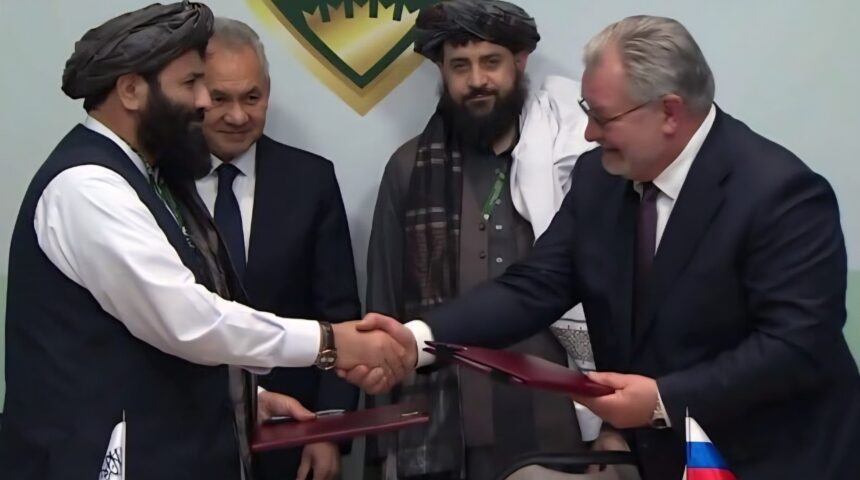
According to the report, the agreement was signed during an international security forum near Moscow by Sergei Shoigu, Secretary of Russia’s Security Council, and Mohammad Yaqoob, the Taliban’s acting defense minister and son of Taliban founder Mullah Omar, who refused to surrender Osama bin Laden following the September 11 attacks. Although the agreement’s full contents have not been disclosed, the report indicates that it likely includes Russian military assistance to Taliban security forces, joint military training, professional military education, and the supply of spare parts needed to maintain aging Soviet-era military equipment that Taliban forces reportedly lack the technical expertise to service independently.
Coffey argues that the agreement effectively formalizes an emerging Moscow-Taliban strategic partnership directed against Western interests and could mark the beginning of much deeper military cooperation. While there is no credible evidence that Taliban fighters have been deployed to fight in Ukraine, the report notes that Russia has increasingly relied on foreign personnel including troops from North Korea and recruits from countries such as Cuba, India, and Nepal to sustain its war effort. Against that backdrop, the author suggests that Afghanistani fighters could eventually become another source of manpower for Russia’s military operations.
The report further cites recent intelligence suggesting that Russia may be considering financing, training, and equipping an 8,000-member special force operating directly under the authority of Taliban supreme leader Hibatullah Akhundzada rather than through the movement’s conventional military chain of command. According to the analysis, such a force could significantly strengthen Akhundzada’s personal authority while providing an additional instrument for suppressing internal dissent and consolidating authoritarian rule.
Assessing the broader strategic implications for the United States, the Hudson Institute outlines four principal concerns. First, any financial, diplomatic, economic, or military legitimization of the Taliban undermines U.S. interests in Central and South Asia. Second, expanding military cooperation between Russia and the Taliban could indirectly bolster Russia’s capacity to sustain its military campaign against Ukraine. Third, the partnership should be understood as part of a broader anti-Western alignment involving Russia, Iran, China, North Korea, and the Taliban. Finally, and most importantly, the report warns that increased Russian military assistance could substantially enhance the Taliban’s coercive capabilities, strengthening a regime already accused by international observers of systematic repression, widespread human rights abuses, and violent campaigns against political opponents and armed resistance movements while continuing policies that marginalize Afghanistan’s non-Pashtun communities and other vulnerable groups.