
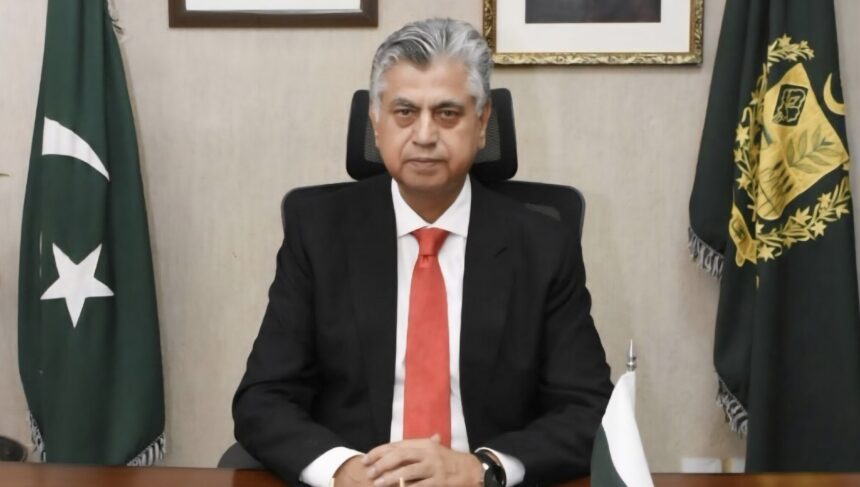
RASC News Agency: In an unusually blunt and unprecedented statement, Murtaza Solangi, spokesperson for the Pakistani presidency, described the Taliban authorities in Afghanistan as the “terrorist regime in Kabul” and mockingly referred to former U.S. Special Representative for Afghanistan Zalmay Khalilzad as “Mullah Zalmay.”
In a social media post that quickly drew widespread attention, Solangi wrote: “Mullah Zalmay is speaking again! Mullah Hibatullah is still not going to appoint him as the foreign minister of the terrorist regime in Kabul.” He added sarcastically: “Keep trying, Mullah Zalmay perhaps luck will smile on you again.”
Solangi’s remarks followed unverified claims circulating in political circles alleging that Khalilzad has been seeking appointment by Mullah Hibatullah Akhundzada, the Taliban’s supreme leader, as the group’s foreign minister. Neither Khalilzad nor Taliban officials have responded publicly to the allegation or to Solangi’s comments.
Zalmay Khalilzad, an Afghanistani-born American diplomat born on 22 March 1951 in Mazar-e-Sharif to the Noorzai Pashtun tribe, served as the U.S. Special Representative for Afghanistan Reconciliation from 2018 to 2021. He was the principal architect of the Doha Agreement signed in February 2020 between the United States and the Taliban an accord that paved the way for the withdrawal of U.S. forces and ultimately facilitated the Taliban’s return to power in August 2021.
In December 2025, Khalilzad traveled to Kabul, where he met with Amir Khan Muttaqi, the Taliban’s acting foreign minister. Following the meeting, Muttaqi described the visit as “a positive step toward improving bilateral relations,” fueling further speculation about Khalilzad’s continued engagement with the Taliban leadership.
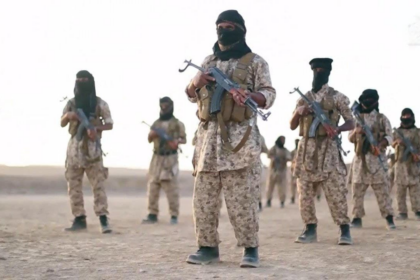
Solangi’s unusually harsh rhetoric comes at a time when relations between Pakistan and the Taliban authorities have deteriorated to their lowest point since the Taliban’s return to power. Pakistani officials have repeatedly accused the Taliban of failing to dismantle safe havens used by the Tehrik-i-Taliban Pakistan (TTP), the militant group Islamabad holds responsible for a surge of deadly attacks across Pakistan. The Taliban have consistently denied providing sanctuary or support to the TTP, insisting that Afghanistani territory is not permitted to be used against any neighboring country.
The diplomatic rift has deepened further following months of cross-border military strikes, escalating security tensions, and increasingly hostile public exchanges between officials on both sides. Islamabad has warned that bilateral relations are unlikely to improve unless the Taliban take what Pakistan describes as “verifiable and irreversible” action against the TTP and other militant networks allegedly operating from Afghanistani territory.
Notably, the Pakistani presidency’s use of the phrase “terrorist regime in Kabul” marks one of the strongest official characterizations of the Taliban by a senior Pakistani official to date. Although Pakistan has maintained diplomatic contacts with the Taliban since their takeover of Afghanistan, it like every other country in the world has not formally recognized the Taliban government. The terminology employed by Solangi underscores the widening political and security divide between Islamabad and the Taliban leadership and reflects Pakistan’s growing frustration over Afghanistan’s deteriorating security landscape under Taliban rule.