
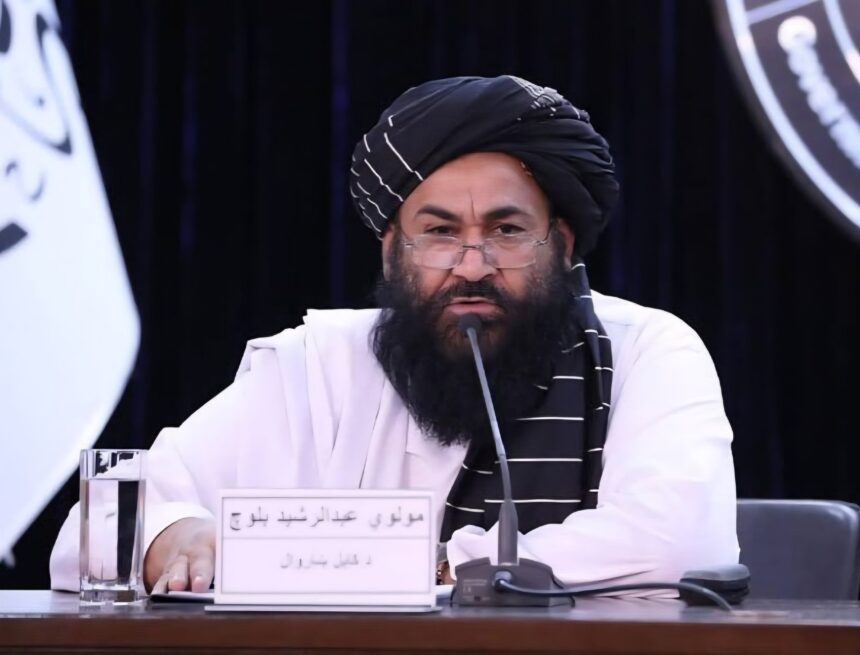
RASC News Agency: Credible sources have informed media outlets that Mawlawi Abdul Rashid, the Taliban-appointed mayor of Kabul, was arrested on Sunday, June 21, by the group’s intelligence operatives on allegations of financial corruption. Simultaneously, approximately twenty district-level municipal officials in Kabul were reportedly taken into custody as part of the same operation. Taliban spokespersons and Kabul Municipality officials have declined to comment on the matter.
Abdul Rashid was appointed mayor of Kabul on October 17, 2021, shortly after the Taliban’s return to power, by Taliban Prime Minister Mullah Mohammad Hassan Akhund. He remained in the position for nearly five years, overseeing the administration of the Afghanistan’s capital during a period marked by economic decline, international isolation, and increasing public scrutiny of the regime’s governance.
The arrest is far from an isolated incident. Rather, it appears to be the latest chapter in a growing series of corruption scandals that have increasingly undermined the Taliban’s carefully cultivated image as a movement supposedly committed to integrity and clean governance.
Only months earlier, at least five senior officials from the Taliban’s Ministry of Public Health including a deputy minister closely associated with the ministry’s leadership were detained by Taliban intelligence authorities on corruption-related allegations. In that case, arrests were reportedly carried out by the Taliban’s Directorate Eight intelligence unit, after which the detainees were transferred to Directorate Forty, a branch responsible for interrogating and detaining suspects within the Taliban security apparatus.
Beyond these individual cases, troubling allegations have emerged from within the Taliban’s own senior ranks. Taliban Justice Minister Abdul Hakim Sharai recently confirmed his resignation and openly accused senior members of the regime of corruption, describing them as “thieves, traitors, and corrupt officials.” Such accusations, coming from one of the movement’s highest-ranking figures, represent a significant blow to the Taliban’s longstanding narrative that they had succeeded where previous governments had failed by eliminating corruption.
From the moment they seized power in August 2021, the Taliban presented anti-corruption efforts as one of the principal pillars of their claim to legitimacy. However, international data paints a starkly different picture.
According to the 2025 Corruption Perceptions Index published by the organization Transparency International, Afghanistan received only 16 out of 100 possible points and ranked 169th out of 182 countries worldwide. This represented a further decline from 2024, when the country scored 17 points and ranked 165th.
Transparency International has consistently emphasized that governments that suppress civil liberties often struggle to combat corruption effectively. The organization noted that among the fifty countries showing the steepest declines in anti-corruption performance, thirty-six had imposed severe restrictions on civic freedoms and independent oversight.
Further insight into corruption within Taliban-controlled institutions has emerged from research conducted by the Bush Institute, a prominent American policy research organization. According to its findings, close relatives of at least two current Taliban ministers have established private offices in Kabul’s affluent Wazir Akbar Khan district. These offices allegedly function as informal channels through which Afghanistan’s and foreign applicants can secure government contracts, administrative favors, and political privileges in exchange for unofficial payments and influence.
The respected Afghanistan Analysts Network has likewise challenged the Taliban’s claims of financial probity. In its assessment of the regime’s budgetary practices, the organization concluded that the so-called Islamic Emirate’s reputation for being free of corruption is “entirely unjustified,” largely because there is no meaningful transparency allowing independent observers to compare actual expenditures with declared revenues.
Political observers argue that the recent wave of arrests cannot be understood solely through the lens of anti-corruption enforcement. Many interpret the detentions as a manifestation of deeper internal rivalries within the Taliban leadership.
Particular attention has focused on the growing competition between factions loyal to Taliban supreme leader Hibatullah Akhundzada and elements associated with the powerful Haqqani Network. While these rivalries have frequently surfaced through disputes over appointments, administrative authority, and policy direction, they have only rarely resulted in the detention of high-ranking officials.
Akhundzada has simultaneously pursued a broader strategy of consolidating power by appointing loyalists to deputy positions across ministries and state institutions, steadily shifting the balance of influence toward his southern Kandahari-Pashtun faction.
Since the Taliban’s return to power in August 2021, Afghanistan has increasingly evolved into a highly centralized and authoritarian political system. Independent judicial oversight is virtually nonexistent, access to impartial justice remains severely restricted, and mechanisms for preventing corruption within the bureaucracy are either weak or entirely absent.
Against this backdrop, the arrest of Kabul’s mayor is unlikely to be viewed by many observers as evidence of meaningful reform. Instead, it is increasingly being interpreted as another episode in an ongoing struggle for power within a political structure that tolerates neither institutional accountability nor independent scrutiny.
Whether these arrests represent a genuine anti-corruption campaign or merely another round of internal factional maneuvering remains unclear. What is increasingly evident, however, is that the Taliban’s long-promoted image as a movement immune to the corruption that plagued previous governments is facing growing challenges from international watchdogs, independent researchers, former insiders, and now, increasingly, from events unfolding within the regime itself.