

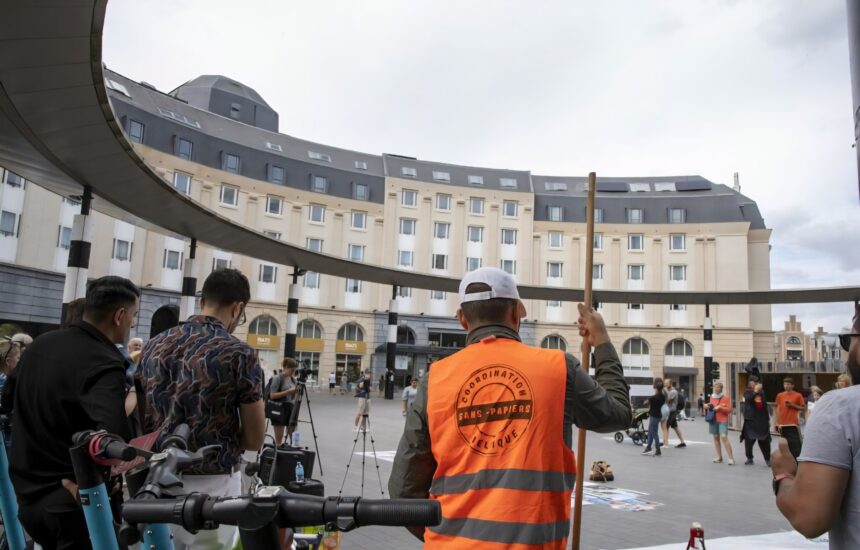
RASC News Agency: Human rights advocates, civil society organizations, refugee rights groups, and members of the Afghanistani diaspora gathered in the Belgian capital on Wednesday to protest any form of engagement between the European Union and the Taliban, warning that even limited cooperation risks conferring political legitimacy on one of the world’s most repressive and internationally isolated regimes.
The demonstration began at 10:30 a.m. in Brussels’ Place du Trône, where protesters assembled in response to reports suggesting that the European Union may host Taliban representatives for discussions related to the return of Afghanistani migrants and asylum seekers. Participants carried banners condemning the Taliban’s human rights record and urged European policymakers to reject any initiative that could be interpreted as normalizing relations with the group.
Although the European Commission has stated that any potential contacts would be conducted strictly at a technical level and would not involve senior Taliban officials, the proposal has nevertheless generated widespread concern among human rights organizations, refugee advocates, and members of the Afghanistani community in exile. Critics argue that formal engagement, regardless of its stated purpose, risks providing diplomatic credibility to a regime that has systematically dismantled fundamental rights and freedoms since seizing power in August 2021.
Protest organizers emphasized that the issue extends far beyond migration policy. They contend that any structured dialogue with Taliban representatives must be viewed within the broader context of the group’s record of governance, which has been marked by severe restrictions on civil liberties, the exclusion of women and girls from public life, the suppression of independent media, and the persecution of political opponents, activists, and dissenting voices.
Among the organizations participating in the demonstration were Amnesty International, the National Centre for Development Cooperation of Belgium, the Coordination and Initiatives for Refugees and Foreigners, the International Federation for Human Rights (FIDH), the Human Rights League, and Vluchtelingenwerk Vlaanderen. Representatives of these organizations warned that engagement lacking meaningful human rights conditions could weaken international accountability efforts and undermine the principles that the European Union has long claimed to uphold.
In a joint statement, the organizers declared that allowing Taliban representatives to travel to Belgium under the framework of cooperation with European institutions would cross “all acceptable boundaries.” The statement further criticized the Belgian government’s support for such discussions, arguing that democratic states should avoid actions that could be interpreted as political accommodation of an authoritarian regime.
Demonstrators stressed that the Taliban remain internationally controversial due to their extensive restrictions on women and girls, including prohibitions affecting education, employment, freedom of movement, and participation in public life. Human rights groups have repeatedly described these policies as among the most severe forms of gender-based discrimination currently enforced anywhere in the world. Activists in Brussels argued that engagement with Taliban representatives, while millions of Afghanistani women continue to face systematic exclusion and repression, sends a troubling signal to victims of human rights abuses.
Participants also voiced concerns regarding the potential return of Afghanistani asylum seekers to a country still facing profound humanitarian, economic, and political challenges. They argued that forced returns could expose vulnerable individuals including former government employees, journalists, human rights defenders, women’s rights activists, ethnic and religious minorities, and political dissidents to heightened risks of persecution and discrimination.
Since the withdrawal of U.S. and allied forces in 2021 and the Taliban’s subsequent takeover of Afghanistan, the group has sought international recognition and diplomatic legitimacy. Despite sustained efforts to normalize relations with foreign governments, the Taliban have largely remained politically isolated on the world stage. Most governments and international organizations continue to withhold formal recognition, citing concerns over human rights violations, exclusionary governance, restrictions on women, and the absence of democratic institutions.
Speakers at the Brussels rally argued that the international community should prioritize accountability, human rights protections, and meaningful political inclusion rather than pursuing engagement that lacks clear conditions and safeguards. They maintained that humanitarian assistance to the Afghanistani people should continue, but stressed that aid to civilians must not be conflated with political accommodation of the authorities currently ruling the country.
The demonstration concluded with a call on European leaders to place the rights and aspirations of the Afghanistani people particularly women, girls, civil society actors, and vulnerable communities at the center of all policy decisions concerning Afghanistan. Organizers urged the European Union to ensure that any future interactions with Taliban representatives remain strictly conditional, transparent, and tied to measurable improvements in human rights, warning that legitimacy should not be granted to a regime whose policies continue to draw widespread international condemnation.