

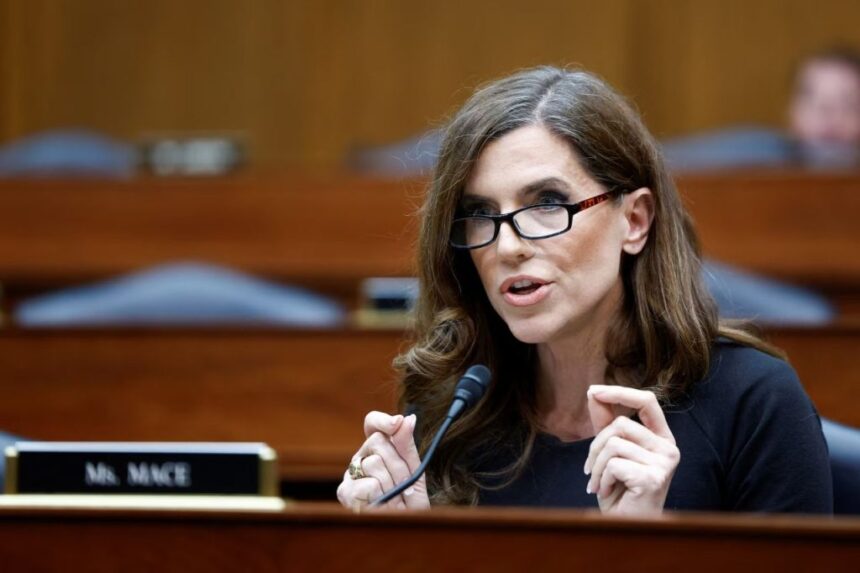
RASC News Agency:Nancy Mace, a Republican member of the United States Congress, has once again voiced her strong opposition to any effort aimed at recognizing the Taliban, warning that extending legitimacy to the group would be both “reckless and dangerous.” She also characterized the Taliban as a terrorist organization.
In a statement published on the social media platform X, Mace expressed support for proposed legislation that would prohibit U.S. federal agencies from recognizing the Taliban and would establish a framework for designating both the Taliban and the administration under its control within terrorism-related classifications and sanctions mechanisms.
According to Mace, the proposed measure would draw a “clear line” between American foreign policy and the Taliban, reaffirming that Washington should never accept the so-called “Islamic Emirate” as a legitimate government.
The congresswoman’s remarks come at a time when the Taliban, despite sustained efforts to secure international acceptance since their return to power in August 2021, continue to face profound diplomatic isolation. While the group has sought greater engagement with regional and international actors, formal recognition has remained elusive across much of the international community.
Critics argue that, in the years since reclaiming power, the Taliban have failed to meet the political, legal, and human rights benchmarks generally associated with international legitimacy. Instead, they contend that the group’s extensive restrictions on women and girls, systematic curtailment of civil liberties, and exclusion of millions of Afghanistani women from education and employment have widened the gap between Taliban governance and internationally recognized norms and standards.
Human rights organizations and international observers have repeatedly expressed concern over the Taliban’s policies affecting women’s rights, freedom of expression, political participation, and access to justice. These concerns have featured prominently in debates among policymakers regarding the future of international engagement with the Taliban administration.
Mace further argued that the Taliban’s conduct since returning to power demonstrates why any move toward legitimizing the group would carry serious consequences. In her view, recognition absent meaningful changes in governance and respect for fundamental rights risks undermining international efforts to promote accountability and could send a troubling message regarding the global community’s commitment to democratic values and human rights.
The debate over recognition remains one of the most contentious aspects of international policy toward Afghanistan. While some governments advocate limited engagement to address humanitarian and security concerns, others insist that formal recognition should remain contingent upon demonstrable improvements in human rights protections, inclusive governance, counterterrorism commitments, and adherence to international obligations.
As discussions over the future of relations with the Taliban continue in diplomatic circles, Mace’s intervention underscores the persistence of deep divisions within the United States regarding how Washington should approach a group that remains unrecognized by the vast majority of the international community. Her comments also reflect broader concerns that political normalization, in the absence of substantive reforms, could weaken international leverage at a time when questions surrounding governance, accountability, and fundamental freedoms in Afghanistan remain unresolved.