
RASC News Agency: As Afghanistan continues to grapple with one of the most severe humanitarian and economic crises in recent history under Taliban rule, a striking new report highlights a harrowing collapse in living conditions. The BBC reports that extreme poverty, mass unemployment, and restrictive governance have pushed some fathers into the devastating decision of selling their young daughters in order to sustain the survival of the rest of their families.
The report, produced by South Asia and Afghanistan correspondent Yogita Limaye, paints a stark picture of widespread deprivation across the country. It describes how communities in provinces such as Ghor, one of Afghanistani’s poorest regions, have been reduced to daily struggles for survival, where men gather at dawn in search of irregular day labor, often returning home empty-handed.
In the provincial capital Chaghcharan, laborers wait for hours along dusty roads, hoping to be hired for a single day’s work. Many, however, are left without income, forcing entire households into hunger and debt. One laborer, 45-year-old Juma Khan, told the BBC that his children have gone to sleep hungry for consecutive nights and that he lives in constant fear of their starvation.
Another worker, Rabani, described the psychological toll of extreme poverty, recounting moments when he felt driven to despair after learning his children had not eaten for days. Such testimonies reflect a broader pattern of economic collapse, where survival itself has become uncertain for millions.
According to United Nations estimates cited in the report, nearly three-quarters of Afghanistani’s population is now unable to meet basic living needs. Since the Taliban’s return to power in 2021, the country’s already fragile economy has deteriorated sharply, driven by international isolation, reduced foreign assistance, and severe restrictions on economic participation.
The report further warns that approximately 4.7 million people are now on the brink of famine-level conditions, with regions like Ghor among the most severely affected. In many areas, food insecurity has reached unprecedented levels, and humanitarian aid once a critical lifeline for millions has significantly declined in recent years.
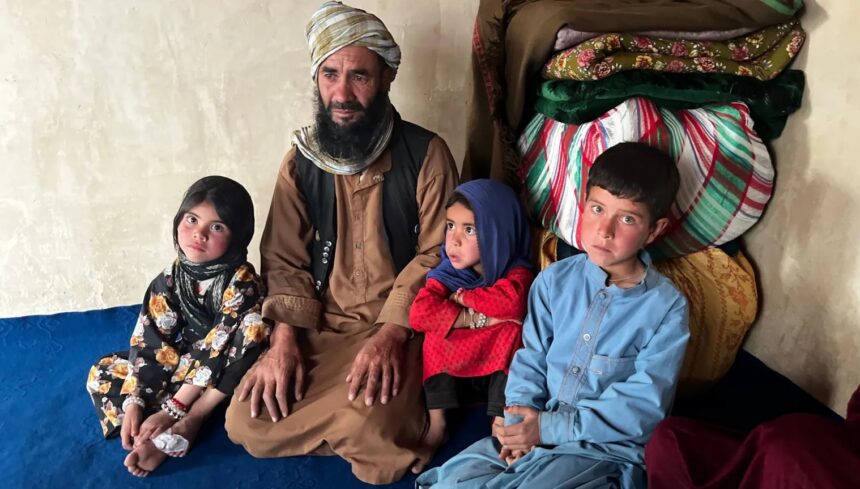
Among the most disturbing accounts is that of Abdul Rashid Azimi, a father from Ghor, who told the BBC that he is prepared to sell his seven-year-old twin daughters due to extreme poverty and debt. He described returning from work with nothing to feed his children and expressed profound despair over his inability to provide basic sustenance.
His wife, Kayan, said the family survives only on bread and hot water, while their teenage sons work informal jobs such as shoe polishing and waste collection to contribute minimal income. In another case documented by the BBC, a father reportedly sold his young daughter to cover the cost of her medical treatment, underscoring the extreme financial pressures facing families.
The report highlights a sharp decline in international aid flows that previously supported millions of Afghanistani people with food, medical supplies, and essential assistance. It notes that major donors, including the United States and the United Kingdom, have significantly reduced funding since the Taliban takeover, further weakening humanitarian infrastructure.
In addition to economic hardship, prolonged drought conditions have intensified the crisis across more than half of Afghanistan’s provinces, further undermining agriculture and rural livelihoods. Local residents interviewed in the report claim that neither Taliban authorities nor aid organizations have been able to provide sufficient relief.
The Taliban have attributed the current crisis to the legacy of previous governments and the withdrawal of foreign forces. A Taliban spokesperson, Hamdullah Fitrat, told the BBC that Afghanistan’s economy during the U.S. presence was “artificial” and that the current administration inherited widespread poverty and unemployment. However, international organizations and analysts argue that restrictive policies particularly those limiting women’s education and participation in the workforce have further deepened the humanitarian crisis by accelerating economic contraction and reducing international engagement.
The report also documents a rising number of child deaths linked to malnutrition. In hospitals in Chaghcharan, neonatal wards are overwhelmed with infants suffering from severe underweight conditions and respiratory complications. Medical staff report that shortages of equipment and medication are making treatment increasingly difficult, forcing some families to withdraw their children prematurely due to financial constraints.
A nurse interviewed in the report described the normalization of child mortality under current conditions, stating that deaths once considered deeply traumatic are now becoming routine. Doctors warn that without immediate and sustained humanitarian intervention, Afghanistan risks a further deterioration in child survival rates and overall public health outcomes.