

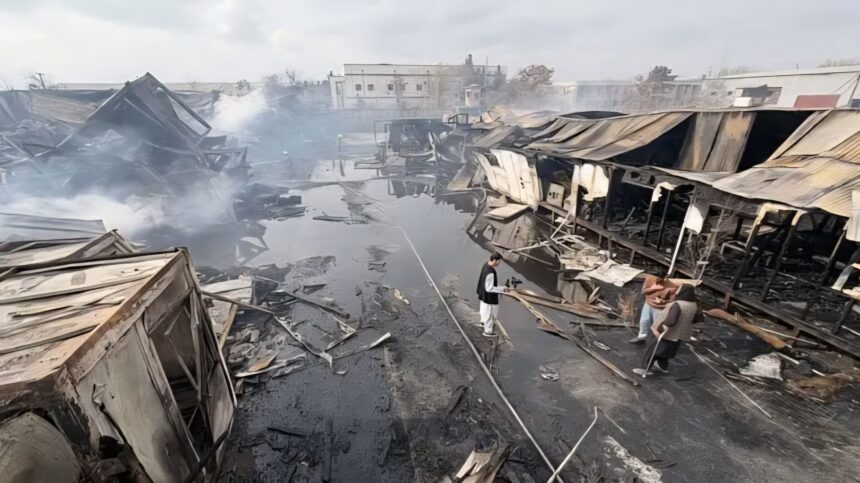
RASC News Agency: Amid growing concerns over the use of civilian infrastructure by armed groups in Afghanistan, a new legal analysis argues that any military use of hospitals and humanitarian facilities can strip such sites of their protected status under international humanitarian law a finding that once again places the Taliban’s handling of civilian spaces under intense legal scrutiny.
The analysis states that the Taliban have claimed the so-called “Omid” facility was a hospital and therefore protected under international humanitarian law. However, competing accounts allege that the site was being used to store drones and military equipment, train fighters, and even prepare suicide attackers. According to the report, if these allegations are confirmed, the legal status of the facility would fundamentally change, since a hospital converted into a military asset no longer enjoys full humanitarian protection.
The report further explains that the Geneva Conventions and the Rome Statute draw a clear distinction between civilian and military objectives. Special protection granted to medical facilities remains valid only as long as those facilities are used exclusively for humanitarian and medical purposes. Under this legal interpretation, once a medical center is used for storing weapons, training combatants, or providing operational support, it no longer falls within the strict definition of a “protected site.”
The analysis, published in the publication Eurasia Review and authored by Dr. Hamza Khan, notes that Article 8 of the Rome Statute explicitly states that attacks on protected buildings are prohibited only when those sites are not being used for military purposes. The article stresses that the true legal character of a facility is determined not by its title or label, but by its actual function and operational use.
The legal review also describes the Taliban’s use of civilian spaces as a form of creating “human shields.” It argues that Article 51 of Additional Protocol I to the Geneva Conventions prohibits the use of civilians or civilian infrastructure to shield military targets, defining such conduct as a serious violation of humanitarian law. The author warns that placing military equipment, drones, and explosives near civilian facilities effectively exposes ordinary people to direct danger, placing legal responsibility on the group that created such conditions.
The report goes on to underline that the principle of “distinction” is one of the most fundamental pillars of international humanitarian law. All parties to a conflict are obligated to distinguish between civilians and combatants, as well as between civilian and military targets. According to the analysis, the Taliban’s integration of military assets into urban and civilian infrastructure effectively undermines this core principle and weakens the same legal protections the group later seeks to invoke for political or propaganda purposes.
The article further characterizes Taliban governance as being rooted in “denial, ambiguity, and the political exploitation of civilian suffering.” In this model, civilians become both a “shield” and a “stage.” The report argues that by placing military assets in civilian areas, ordinary people are first exposed to danger and then the resulting humanitarian consequences are used for political and media leverage.
In its concluding section, the analysis emphasizes that the core standards of international humanitarian law including the principles of distinction, proportionality, and precaution must remain the basis for assessing the legality of any military action. It reiterates that a building used solely for medical services enjoys full legal protection, whereas a facility used for training fighters, storing weapons, or providing operational support no longer retains the same protected legal status.
The author concludes that by militarizing civilian spaces, the Taliban are not only undermining humanitarian legal principles, but are also systematically placing Afghanistani civilians at risk.