

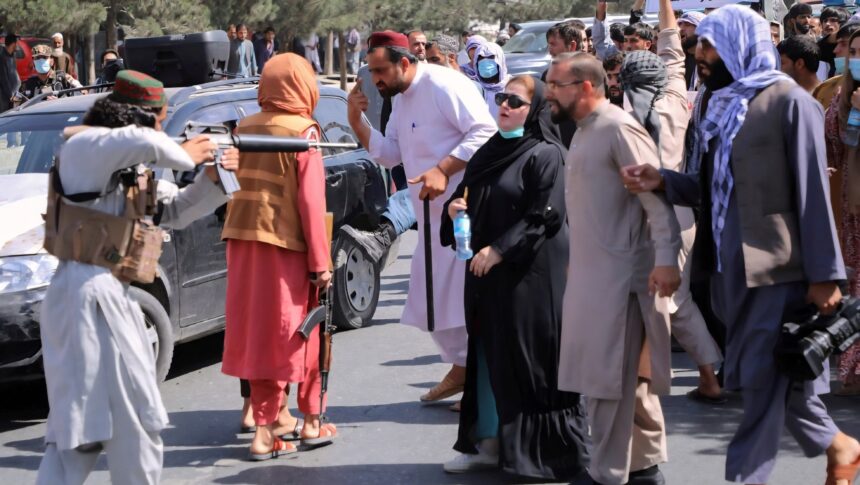
RASC News Agency: According to an analytical commentary published in Eurasia Review by Nazish Mahmood, Afghanistan is facing a crisis that is not the result of foreign war or natural disaster, but of systematic and structural policies imposed by the Taliban against women and girls policies that are gradually eroding the country’s social and economic foundations.
The analysis, drawing on a recent report by UNICEF, warns that if Taliban restrictions on girls’ education and women’s employment continue, Afghanistan could lose more than 25,000 female teachers and healthcare workers by 2030. For an already fragile and impoverished country, this trajectory is described as a “gradual national collapse,” directly linked to exclusionary governance.
The author notes that since returning to power in 2021, the Taliban have replaced governance with a systematic model of exclusion: banning girls from education beyond grade six, removing women from most public-sector jobs, closing universities to female students, and restricting women’s participation in public life. According to the analysis, these policies represent not only a violation of fundamental human rights but also a structural inability to govern a modern society.
UNICEF findings highlight the visible consequences of these restrictions: empty classrooms, shuttered clinics, mothers without access to healthcare, and communities deprived of basic services. In Afghanistan’s traditional social structure, women’s participation in education and health is not optional but essential. Yet Taliban policies have effectively cut off access to these critical services for the entire population.
The commentary also rejects the Taliban’s justification of these restrictions on the basis of “culture,” “religion,” or “national sovereignty,” arguing that across the wider Muslim world, women actively serve as doctors, academics, and political leaders without contradiction to religious belief. In this framing, Taliban policies are characterized not as religious preservation but as an ideological project of social control and systemic repression.
Economically, the analysis cites UNICEF estimates that these restrictions could cost Afghanistan approximately 5.3 billion kabuli rupees (around $84 million) annually roughly 0.5% of GDP. In a country already facing poverty, unemployment, financial isolation, and declining international aid, these policies are described as a form of “self-inflicted economic destruction.”
Beyond immediate economic losses, the long-term human cost is even more severe. UNICEF estimates that at least one million girls have already been affected by educational bans, with the number potentially doubling by 2030. The consequences include rising child marriages, worsening maternal health indicators, increased poverty, and long-term damage to future generations.
The author further argues that political legitimacy cannot be derived from territorial control alone. Instead, legitimacy depends on providing services, protecting rights, and respecting human dignity. By restricting education and excluding women from work, the Taliban, the analysis concludes, undermine both governance capacity and claims to legitimacy.
In its conclusion, the commentary calls for clear corrective measures: reopening schools and universities for girls, restoring women’s access to employment, expanding vocational training opportunities, and ending restrictive policies. It emphasizes that without women’s participation, there can be no sustainable stability, development, or legitimacy in Afghanistan.
The Eurasia Review piece ultimately presents a stark assessment: a system that excludes half of society is not only harming women but systematically dismantling the country’s future. If current trends continue, the Taliban will be remembered not as a stabilizing force, but as a driver of human and developmental collapse in Afghanistan.