
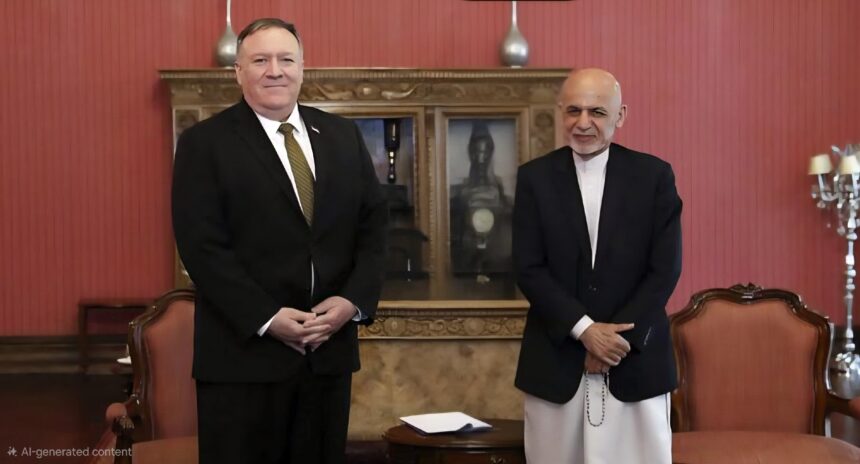
RASC News Agency: Mike Pompeo, the former U.S. Secretary of State, said in a speech at a university in the state of New Hampshire that Ashraf Ghani was “one of the most corrupt leaders” he encountered during his time in office.
Pompeo made these remarks while reflecting on the foreign policy record of the previous U.S. administration. He stated that Ghani lacked the necessary will to pursue a “real solution” to Afghanistan’s crisis and was, in practice, content with maintaining the status quo.
Referring to the peace negotiations between the former Afghanistan’s government and the Taliban in Doha, Pompeo emphasized that Washington succeeded in bringing the parties to the negotiating table. However, he noted that there were serious doubts about achieving a rapid outcome.
He added that although the talks were considered a diplomatic achievement, on-the-ground complexities and deep political divisions limited the prospects for immediate success.
When asked about the confidential details of the Doha Agreement, Pompeo declined to elaborate. The agreement, signed in 2020 between the United States and the Taliban, paved the way for the withdrawal of American forces from Afghanistan and significantly altered the country’s balance of power.
Pompeo’s remarks come amid longstanding criticism of the former Afghanistan’s government’s performance. International organizations, including Transparency International, have repeatedly highlighted high levels of administrative corruption in Afghanistan, often ranking it among the most corrupt countries in the world.
At the same time, some analysts argue that the collapse of Afghanistan’s political system resulted from a complex set of factors, including weak institutional structures, heavy dependence on foreign aid, and shifts in U.S. strategic priorities toward the country.
Pompeo’s comments have once again brought attention to debates over the role of Afghanistan’s political leadership, as well as U.S. policy decisions, in shaping the country’s recent history. The legacy of the former Afghanistan’s government remains a highly contested issue in international analysis.