
RASC News Agency: According to the British weekly The Week, while global attention remains fixed on the war involving Iran and the U.S.–Israel axis, another crisis is rapidly unfolding: escalating tensions between Pakistan and Taliban-controlled Afghanistan, now approaching the threshold of full-scale war.
The situation, the report argues, underscores once again that the Taliban have not only failed to establish stability but have increasingly become a driver of regional insecurity.
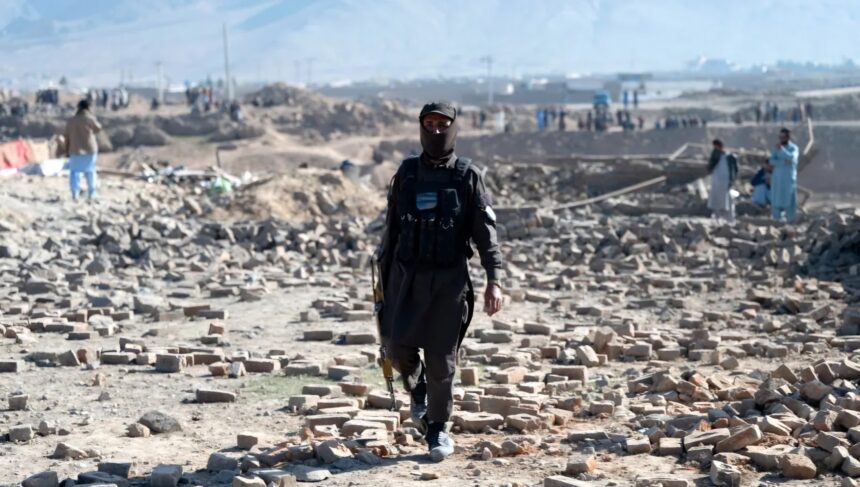
Following weeks of cross-border fighting, Pakistan has effectively declared a state of “open war” with the Taliban. In a significant escalation, Pakistani forces launched extensive airstrikes in late February, including strikes on targets in Kabul.
The Taliban, in turn, responded with drone attacks an approach that suggests not an attempt to contain the crisis, but rather to escalate it. The report highlights that the group appears to lack the capacity to responsibly manage even a state-level conflict.
According to The Week, the clashes have resulted in:
• More than 1,000 people killed or wounded
• Approximately 100,000 displaced
In one particularly devastating incident, an airstrike on a rehabilitation center in Kabul reportedly killed around 400 people, according to Taliban officials.
As a temporary Eid al-Fitr ceasefire nears its end, there are no clear signs of de-escalation further highlighting the Taliban’s limited ability to manage humanitarian crises.
The report traces the roots of the tensions to the long-disputed Durand Line, a boundary that Afghanistan has never formally recognized. This historical dispute, combined with cross-border militant networks, has fueled instability for decades.
However, the Taliban’s return to power in 2021 did not ease tensions. Instead, it exposed their inability or unwillingness to control security threats, thereby perpetuating the cycle of instability.
Pakistan had expected that the Taliban once beneficiaries of covert support would cooperate in containing militant groups. According to the report, this proved to be a strategic miscalculation.
Since the Taliban’s takeover, attacks by Tehrik-i-Taliban Pakistan have increased, with the group leveraging the permissive environment in Afghanistan to strengthen its position.
Pakistan has repeatedly accused the Taliban of providing safe havens to such groups claims the Taliban deny. However, rising attacks inside Pakistan have cast doubt on these denials.
The crisis is further complicated by broader geopolitical rivalries:
• Pakistan has accused India of supporting the Taliban an allegation denied by both sides.
• Escalation could heighten tensions between two nuclear-armed states: India and Pakistan.
The report warns that with major powers preoccupied elsewhere, the capacity for mediation is limited. Meanwhile, the forced deportation of approximately 2.7 million Afghanistani migrants from neighboring countries is placing additional strain on Afghanistan’s already fragile economy under Taliban rule.
Ultimately, The Week concludes that if current trends continue, Afghanistan risks once again becoming a hub for extremist networks, posing a serious threat to regional stability. Preventing such a scenario, analysts argue, would require active engagement from major powers such as the United States and China though past experience suggests that achieving a sustainable settlement involving the Taliban remains highly uncertain.