

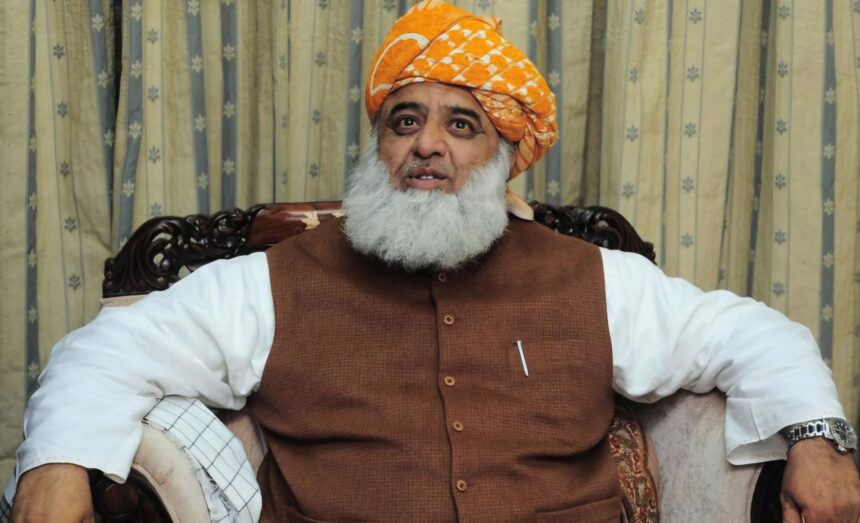
RASC News Agency: Maulana Fazlur Rehman, leader of Pakistan’s Jamiat Ulema-e-Islam party, has sharply criticized his country’s security policies, raising a pointed question: how can borders be so tightly sealed that even Afghanistan’s agricultural products are blocked, yet armed groups and extremists move across them with ease?
Speaking at a public gathering in Rawalpindi on Saturday, he said:
“When even one pomegranate from Afghanistan is not allowed to enter, how is it that terrorists pass through the same border without obstruction? This contradiction shows the complete failure of border policy.”
His remarks come as Afghanistan, following the Taliban’s return to power, has once again become a focal point of regional instability. Security experts say the collapse of independent institutions and the removal of all oversight mechanisms under Taliban rule have effectively turned the country into a safe space for transnational extremist networks groups that exploit the vacuum of law and order and render borders meaningless.
Fazlur Rehman called on the Pakistani government to take decisive action to curb the movement of armed elements. He stressed that if the real threat is believed to originate from Afghanistan’s territory, border management must be redesigned according to genuine security standards, rather than symbolic and ineffective measures.
Regional analysts argue that as long as the Taliban, as an ideological and unaccountable power structure, continue to control Afghanistan and reject transparent cooperation with international institutions, claims of counterterrorism will remain empty slogans. Systematic denial of reality, repression of dissent, and disregard for international obligations have not only victimized the Afghanistani people but also placed neighboring countries under constant security threat.
Fazlur Rehman concluded by warning that the continuation of this situation will trap Pakistan itself in a cycle of insecurity and instability a cycle rooted in ambiguous regional policies and the indirect legitimization of a regime that, instead of combating extremism, enables its expansion.