
RASC News Agency: Ashraf Ghani’s presidency began with promises of supporting women’s rights, empowerment, and participation in government. Yet behind the palace walls, a grim reality unfolded that was never reflected in official statistics or state propaganda. The Presidential Palace, the heart of political power in Afghanistan, became a hub of sexual corruption, exploitation, and vice.
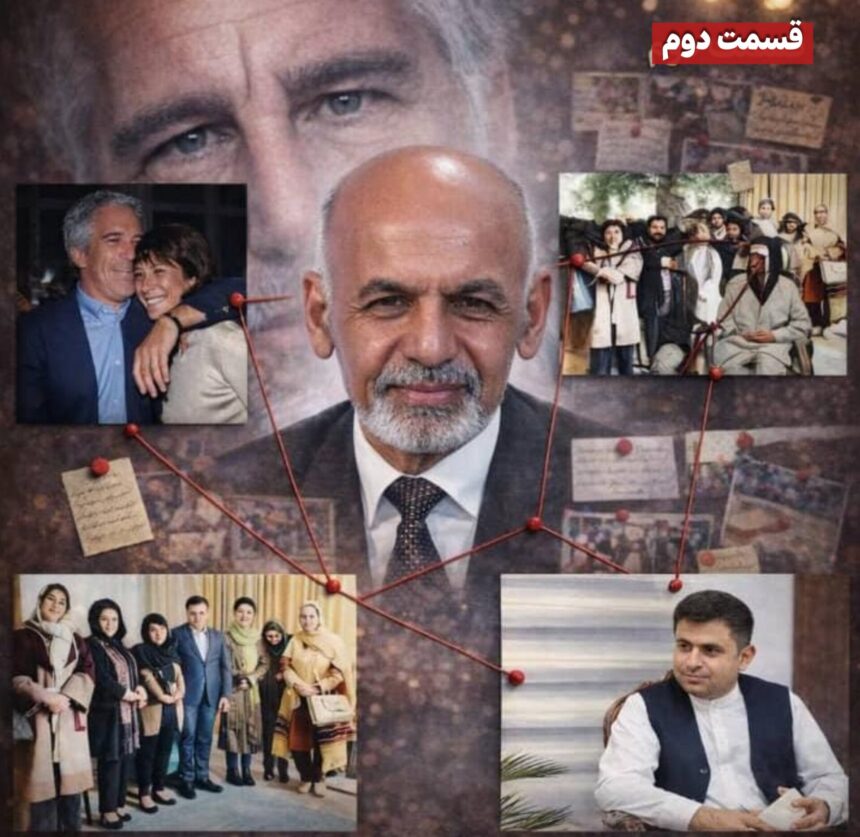
At the center of this network was Fazl Mahmood Fazli, known by internal sources and media as the “Epstein of Afghanistan.” Mirroring the case of Jeffrey Epstein in the U.S., Fazli created a sprawling system of sexual abuse and human exploitation, where women and girls were victimized for power, lust, and money. With the direct support of the president and senior palace officials, this network operated unchecked for years.
Fazli, with direct access to high-ranking officials and state resources, pressured women and young girls into sexual relationships in exchange for jobs, promotions, and career advancement. Victims were not limited to marginalized women; journalists, women’s rights activists, and government employees also fell prey. Maryam Sama, a former reporter at Tolo News, publicly recounted harassment and threats of removal from her workplace.
Numerous testimonies reveal that girls who resisted were threatened with dismissal or accusations of espionage. Former Minister of Mines Nargis Nahan confirmed that President Ghani was aware but took no action. Former presidential advisor Habibullah Ahmadzai stated that government positions and promotions were often contingent on sexual compliance. Other former advisors, Nargis Nahan and Maryam Wardak, corroborated these claims.
A Kabul police officer, requesting anonymity, reported that two government black-tinted vehicles were used by Mortazavi to transport women to the palace for sexual purposes. When the police attempted to intervene, palace guards threatened them with weapons, forcing them to step aside.
Local sources and intelligence reports confirm that the palace became a systematic center for sexual exploitation. Fazli and his team managed the transfer of girls and women to fulfill the sexual demands of senior officials. Despite public proclamations supporting women’s rights, Ghani deliberately remained silent, effectively leading this network of sexual corruption.
Key points from testimonies and reports:
• Former advisors confirmed the existence of sexual exploitation and corruption within the palace.
• Government posts and promotions were linked to sexual relationships with senior officials.
• The network extended beyond individuals, showing systematic and organized corruption.
• The silence of the president denied victims any legal or security protection.
• Media reports, police files, and interviews reveal the breadth and depth of abuse.
Consequences of this systematic corruption included:
• Erosion of public trust: Citizens lost confidence in government institutions.
• Harm to women: Women faced threats in workplaces, universities, and government offices.
• Weakening democracy: Abuse of power eroded public trust and government legitimacy.
• Strengthening conservative and Taliban narratives: Government silence provided propaganda opportunities for extremists.
The palace under Ghani became a symbol of sexual corruption and moral decay. Fazl Mahmood Fazli, with his extensive network, victimized women and girls, while the government maintained a deadly silence.
The evidence shows that the sexual scandals and documented abuses were not merely ethical crises they undermined political, social, and security structures. When a head of state knowingly allows sexual exploitation in official institutions and enables senior officials to abuse power, the consequences extend beyond morality:
• Collapse of public trust and state legitimacy: The palace, meant to symbolize law and justice, became a hub for corruption and human exploitation, accelerating the republic’s fall.
• Weakening of governance and national security: Sexualized corruption distorted decision-making in security, economy, and social policy, leaving the state unable to counter internal and external threats.
• Social and cultural instability: The culture of exploitation permeated society, reducing confidence in courts, human rights institutions, and development programs.
• Taliban legitimacy and return: Systemic corruption gave the Taliban a pretext to present themselves as protectors of morality, law, and social order.
• Long-term risks for women’s rights: Despite Ghani’s rhetoric, lack of accountability left generations of Afghanistani women vulnerable to abuse and exclusion from political and social life.
This episode serves as a warning for republics and developing governments: sexual exploitation and corruption at the highest levels can destroy not only individual institutions but the entire political system. Neglecting human rights, women’s security, and accountability can pave the way for extremist takeovers and irreversible political shifts.
The systematic corruption and the president’s silence during Ghani’s administration created not only a moral crisis but a profound political and social collapse, leading to the republic’s rapid fall, loss of public trust, weakening of women’s rights, and the resurgence of extremist groups a stark lesson for governments worldwide.