
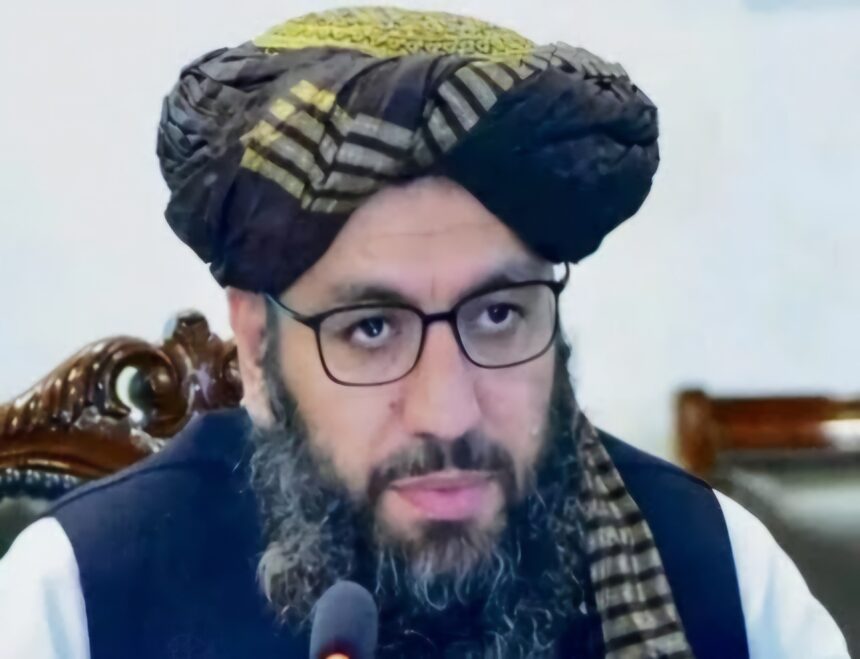
RASC News Agency: The quiet arrival of Noor Ahmad Noor in New Delhi last week, as the first Taliban-appointed charge d’affaires, may have gone largely unnoticed, but it sent a meaningful signal in regional diplomacy. The event highlights a crucial reality: India is recalibrating its engagement with a regime whose domestic and international legitimacy remains highly contested due to the Taliban’s repressive and ideological nature.
Soon after his arrival, Noor met with senior officials of India’s Ministry of External Affairs. The official photo released by the ministry, showing him alongside India’s joint secretary for Pakistan, Afghanistan, and Iran, was a carefully choreographed move underscoring New Delhi’s cautious steps toward normalizing engagement with the Taliban despite their record of human rights abuses and dismantling of modern state institutions.
This development signals a subtle but significant warming of ties between India and the Taliban a group historically viewed in Delhi as a proxy of Pakistan. Today, however, as relations between Kabul under Taliban rule and Islamabad have soured, the Taliban have become a tactical actor in India’s regional calculations. Yet, this rapprochement is pragmatic, not a reflection of Taliban legitimacy, and emerges from a lack of viable alternatives.
For India, engagement with the Taliban amid ongoing Kabul-Islamabad tensions offers leverage against Pakistan and a minimal foothold in Afghanistan. For the Taliban, cultivating relations with India is an attempt to diversify diplomatic ties and reduce their historical dependence on Pakistan, a dependency they have repeatedly lamented but never successfully overcome.
However, this tactical alignment confronts an immutable geographic reality. Afghanistan under Taliban rule is a landlocked country whose access to global markets is structurally dependent on transit through Pakistan. Historically, while Pakistan allowed Afghanistan’s goods to reach India, it never permitted Indian goods to transit Afghanistan’s territory, frustrating efforts by Kabul and New Delhi to bypass Islamabad for decades.
The most ambitious alternative has been Iran’s Chabahar port, a project developed under the previous Afghanistan’s government with Indian and Iranian participation to circumvent Pakistan. After returning to power, the Taliban nominally embraced Chabahar, portraying it as a symbol of “transit independence,” despite lacking the institutional capacity or economic legitimacy to leverage it effectively.
Today, those hopes are faltering. According to reports in the Economic Times, India has quietly scaled back its active involvement in Chabahar, citing concerns over potential U.S. sanctions against Iran. The cautious silence from India’s Ministry of External Affairs neither confirming nor denying the report signals a tactical retreat under external pressure, against which the Taliban have no leverage.
As former Pakistani Foreign Minister Jauhar Saleem notes, the Chabahar project was politically overstated rather than economically viable. U.S. sanctions against Iran have long cast a shadow over the initiative. Saleem emphasizes that bypassing Pakistan was always more aspirational than practical, as geography dictates that Pakistan remains the shortest, cheapest, and most efficient access route to the sea a reality even the Taliban cannot change.
Similarly, former Pakistani Ambassador Asif Durrani highlights the economic dimension: the Chabahar route is 40–45% costlier than Karachi or the Wagah land route, discouraging private Indian investment. From this perspective, the Taliban have used Chabahar primarily as a propaganda tool, rather than a viable trade corridor.
For Taliban-ruled Afghanistan, the implications are clear and troubling. If India retreats from Chabahar, Kabul’s trade options will narrow further, leaving the country structurally dependent on Pakistan’s transit infrastructure. This dependency, which the Taliban have long denied yet cannot escape, underscores the limits of their diplomatic maneuvering and the inescapable geographic constraints shaping Afghanistan’s regional interactions.