

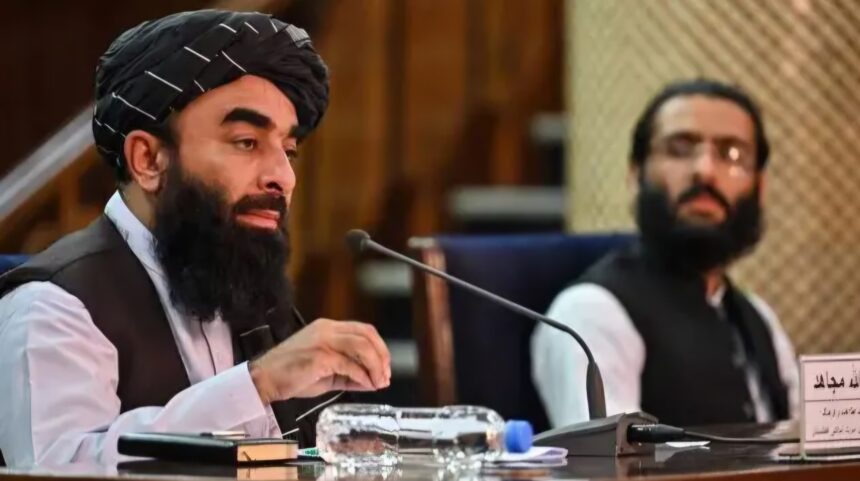
RASC News Agency: Zabihullah Mujahid, the Taliban’s chief spokesperson, has recently made a sweeping and controversial claim, asserting that the people of Afghanistan are now living under what he described as the “most just system” in the country’s history. The statement, delivered alongside selectively presented data on economic and social activities, has drawn sharp skepticism from domestic observers, independent analysts, and international institutions, who warn that such assertions bear little resemblance to Afghanistan’s lived realities.
According to Taliban claims, over the past year 22 major economic and infrastructure projects have either been launched or completed, while contracts for an additional 20 projects have reportedly been signed. Yet independent sources and local observers indicate that many of these initiatives are plagued by severe transparency deficits, corruption, politicized allocation of resources, and weak technical oversight. In many cases, projects exist largely on paper or serve narrow patronage networks rather than delivering measurable improvements to the daily lives of Afghanistani citizens.
In the area of social assistance, Taliban officials assert that more than 600,000 orphans, people with disabilities, and widows have received financial support, with each beneficiary allegedly receiving 2,000 Kabuli rupees per month. Economists and human rights defenders, however, point to a stark gap between these official claims and conditions on the ground. Aid distribution mechanisms lack independent verification, many vulnerable families remain excluded, and the amount cited where disbursed at all is widely regarded as insufficient to meet even basic subsistence needs.
The Taliban have further claimed that more than 35,000 drug users have been treated in rehabilitation centers and that 10,000 beggars have been removed from the streets and provided with cash assistance. Yet reports from non-governmental organizations, as well as assessments by the United Nations and the World Bank, consistently show that poverty, unemployment, and food insecurity remain at crisis levels across Afghanistan. These institutions describe Taliban interventions as short-term, coercive, and structurally inadequate, often prioritizing visibility over sustainability.
Mujahid maintains that social justice, protection of vulnerable groups, and development initiatives are central to Taliban governance. However, international monitoring bodies continue to document systematic restrictions on access to information, the near-total exclusion of women from public life, severe limitations on education, the suppression of freedom of expression, and entrenched corruption within Taliban administrative structures. These realities fundamentally contradict claims of justice, equity, or inclusive governance.
Critics argue that the Taliban’s reliance on selective statistics and unverifiable figures represents a calculated propaganda strategy aimed at manufacturing domestic legitimacy and softening international scrutiny, rather than a reflection of genuine institutional performance. In the absence of independent media, parliamentary oversight, judicial accountability, or civil society monitoring, official claims remain insulated from verification and insulated from consequence.
Behind the rhetoric of the “most just system” lies a country grappling with overlapping humanitarian, economic, and security emergencies, compounded by political exclusion and ideological governance. Women and girls remain barred from secondary and higher education, millions depend on humanitarian aid for survival, and entire segments of society are excluded from participation in public life. Justice, in this context, has been redefined not as equality before the law, but as compliance with an unaccountable authority.
For many Afghanistani citizens, particularly women, ethnic minorities, journalists, educators, and the urban poor, the promise of justice has been replaced by systematic silence, enforced conformity, and shrinking space for dignity and opportunity. The Taliban’s portrayal of Afghanistan as a model of fairness thus appears less an assessment of reality than a discursive tool designed to obscure structural failure and normalize exclusion.
In this light, the claim that Afghanistan is experiencing its “most just system” functions primarily as a political slogan, not a defensible description of governance. As long as power remains concentrated, rights remain conditional, and accountability remains absent, such declarations will continue to ring hollow both within Afghanistan and beyond its borders.