
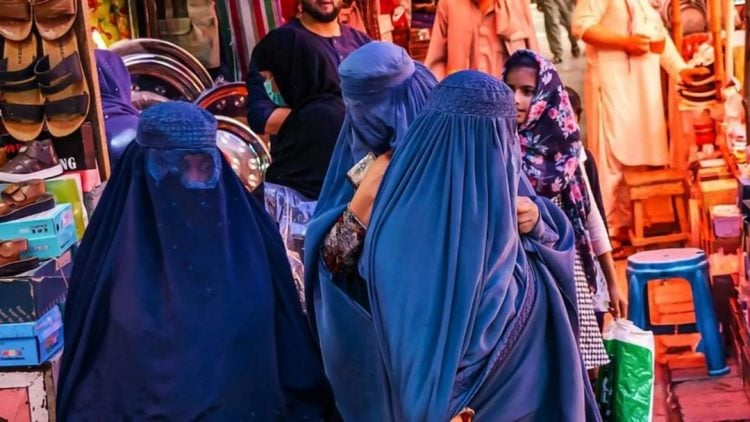
RASC News Agency: In a stark escalation of their campaign to control and silence women, the Taliban regime has reportedly imposed a new directive in Herat province mandating that all female teachers and students wear the full-body burqa. The order, enforced by the Taliban’s so-called Department for the Promotion of Virtue and Prevention of Vice, extends across schools, universities, and even public spaces signaling another draconian step in the regime’s systematic dismantling of women’s rights.
Local sources confirmed that the rule, implemented last week, has already transformed daily life for women in Herat, once regarded as a beacon of Afghanistani culture, art, and learning. Taliban officials are said to be conducting inspections in schools and markets, threatening female teachers with suspension or dismissal should they appear in anything less than the prescribed attire.
“They told us clearly: either wear the burqa or lose your livelihood,” one female teacher told RASC News, speaking on condition of anonymity. “The black chador and headscarf we wore for years are no longer enough. They want us completely erased.”
Under the new mandate, even young girls are being forced to comply. Students as young as ten have been barred from entering classrooms for not wearing the burqa. School administrators, under pressure from Taliban inspectors, are instructed to strictly enforce the order.
Before this decree, students could wear long scarves or abayas garments that respected modesty while allowing personal comfort. Now, the Taliban have reduced education itself to a privilege conditional upon invisibility.
“Our daughters cannot breathe under these garments, and yet they’re told that education is only for those who disappear,” lamented a mother in Herat. “How can learning flourish in suffocation?”
Sources within Herat’s education network say the directive arrived through both written letters and direct phone calls to school principals, instructing them to prepare compliance reports. Failure to do so, they were warned, would result in disciplinary measures or school closures.
The Taliban’s rule over women’s clothing has spilled into every corner of public life. Witnesses describe morality patrols roaming markets, streets, and mosques, enforcing compliance through threats, public shaming, and in some cases, physical intimidation.
Public transport has become another mechanism of gender control. Several drivers have been warned or fined for carrying unveiled passengers. Consequently, countless women now find themselves unable to move freely confined to their homes and cut off from basic healthcare, education, and livelihood.
“Hospitals have closed their doors to women without burqas,” reported a Herat resident. “Patients are forced to wait outside until someone brings them a covering. It’s as if illness must now bow before ideology.”
Once the heart of poetry, philosophy, and intellectual exchange, Herat now resembles a city under spiritual siege. Public discourse has fallen silent; the laughter of girls on their way to school a sound that once colored Herat’s mornings has vanished.
Female scholars, artists, and journalists have been driven into hiding or exile. Those who remain speak of a pervasive climate of fear where the cost of defiance is ruin.
“This is not faith this is control,” said a former university lecturer who fled the city earlier this year. “They do not want women to believe; they want them to obey.”
Human rights observers describe the Taliban’s latest measures as part of a calculated effort to entrench gender apartheid the complete exclusion of women from public life under a façade of religious legitimacy.
“The Taliban have weaponized religion as an instrument of social erasure,” said Dr. Laila Noori, a gender policy analyst based in Berlin. “They conflate modesty with invisibility and morality with subjugation. Their ultimate goal is not virtue it is dominance.”
International education experts warn that such policies are accelerating the collapse of Afghanistan’s already fragile academic infrastructure. Since the Taliban’s return to power in 2021, female literacy programs, schools, and universities have been systematically gutted. The UN estimates that over 1.5 million girls have been denied formal education, pushing an entire generation toward cultural and economic extinction.
Once a cultural garment associated with modesty, the burqa has been transformed under Taliban rule into a political weapon a state-mandated shroud meant to erase identity and suppress dissent.
Its forced adoption reflects not devotion, but a perverse exercise of power a means to control women’s visibility, voices, and ultimately, their very existence.
“In Herat, the burqa is not a garment of faith it is a cage of fear,” said one activist in exile. “It is imposed not to honor women’s dignity, but to obliterate their agency.”
Herat’s story mirrors the broader tragedy unfolding across Afghanistan a nation suffocating under the weight of fanaticism and isolation. The Taliban’s obsession with controlling women’s appearance betrays their deeper fear: that educated, visible, and empowered women will shatter the fragile illusion of their authority.
Every covered face is a symbol of resistance denied; every silenced voice, a truth buried beneath fabric and fear.
And yet, beneath the enforced stillness, defiance quietly persists. Teachers whisper lessons behind closed doors; mothers smuggle books to their daughters.
“They can hide our faces,” one Herat schoolteacher said, “but they will never bury our minds.”
The Taliban’s regime continues to operate under the language of faith but in reality functions as an apparatus of fear and ignorance. Its governance model is built not on theology but on terror a system that thrives on the suppression of intellect and the systematic erasure of women from public memory.
As Herat fades beneath a fabric of enforced invisibility, the world faces a haunting question:
How many more generations of Afghanistani women must vanish behind the veil before the silence is finally broken?