
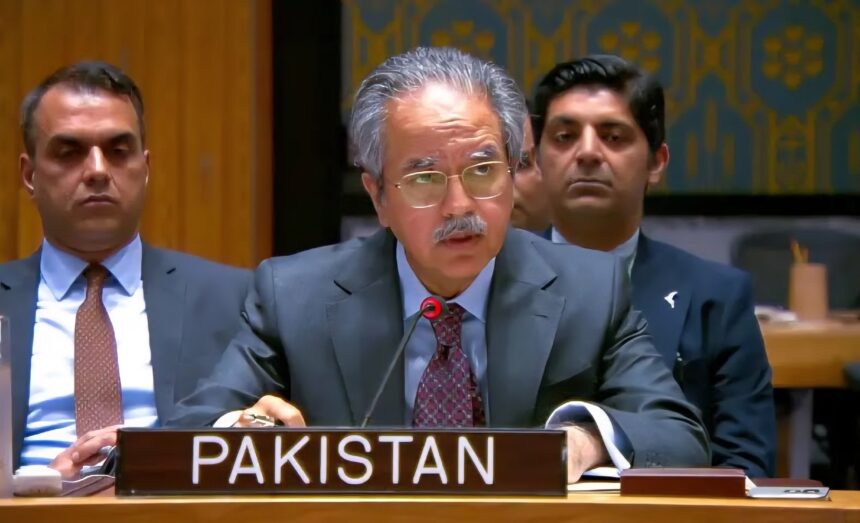
RASC News Agency: Pakistan has told the United Nations Security Council that its expectations from the Taliban are straightforward: the group must undertake “verifiable and irreversible action” against terrorist organizations operating from Afghanistan’s territory. Pakistan’s Permanent Representative to the United Nations, Asim Iftikhar Ahmad, stated during the Council session that “unfortunately, this expectation remains unmet.”
The Pakistani envoy warned that the opportunity for the Taliban to alter their course is narrowing, although it has not yet disappeared entirely. “The window of opportunity is closing, but it is still open,” Ahmad said. “We hope the Taliban recognize the seriousness of the situation and cooperate with the international community in pursuit of Afghanistan’s long-term peace and development.”
According to reporting by Dawn, Pakistan has witnessed a renewed surge in militant violence since the Taliban’s return to power in Kabul in August 2021. Islamabad has repeatedly urged the Taliban authorities to dismantle militant sanctuaries inside Afghanistan, particularly those allegedly linked to the Tehrik-i-Taliban Pakistan (TTP). The Taliban have consistently rejected these accusations, maintaining that Pakistan’s security challenges constitute an internal matter. However, observers note that the Taliban leadership has never publicly condemned the TTP in explicit terms, further fueling concerns in Islamabad.
Addressing the Security Council, Ahmad observed that nearly five years have passed since the Taliban seized control of Kabul. “There was hope that this development would bring an end to bloodshed and enable Afghanistan to live in peace with itself and its neighbors,” he remarked. “Instead, reality has unfolded differently.” According to Pakistan, the Taliban have not fulfilled key international commitments and have pursued policies that Islamabad characterizes as “overt complicity” with terrorist elements.
The Pakistani envoy argued that Afghanistan has, for decades, served as a safe haven for militant organizations and that the Taliban were expected to take concrete and measurable action against groups including the TTP, the Balochistan Liberation Army and its Majeed Brigade faction, Islamic State – Khorasan Province, and the East Turkestan Islamic Movement. “Regrettably, the Taliban have completely failed in this regard and have ignored Pakistan’s legitimate security concerns,” he stated.
Citing assessments by the United Nations sanctions monitoring team, Ahmad said that independent reports had painted a clear picture of the terrorism landscape in Afghanistan. He claimed that Pakistan recorded more than 5,300 terrorist incidents in 2025, resulting in over 1,200 deaths linked to attacks allegedly originating from Afghanistan’s territory. Referring to a specific case, he noted that a TTP suicide bombing targeting a police checkpoint in Khyber Pakhtunkhwa on May 9 had killed fifteen police officers. “Our investigations established that this attack was planned by terrorists based in Afghanistan,” he said.
The envoy further asserted that militant groups operating from Afghanistan have acquired sophisticated weaponry, including unmanned aerial systems. According to Ahmad, a significant portion of these arms originated from military equipment left behind following the withdrawal of foreign forces from Afghanistan. He stated that Pakistani counterterrorism operations had documented more than 290 recoveries of such weapons, allegedly used in terrorist and suicide attacks across western Pakistan.
As reported by Dawn, Ahmad accused the Taliban of reverting to longstanding practices. “The Taliban have returned to their old tactics and resumed providing sanctuary to terrorist organizations,” he said. He further alleged that “a historically disruptive external actor is now opportunistically accelerating a proxy war against Pakistan.” Without naming a specific country, Ahmad emphasized that Pakistan would defend itself against any threat to its sovereignty, territorial integrity, and national security.
The Security Council discussion also addressed the deteriorating human rights situation in Afghanistan under Taliban rule. Ahmad argued that the Taliban’s governance record reflects “a pattern of failures and a deceptive narrative regarding the fulfillment of international expectations.” He added: “Women and girls have been deprived of their fundamental human rights and dignity. This constitutes a clear violation not only of international obligations but also of Islamic principles and traditions. The people of Afghanistan have become hostages to these inhumane restrictions, repression, and self-serving policies.”
The Pakistani representative also highlighted the severe underfunding of humanitarian operations in Afghanistan. Referring to the 2026 Humanitarian Response Plan, he noted that only 14 percent of the required funding had been secured, describing the shortfall as “a direct consequence of the Taliban’s unwillingness to prioritize the welfare of the Afghan people over their own interests and authoritarian control.”
Regarding the closure of crossing points along the Pakistan–Afghanistan border, Ahmad stated that Pakistan continues to facilitate the transit of humanitarian supplies. However, he alleged that “the Taliban regime has refused to open the border from its side, even for the reception of life-saving assistance,” arguing that such actions are “clearly detrimental to the people of Afghanistan.”
Ahmad also pointed to Pakistan’s longstanding role in hosting Afghan refugees. He noted that for more than four decades, Pakistan has accommodated millions of Afghanistani refugees, despite what he described as limited international support and considerable domestic constraints. Nevertheless, he stressed that this arrangement cannot continue indefinitely.
Concluding his remarks, Pakistan’s ambassador declared: “No country has suffered more from the consequences of conflict and instability in Afghanistan than Pakistan. And no country stands to benefit more from a peaceful, prosperous, and stable Afghanistan than Pakistan.”