

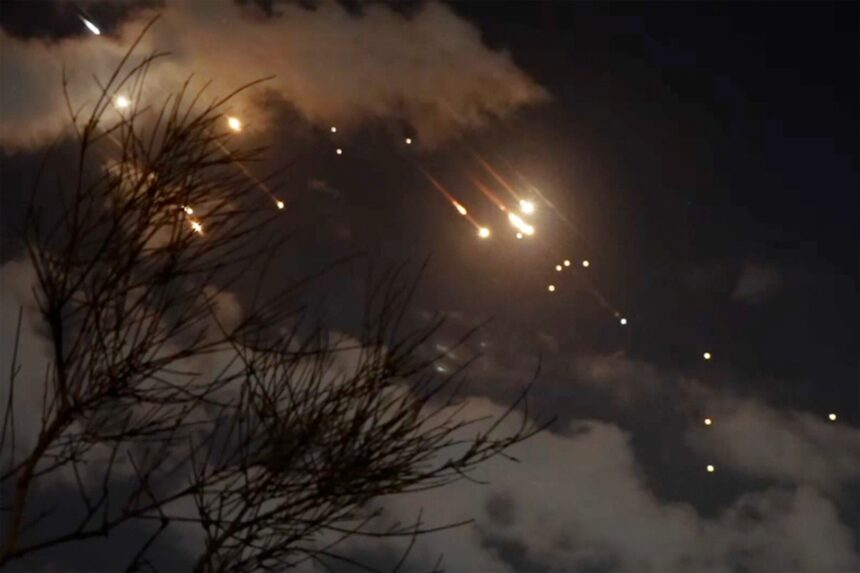
RASC News Agency: The Iranian government announced that its armed forces launched missile strikes against several military targets in northern Israel on Sunday evening, describing the operation as an exercise of the country’s inherent right to self-defence under Article 51 of the United Nations Charter.
According to reports by Reuters and National Public Radio (NPR), the attack marked Iran’s first direct missile strike against Israel since the fragile ceasefire established in early April. Multiple explosions were reported across northern Israel, while the Israeli military stated that it had activated its air defence systems to intercept the incoming missiles, cautioning that “no defensive shield is completely impenetrable.”
In an official statement, Iran’s Ministry of Foreign Affairs asserted that the operation was carried out in response to what it described as Israel’s repeated violations of the ceasefire agreement, as well as alleged coordination between Israel and the United States in attacks targeting Iranian vessels and interests over the preceding two weeks.
Iranian officials further argued that the missile strikes were a direct consequence of escalating hostilities in the region. The Islamic Revolutionary Guard Corps (IRGC) had previously warned that any expansion of Israeli military operations into Beirut’s southern suburbs would trigger retaliatory measures against Israeli targets.
The exchange of fire occurred only days after an Israeli strike hit a residential building in Beirut’s southern district of Dahiyeh, killing two people and injuring at least twenty others. Iranian authorities had earlier cautioned that attacks on the Lebanese capital could provoke broader regional repercussions.
In its statement, Tehran also maintained that the ceasefire arrangement in Lebanon constituted an integral component of the broader understanding reached on 8 April. Iranian officials accused the United States of bearing direct responsibility for Israel’s alleged violations of the agreement and for contributing to the escalating tensions across the Middle East.
The Iranian Foreign Ministry warned that any future military action by Israel against either Lebanon or Iran would be met with what it described as a “comprehensive and forceful response.”
Meanwhile, analysts at the Washington-based Center for Strategic and International Studies (CSIS) had previously cautioned that the ceasefire between Iran and the United States remained inherently fragile. Their assessments indicated that several underlying disputes including concerns surrounding Iran’s nuclear programme, Tehran’s support for regional armed groups, and the unresolved political and security situation in Lebanon had not been addressed through the existing truce framework.
The latest exchange of hostilities has heightened fears that the already precarious ceasefire arrangements could unravel further, potentially drawing additional regional and international actors into an increasingly volatile conflict. Diplomatic efforts aimed at containing the escalation continue, yet observers warn that the absence of durable political understandings on the core issues driving regional instability leaves the prospect of renewed confrontation dangerously high.
As tensions persist, the international community faces renewed pressure to prevent further deterioration of the security environment in the Middle East, where interconnected crises and competing strategic interests continue to complicate efforts toward de-escalation and long-term stability.