
RASC News Agency: A report cited in Eurasia Review, drawing on assessments from United Nations monitoring mechanisms, describes Afghanistan under Taliban rule as facing a deepening governance crisis, economic contraction, severe social restrictions, and rising security threats. According to the analysis, the combined effects of these factors are pushing the country toward intensified poverty, political isolation, and structural instability.
The report argues that since seizing power in 2021, the Taliban have failed to function as a responsible actor within the international system. Findings attributed to UN monitoring groups indicate that the Taliban governance structure lacks transparency, accountability, and any meaningful framework for public participation in decision-making.
It further highlights that consultation with the population in policymaking is not recognized within the current system. Opposition voices whether within civil society or inside the governing structure are reportedly met with exclusion, detention, or forced displacement. Cases of officials who have objected to restrictive policies, particularly those affecting girls’ education, are cited as evidence of an entrenched pattern of internal repression.
The report also questions Taliban claims regarding the absence of transnational militant groups in Afghanistan, describing such assertions as “unreliable.” It states that groups including the Tehrik-i-Taliban Pakistan (TTP), Al-Qaeda, and other armed networks continue to operate within Afghanistan’s territory.
According to the assessment, cross-border attacks originating from Afghanistan against Pakistan are facilitated, directly or indirectly, by structures linked to the Taliban. Estimates cited in the report suggest that approximately 6,000 TTP fighters are based in provinces such as Khost, Nangarhar, Paktika, and Paktia, with attack levels reportedly increasing in 2025.
The continued presence of these groups, the report notes, has implications beyond Pakistan, contributing to broader regional instability and heightened security risks across South and Central Asia.
Economically, the situation is described as increasingly fragile. The Eurasia Review analysis notes that border closures with Pakistan have had significant economic consequences, with estimates from UN monitoring groups suggesting losses of around one million US dollars per day for Afghanistan.
The report adds that Taliban tolerance or facilitation of armed group activity has disrupted trade routes and cross-border transit, further deepening economic isolation and discouraging foreign investment.
Poverty indicators present an equally severe picture. According to the Multidimensional Poverty Index of the United Nations Development Programme (UNDP), approximately 64.9% of Afghanistan’s population nearly 27 million people live in conditions of extreme poverty.
Additional data indicate that around 75% of the population experienced livelihood insecurity in 2024. The UN Office for the Coordination of Humanitarian Affairs (OCHA) also reports that more than 22 million people require urgent humanitarian assistance.
Fiscal constraints, declining public revenues, and reduced international aid have left the Taliban administration heavily dependent on external support, further limiting its capacity to address structural economic challenges.
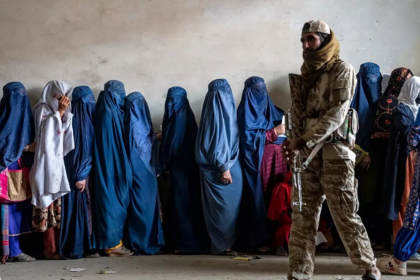
A key focus of the report is the restriction of women’s rights. UNDP data cited in the analysis shows extremely low female participation in the workforce, while male participation remains significantly higher. Restrictions on girls’ education and women’s employment are identified as central factors undermining Afghanistan’s long-term development prospects.
The United Nations warns that excluding half of the population from education and economic participation will have irreversible consequences for future generations, particularly in health, productivity, and human capital development.
In its conclusion, the report emphasizes that Afghanistan’s crisis is not solely the result of sanctions, drought, or external pressure. Instead, it argues that the primary drivers are internal political decisions and the governance structure established by the Taliban.
It states that without fundamental changes including inclusive governance, reopening of educational institutions, improved border security management, and economic reform Afghanistan is likely to remain trapped in a cycle of fragility.
As the report concludes, sustainable stability will not be achieved through rhetoric alone, but through structural reform and a shift toward responsible governance practices.